
It’s increasingly frustrating to wake up to sensationalism, normally from people who have never set foot in Ukraine, let alone Eastern Ukraine or Donbas.
I can accept that the war in Ukraine has never only been fought with tanks, artillery and drones, but also through narratives, talking points, selective outrage and the slow erosion of public understanding abroad.
As Russia’s battlefield failures deepen, the Kremlin’s dependence on propaganda, disinformation and sympathetic voices in the West has only intensified.
That is why the recent appearance of Yuliia Mendel on Tucker Carlson felt so jarring to many Ukrainians actually living through this war, something reflected heavily across Ukrainian social media afterwards.
Mendel served as President Volodymyr Zelenskyy’s press secretary from 2019 until 2021 before stepping down following a series of public controversies and criticism surrounding her handling of media relations, which made both her appearance and messaging all the more notable given her former proximity to Ukraine’s leadership, not to mention being a so called Ukrainian.
At a time when even publications traditionally cautious in their assessments, including Kyiv Post citing analysis from The Economist, have increasingly acknowledged Russia’s mounting military and economic difficulties, Mendel instead chose to attack Volodymyr Zelenskyy while recycling defeatist narratives that sounded painfully familiar to anybody who has spent the last four years watching Russian information operations unfold in real time.
Steady. We’re not at that level here at all. No KABs, and the last two weeks have actually been unusually quiet. What exactly are you writing?
— Shaun Pinner (@ShaunPinnerUA) April 17, 2026
I have personally had my own run-ins with Mendel online, particularly over the sensationalising of events in my own city of Dnipro, despite not actually living in Ukraine herself. Yet there she was, openly reinforcing narratives on Carlson’s platform, a commentator who himself has not spent meaningful time inside wartime Ukraine and is widely viewed by many Ukrainians as openly sympathetic to Russian talking points.
I have found with people like this that it is always easier to advocate “compromise,” “peace,” or even capitulation when you are not the one living under nightly missile attacks, hearing air raid sirens, watching civilians killed, or wondering whether your own city will be targeted next.
On one side, you have growing evidence that Russia’s so-called “special military operation” has become a grinding war of attrition that has failed to achieve its original strategic goals. Kyiv still stands. Ukraine’s statehood still exists. NATO has expanded, while Russian losses continue mounting at levels that would once have seemed politically impossible to sustain. Even Russian military bloggers increasingly acknowledge the lack of meaningful breakthroughs despite the enormous human cost.
Yet simultaneously, the propaganda machine has shifted into overdrive.
Her messaging, much like the broader defeatist narrative now circulating online, no longer revolves around inevitable Russian victory, instead, it revolves around exhaustion, convincing Western audiences that Ukraine cannot win, convincing Ukrainians that resistance is pointless, and persuading foreign observers that capitulation is somehow the “humane” option.
And that is where figures like Mendel become useful.
Mendel claimed Zelensky “agreed to give Donbas to Russia” during the 2022 Istanbul negotiations. Yet the President’s Office publicly refuted those remarks. Dmytro Lytvyn stated she was not involved in the negotiations and had no access to state decision-making.
There is no official evidence Ukraine even agreed to surrender Donbas. In fact, Ukrainian authorities have repeatedly stated the opposite.
So back to my point, modern propaganda rarely arrives solely through official Kremlin spokesmen anymore. More often, it is delivered by people presenting themselves as “balanced,” “reasonable,” or merely “concerned about peace.”
That is what makes it effective.
The messaging itself has become painfully familiar to anybody who has followed Moscow’s information campaign since 2022: endless references to “Nazis,” recycled accusations about “drug addicts” in Kyiv, and the constant framing of Ukrainian resistance as somehow illegitimate or dangerous. The message is rarely wrapped in overt support for the Kremlin itself, but instead in repeated suggestions that Ukraine should negotiate, compromise, concede territory or simply accept “reality.”
But that reality often sounds very different when discussed comfortably from outside Ukraine.
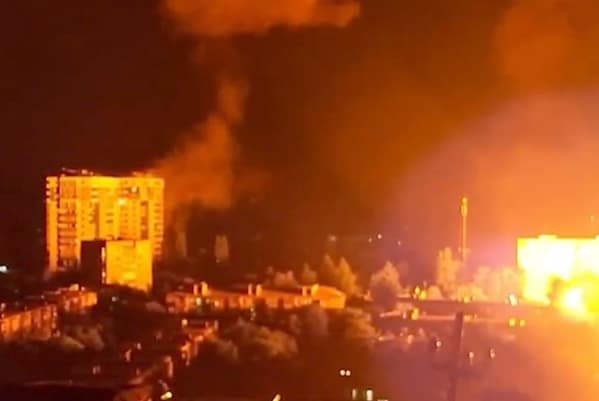
The reality I see living here on the ground, is very different from the one often presented abroad. Mendel has repeatedly spread gossip and misinformation about the very city I live in, while simultaneously pushing the idea that Ukraine should somehow capitulate to a country actively bombing civilians, targeting infrastructure, abducting children and committing documented war crimes across occupied territories.
And this is always the same pattern.
Claim to “care about the people” while advocating policies that would hand those same people over to occupation, repression and terror.
Who exactly are Ukrainians supposed to sell out?
The people in occupied territories who have lived through filtration camps, forced Russification and disappearances? The civilians murdered in places like Bucha? Families whose homes, including my own, that have been erased by glide bombs and ballistic missiles or even stolen? What about the children deported into Russia or the Prisoners tortured in captivity?
There is a strange moral inversion that often appears in these conversations abroad. Ukrainians defending themselves are framed as “prolonging war,” while the invading state responsible for starting it somehow escapes equal scrutiny, especially on Tucker Carlson’s Show. Calls for surrender are dressed up as pragmatism, Resistance becomes “escalation” and Survival itself becomes controversial, even by somebody presenting themselves as a concerned Ukrainian voice.
Yet none of the people calling for capitulation ever seem willing to personally live under the occupation they recommend for others, and surprisingly, it is rarely challenged strongly enough.
That hypocrisy becomes even more glaring when viewed alongside the battlefield reality itself.
For all the endless rhetoric about inevitable Russian victory, Moscow now finds itself in an extraordinary position. Four years into the largest war in Europe since 1945, Russia remains heavily reliant not only on authoritarian allies like Iran and North Korea, but increasingly on political developments inside the United States itself.
The Kremlin’s hopes now rest not purely on military success, but on political exhaustion in the West and a far more sympathetic climate in Washington under President Donald Trump. Recent moves surrounding sanctions relief for Russian-linked seaborne oil trade have only reinforced the perception that Moscow is increasingly dependent on political fractures abroad rather than decisive breakthroughs on the battlefield itself.
And that is telling.
Think about the position Russia now occupies.
The country that once portrayed itself as a geopolitical superpower capable of reshaping Europe in days now depends heavily on sanction evasion, foreign ammunition shipments, propaganda amplification and favorable political developments overseas. Instead of projecting confidence, Moscow spends enormous energy trying to convince others that Ukraine cannot survive.
Why?
Because despite the destruction Russia continues to inflict, the war has not unfolded as the Kremlin promised, and this weekend’s Victory Day parade only reinforced that reality to the wider world. What was intended to project strength instead exposed just how defensive and politically reliant Moscow has become after four years of war.
And the more the military situation stagnates, the more important the information war becomes.
That is why voices spreading defeatism matter, why narratives about “inevitable surrender” matter, and why platforms amplifying selective criticism of Ukraine while downplaying Russian aggression have become so valuable to Moscow’s wider information war.
The battlefield and the propaganda war have always operated hand in hand, but increasingly Russia now needs psychological victories as much as military ones, it needs Western audiences to stop caring and it needs Ukrainians to lose hope. The Kremlin wants enough confusion and cynicism to fracture support abroad.
Yet people in Ukraine continue going to work after missile strikes. Cafes reopen after attacks. Trains still run despite repeated bombardments. Volunteers still deliver aid. Soldiers still hold the line. Entire cities continue functioning under conditions that most outside observers can barely comprehend.
That resilience is precisely what Russian propaganda struggles to defeat.
Because for all the narratives pushed abroad, Ukrainians themselves understand exactly what Russian occupation looks like, and why surrender is not some abstract political compromise, but a life-or-death reality for millions of people.
Which is perhaps why the Kremlin increasingly relies on convincing everybody else instead.


Leave a Comment