
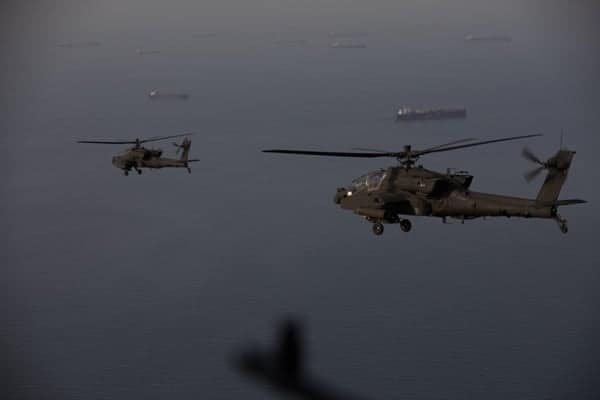
The United States has launched fresh air and missile strikes on Iranian military infrastructure after Tehran downed an American drone, intensifying fears that an already fragile ceasefire in the Gulf could unravel into wider regional war.
US Central Command confirmed it carried out attacks on radar installations, drone facilities and a ground control station around the Iranian coastal city of Geruk and on Qeshm Island over the weekend, in what it described as a “measured and deliberate” response to Iranian aggression.
Washington said the strikes were authorised after Iran shot down a US MQ-1 drone operating over international waters, prompting American fighter jets to retaliate by targeting air defence systems and unmanned attack platforms believed to threaten commercial shipping routes.
“The measured and deliberate strikes occurred in response to aggressive Iranian actions,” Central Command said.
Iranian officials confirmed they had launched retaliatory strikes of their own, while Kuwait reported activating its air defence systems to intercept incoming missiles and drones in the early hours of Monday.
The exchange marks one of the most serious escalations in weeks of mounting tit-for-tat attacks that have repeatedly strained a nominal ceasefire between Tehran and Washington, even as diplomatic efforts continue behind the scenes.
The situation has been further complicated by parallel instability across the region, with Israel and Hezbollah continuing to exchange drone fire despite their own ceasefire arrangement, and Israeli forces extending their presence deeper into Lebanese territory.
At the centre of the crisis is Iran’s tightening control over the Strait of Hormuz, a vital global shipping artery through which roughly a fifth of the world’s oil and gas supplies normally pass.
Although a small number of vessels have managed to transit the waterway, shipping volumes remain heavily disrupted, driving up global energy prices and raising fears of wider shortages in fuel, chemicals and agricultural fertilisers.
Gulf states produce around 30 per cent of globally traded fertilisers, prompting growing concern among policymakers that prolonged disruption could feed into global food supply pressures.
In Washington, President Donald Trump met senior advisers over the weekend but has yet to confirm whether the administration will pursue a more formal agreement to extend the ceasefire or reopen maritime routes through the strait.
Iran has insisted that no deal has been finalised, with officials in Tehran accusing the United States of shifting its negotiating position and undermining trust in the talks.
“We are negotiating in an atmosphere of mistrust,” Iranian Foreign Ministry spokesperson Esmail Baghaei said.
The Trump administration has repeatedly stated that preventing Iran from acquiring a nuclear weapon remains a central objective of its campaign, although officials have also signalled openness to a broader framework agreement.
Vice President JD Vance said negotiators were attempting to agree on general principles before working through technical details in further talks.
The confrontation has already had tangible effects on global trade, with reports of vessels being targeted or detained as they attempt to pass through the strait.
Over the weekend, US forces reportedly struck a Gambia-flagged cargo vessel attempting to breach Iranian restrictions on maritime traffic, further escalating tensions over freedom of navigation in the region.
Iranian state media later released footage purporting to show ballistic missile launches, including imagery featuring anti-US messaging directed at President Trump.
With diplomatic efforts still underway but increasingly fragile, analysts warn that each new strike risks tipping the conflict beyond containment.
For now, both sides insist they are open to negotiation. But with drones, missiles and warships already in active confrontation, the space for compromise is narrowing fast.
“Iran really wants to make a deal, and it will be a good one for the U.S.A. and those that are with us,” he wrote. “Just sit back and relax, it will all work out well in the end — It always does!”


Leave a Comment