
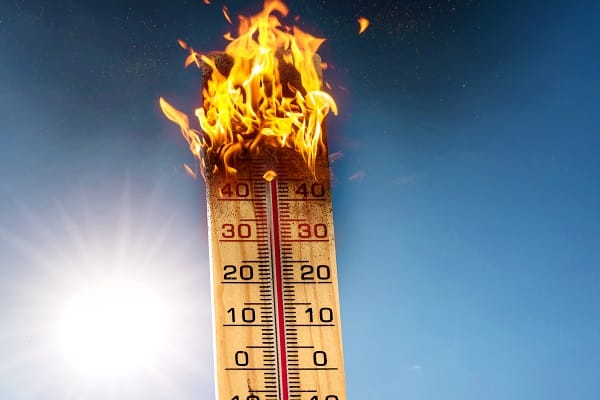
Britain’s latest heatwave is being viewed not only as a public health challenge but as a warning of the economic pressures that could emerge as climate extremes become more frequent.
The Met Office has warned that by the 2050s, a summer heat event comparable to the historic 1976 drought could see temperatures reach 45C in parts of the UK — a level that would transform assumptions about infrastructure, business operations and public services.
The scenario is not a forecast of one specific event, but a climate projection designed to illustrate how risks could change as global temperatures rise.
The warning comes as the UK faces the possibility of breaking its June temperature record, with scientists highlighting how quickly extreme heat has moved from a rare occurrence to a growing economic concern.
Professor Stephen Belcher, the Met Office’s chief scientist, said recent heat events showed the impact of human-driven climate change.
“To see temperatures like this in the UK in June is sobering,” he said, warning that extreme heat and humidity could create significant challenges for health, transport, energy and water systems.
For businesses, the implications of a hotter climate extend far beyond discomfort.
Transport networks, power supplies, water infrastructure and workplaces are all increasingly exposed to extreme weather risks.
Periods of intense heat can disrupt rail services, reduce productivity, increase energy demand and place additional pressure on essential services.
The economic challenge is that many systems were designed around historical climate patterns that are rapidly changing.
The summer of 1976 remains one of Britain’s defining weather events, remembered for prolonged heat and drought that affected agriculture, water supplies and daily life.
But the Met Office’s future scenario suggests a similar event in the 2050s could look dramatically different — with potentially two weeks of extreme heat and nine consecutive days above 40C somewhere in the UK.
Investors and businesses are increasingly treating climate resilience as a financial issue rather than an environmental one.
Companies face questions over whether their supply chains, buildings and operations can withstand more frequent temperature extremes.
Insurance costs, energy demand and infrastructure investment are all likely to be affected as governments and businesses adapt.
The challenge for policymakers will be balancing the immediate costs of climate adaptation with the longer-term economic consequences of failing to prepare.
The UK’s average summer temperatures have already increased significantly since the 1970s, while extreme events have become more intense.
The record-breaking 40.3C temperature recorded in Coningsby, Lincolnshire, in 2022 was once considered almost unimaginable.
Scientists now warn that temperatures approaching 45C could become a realistic possibility within a generation.
The economic question facing Britain is no longer whether extreme heat can happen — but how quickly businesses, infrastructure and government can adapt to a climate that is becoming increasingly difficult to predict.


Leave a Comment