
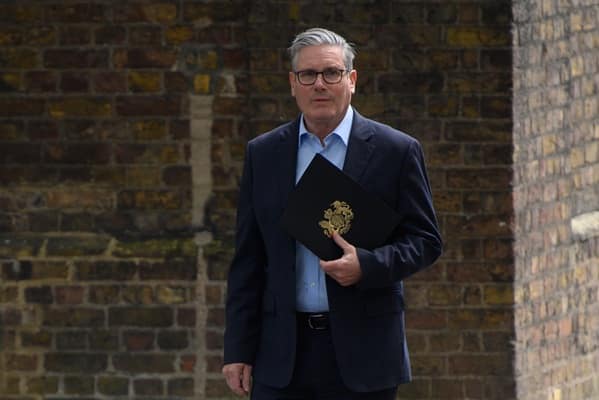
Financial markets have reacted with surprising calm to Sir Keir Starmer’s resignation, with sterling holding broadly steady as investors appear relieved that a period of political uncertainty has come to an end and that Labour is likely to avoid a protracted leadership battle.
The restrained market response contrasts with the turbulence that has often accompanied changes of leadership in recent years and suggests investors are placing greater weight on political clarity than on the immediate implications of a new prime minister.
The pound remained relatively resilient following Starmer’s departure, avoiding the sharp sell-off that some analysts had feared. While sterling has weakened over recent months amid broader concerns about Britain’s economic outlook, markets appeared reassured by the prospect of a swift transition of power rather than a lengthy and divisive contest for Labour’s leadership.
Nigel Green, chief executive of deVere Group, said the reaction reflected relief that uncertainty surrounding Starmer’s future had finally been resolved.
“For a prime ministerial resignation, the reaction in sterling has been surprisingly restrained,” he said.
“This says more about how investors felt about Starmer than how they feel about Burnham.”
The comments highlight an important distinction emerging in financial markets. Investors may have welcomed the end of one source of uncertainty, but they have yet to reach a conclusion about the implications of an Andy Burnham premiership.
Burnham has rapidly emerged as the overwhelming favourite to succeed Starmer after securing the backing of key Labour figures, including former health secretary Wes Streeting. With the leadership contest potentially concluding within weeks, investors are beginning to shift their focus from Westminster politics to economic policy.
That scrutiny is likely to intensify.
Throughout his political career, Burnham has argued that Britain places too great a tax burden on work while allowing wealth and capital to be taxed comparatively lightly. Such views are likely to attract close attention from investors seeking clues about the future direction of taxation, property policy and wealth management under a new government.
“Markets are already beginning to look beyond the leadership contest itself and towards what a Burnham government could mean for wealth, property, capital and investment,” Green said.
For financial markets, the questions extend beyond tax policy. Investors are also watching for signals on public spending, borrowing and the future role of Chancellor Rachel Reeves, whose emphasis on fiscal discipline became central to Labour’s efforts to rebuild credibility with businesses and international investors.
Reeves has been widely viewed in the City as a stabilising figure whose commitment to fiscal rules helped reassure markets after years of political volatility. Whether that framework survives a change in leadership may prove one of the most important determinants of investor sentiment in the months ahead.
The challenge facing Burnham is therefore twofold.
Politically, he must demonstrate that Labour can move beyond the instability that ultimately brought down Starmer’s premiership. Economically, he must convince investors that any new agenda can support growth without undermining confidence in Britain’s public finances.
For now, markets appear willing to extend a degree of patience.
“The pound has given Burnham the benefit of the doubt,” Green said.
“That’s very different from giving him a vote of confidence.”
The distinction matters.
Britain enters this transition facing sluggish growth, weak productivity and a public debt burden approaching £3tn. Against that backdrop, financial markets are likely to scrutinise every statement from the incoming leadership team for evidence of how they intend to balance economic expansion with fiscal credibility.
The relative stability in sterling should therefore not be interpreted as an endorsement of a future Burnham administration. Rather, it reflects relief that a lingering question over Starmer’s future has been resolved and that Labour appears to have avoided a destabilising internal struggle.
The next test will be whether Burnham can persuade investors that Britain remains an attractive destination for capital, investment and enterprise.
That judgment has yet to be made. Markets may have welcomed the end of the Starmer era, but they are only beginning to assess what comes next.


Leave a Comment