
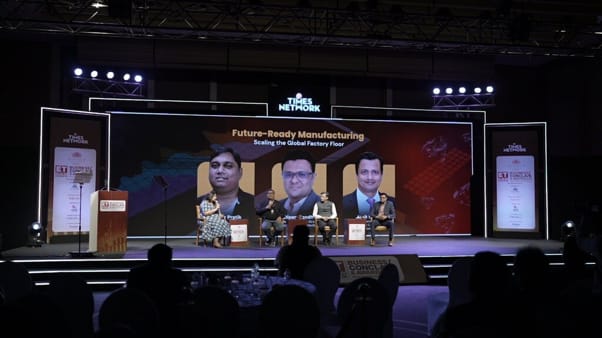
GeekyAnts CEO Kumar Pratik joined the ET Now Business Conclave & Awards 2026 – Gujarat Edition to discuss how AI-driven automation can help manufacturers build future-ready operations. The panel shifted the conversation from awards and recognition to execution: how industrial companies can move from isolated digital projects to connected systems that improve throughput, quality, resilience, and decision-making.
ET Now hosted the conclave on June 16, 2026, in Ahmedabad, Gujarat, India. Pratik joined the panel “Future-Ready Manufacturing: Scaling the Global Factory Floor” with Dipen Gandhi of DeepTech Sales Consultant and Amit Saluja of digiXLT, former Center Head at NASSCOM Gandhinagar CoE. The session focused on global factory competitiveness, automation maturity, and the technology foundations that manufacturers need for scale.
Pratik’s roadmap placed AI inside daily operations rather than at the edge of transformation programs. For enterprise technology leaders, that distinction matters. A factory floor generates data across machines, sensors, ERP systems, supply chains, inspection workflows, maintenance logs, and workforce tools. AI can create value when companies connect those signals through secure platforms, clean data pipelines, and governance models that support action.
The market context supports that message. Gartner reported that 49% of organizations lack confidence in their manufacturing strategy to deliver business outcomes over the next three years. McKinsey’s 2025 AI research found that 88% of organizations use AI in at least one business function, while most still struggle to bridge the gap between pilots and enterprise-scale impact. A 2026 AI and machine learning roadmap for smart manufacturing highlighted persistent barriers around industrial data complexity, heterogeneous systems, and trustworthy AI deployment.
For North American engineering and digital platform leaders, the panel’s theme connects with current modernization pressure. Manufacturers need automation that does more than replace manual work. They need systems that predict asset issues, reduce inspection cycles, improve production planning, support frontline decisions, and surface risks before they affect output or customer commitments.
GeekyAnts, an AI-Powered Digital Product Engineering and Consulting Company, has public work that aligns with that roadmap. In an AI-driven process automation engagement for Nexus, GeekyAnts reduced manual validation by 50% and accelerated testing by 30% using AI agents, RAG models, and business process management automation. The case reflects a pattern that manufacturing leaders now track: AI delivers value when teams tie automation to a measurable workflow bottleneck.
The company’s manufacturing work includes an asset management dashboard for a multinational industrial and automation company. GeekyAnts built web and mobile interfaces that helped plant teams use sensor and operational data to track assets, monitor plant performance, and support heavy-industry operations. That case aligns with the panel’s core point: manufacturers need usable digital layers on top of complex industrial systems.
In another engagement, GeekyAnts built a monitoring dashboard and mobile application for a railway manufacturing giant. The solution helped teams manage real-time hardware status and maintenance workflows across train systems. The project illustrates how mobile access, data visibility, and field-ready interfaces can turn asset intelligence into operational action.
Kumar Pratik said manufacturing leaders should treat AI automation as a systems program, not a tool rollout. “Future-ready manufacturing will depend on connected data, resilient platforms, and AI workflows that support decisions on the shop floor and across the enterprise. The goal is not automation for its own sake. The goal is measurable improvement in quality, uptime, speed, and workforce productivity,” he said.
The panel discussion gave enterprise leaders a practical lens for 2026 planning. Large manufacturers understand the promise of AI, robotics, digital twins, and intelligent workflows. The harder task involves sequencing investments, securing data, integrating plant and enterprise systems, and designing adoption models that frontline teams trust.
Pratik’s remarks placed GeekyAnts in that execution conversation. As industrial companies evaluate AI-led modernization partners, the focus will remain on proof, integration discipline, and operational outcomes. For technology leaders reviewing factory, platform, and automation roadmaps, the discussion offered a grounded reminder: future-ready manufacturing starts with connected systems and ends with measurable performance.
Contact Information
US Office
GeekyAnts Inc.
315 Montgomery Street, 9th & 10th Floors
San Francisco, CA 94104, USA
+1 845 534 6825
[email protected]
www.geekyants.com/en-us
India Office
GeekyAnts India Pvt Ltd
No. 18, 2nd Cross Road, N S Palya, 2nd Stage,
BTM Layout, Bangalore – 560076, Karnataka, India
+91 80 4305 8884
UK Office
GeekyAnts UK Ltd
SPACES Finsbury Park
17 City North Place, London N4 3FU, England, UK
+44 1702 655221




Leave a Comment