
The last 48 hours have once again shown how this war is no longer confined to frontlines, it’s everywhere.
From the skies over Dnipro to the outskirts of Moscow, what we are witnessing is a sustained exchange of long-range strikes, a kind of modern “drone ping-pong” where both sides trade blows deep behind the lines.
In Dnipro, the reality was immediate and personal.
Russia launched another mixed-package attack, combining drones and missiles as part of its ongoing campaign against Ukrainian cities. Across Ukraine, hundreds of aerial threats were reported, with Ukrainian air defences intercepting the vast majority.
According to Ukrainian officials, 249 out of 269 drones and missiles were shot down, an interception rate of over 92 per cent.
And yet, as always, it only takes a few to get through.
In Dnipro itself, strikes caused civilian casualties, with reports confirming injuries and at least one death after missiles hit residential areas, including a university dormitory. The pattern is familiar: infrastructure, housing, transport hubs, targets that blur any distinction between military and civilian life.
One detail stood out: a Russian missile reportedly landed in the Dnipro River.
Why does that happen?
There are several likely explanations. First, interception, Ukrainian air defence systems often destroy incoming missiles mid-flight, causing debris, or even partially intact warheads, to fall short of their intended targets. Second, electronic warfare. Ukraine’s increasing use of jamming and spoofing can disrupt guidance systems, especially in older or less sophisticated missiles, causing them to veer off course, and third, simple failure, these systems are not flawless, and malfunction rates increase under pressure from layered defences.
https://x.com/ShaunPinnerUA/status/2050970108877521012?s=20
A missile landing in a river might sound like a near miss, but it highlights something more important: the density of the defensive battle over Ukrainian cities. What doesn’t hit a building often hits somewhere else, fields, roads, rivers, because it has already been fought over in the sky, but while Dnipro absorbed the shock, Ukraine responded in kind.
Within hours, reports emerged of Ukrainian drone strikes reaching deep into Russia, including areas near Moscow, with these attacks now becoming routine. Russian authorities reported multiple interceptions, while casualties from drone debris were confirmed, including the death of a civilian near the capital.
Russia, for its part, claimed to have shot down over 300 Ukrainian drones, while Ukraine reported launching waves that hit strategic targets, including energy infrastructure and ports such as Primorsk on the Baltic Sea.
This exchange of numbers matters and it tells us two things. First, both sides are scaling up: hundreds of drones in a single night is no longer exceptional, it’s becoming standard. Second, air defence saturation is now a central tactic; even a 90 percent interception rate still allows dozens of drones or missiles through, more than enough to cause fires, deaths, and disruption.
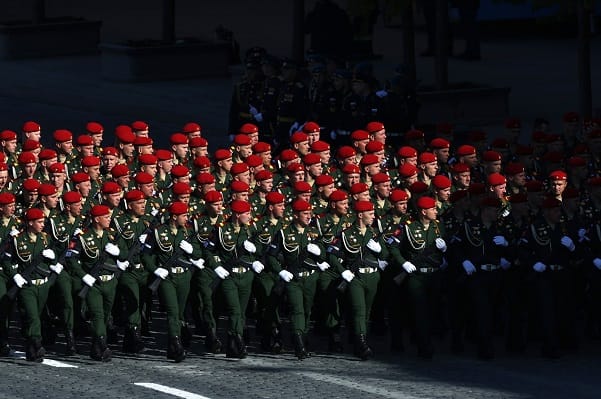
The timing is becoming critical, and also particularly bad for Putin, as these strikes on Moscow come just days before Russia’s annual Victory Day parade on May 9th, a cornerstone of Kremlin messaging designed to project strength, continuity, and historical legitimacy; this year, however, the optics are shifting. Russia has already scaling back the parade, removing heavy military hardware such as tanks and missile systems due to fears they could be targeted by Ukrainian strikes.
Putin’s Victory Day: Beating Nazis whilst behaving just like Hitler
Victory Day is supposed to be about triumph, power, and security, and yet here we are, with the Russian capital under periodic drone threat, and the parade itself adjusted because it cannot be fully protected.
It raises an uncomfortable question for Moscow: what does victory look like when your own skies are contested?
From Ukraine’s perspective, these strikes are strategic. Hitting Moscow, or even just reaching it, has psychological and political value far beyond the physical damage. It demonstrates reach, undermines the perception of Russian control, and forces the Kremlin to divert resources to homeland defence.
From Russia’s perspective, the continued bombardment of cities like Dnipro serves a different purpose: pressure. It is designed to exhaust civilian populations, strain infrastructure, and signal that no part of Ukraine is beyond reach.
So what we are seeing is not random escalation, it is a deliberate exchange of pressure points.
Dnipro represents the civilian cost of Russia’s campaign, daily life interrupted by sirens, basements, and the uncertainty of what gets through. Moscow represents the shifting battlefield, where distance no longer guarantees safety, and between the two, drones and missiles move back and forth in a relentless cycle.
This is the new phase of the war is no longer just trenches and artillery, but depth and reach. It’s something Ukraine has acquired and continues to refine, with retaliation measured not only in kilometres gained, but in kilometres crossed.
Drone ping-pong.
The difference is, this isn’t a game, and as Victory Day approaches, the symbolism couldn’t be sharper. A parade meant to celebrate past victory now unfolds under the shadow of a present conflict that is far from decided, and increasingly impossible to contain.
Moscow’s war it started, has come home.


Leave a Comment