
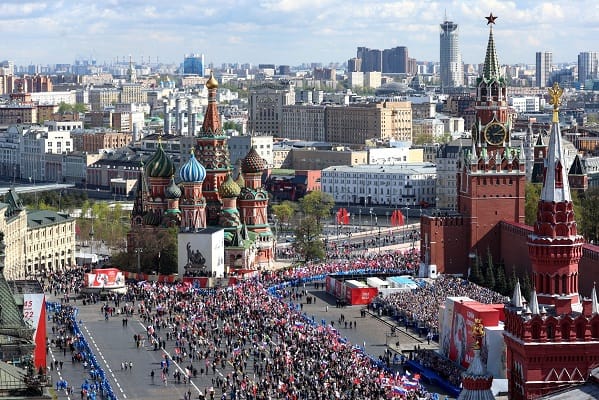
A day meant to mark the defeat of Nazism now sits uneasily alongside tactics and rhetoric that echo its darkest traits.
Four years ago, I marked it in a basement prison in Donetsk.
I had been captured in Mariupol and handed over to Russian forces and their self-proclaimed proxy, the so-called Donetsk People’s Republic.
While the parade rolled through Red Square, I was in a black site, beaten, electrocuted, and pushed through a system that bore no resemblance to justice. What they called a process felt closer to something out of history, and what I referred to as a Nazi-style filtration system designed to break people.
I wasn’t alone. In my cell was a 19-year-old train driver from Mariupol, a civilian, accused of nothing more than being a Ukrainian sympathiser. It didn’t matter; he was treated the same, and later I would realise it wasn’t just us; every man and woman passing through that system faced it, regardless of whether they were military or not.
The worst of it wasn’t just the violence, but the slow grind, starvation, exhaustion, the way hunger takes over your mind until it’s all you can think about. By the time I reached my so-called trial, I was down to around 60kg (9 stone), barely holding it together.
Voices from the Front is a reader-supported publication. To receive new posts and support my work, consider becoming a free or paid subscriber.
The verdict was already written, a trial by public opinion, followed by a show trial staged for effect, then by a death sentence delivered as theatre, part propaganda, part justification for an invasion that had already failed in its stated aims. I was labelled a Nazi, a mercenary, a terrorist. The irony wasn’t lost on me, I hadn’t left Ukraine, I was living in it legally with my family, ties to the country itself, and i can assure you while saying with relative confidence, I am most certainly not, a Nazi.
The irony, with all that going on, was Russia’s preparation to celebrate the defeat of Nazism, to commemorate those darker chapters of history, but from where I stood, those chapters weren’t history.
They were happening again, in the underground torture cupboard three of us lived in.
From that moment on, Victory Day was no longer about remembrance, it was just theatre, now reflecting something far darker.
Russia defines itself through the defeat of Nazism, yet increasingly, the behaviors being documented in this war sit uncomfortably alongside that identity. This is not a propaganda piece or rhetoric, it is reflected in the scale of what the invasion of Ukraine has created.
According to the United Nations, more than 15,000 civilians have been killed and over 41,000 injured since February 2022. In 2025 alone, civilian casualties rose by more than 30 percent compared with the previous year. Behind those numbers are cities reduced to rubble, families displaced, and communities erased, including my own in Mariupol, some 6 million displaced internally with many more leaving the country under various schemes.
But those statistics only tell part of the story, and they are widely understood to be conservative.
Mariupol is a prime example of why.
Since falling under Russian occupation in 2022, access to the city has been heavily restricted. Independent investigators, journalists, and international organizations have been largely unable to operate freely on the ground. That means casualty figures cannot be properly verified, documented, or updated in real time.
What we do have, however, is evidence from above.
Satellite imagery has repeatedly identified the rapid expansion of burial sites on the outskirts of Mariupol, particularly in areas like Manhush and Staryi Krym. Long trenches, mass graves, visible from space, growing over time. These findings have been analysed by Maxar Technologies and Human Rights Watch, pointing to death tolls that likely far exceed officially recorded figures.
Mariupol mass grave: Satellite images suggest location of up to 9,000 bodies: The Picture Show The apparent mass grave seen in satellite images covers a space larger than three football fields. The imagery shows rows of graves stretching away from an existing cemetery in Manhush,… pic.twitter.com/PDEiDeFSvU
— Shaun Pinner (@ShaunPinnerUA) May 21, 2024
Local Ukrainian officials have previously estimated that tens of thousands of civilians may have been killed in Mariupol alone. While exact numbers remain difficult to confirm, the scale of destruction, the siege conditions, and the burial patterns strongly suggest that the true human cost is significantly higher than what is currently documented.
That is the reality behind the numbers, they are not wrong, but they are incomplete.
Places like Mariupol, the full extent of loss is still buried, quite literally, beneath occupation, silence, and time, also, inside detention centres, survivors have described systematic abuse, coercion, and forced confessions. The United Nations Human Rights Monitoring Mission has found that torture and ill-treatment of prisoners of war and civilian detainees by Russian authorities has been widespread and systematic.
The methods vary, beatings, electric shocks, isolation, but the structure is consistent.
This is not about extracting intelligence, well, maybe it is a little, but mainly it’s about control, I know that because I lived it. As one former detainee told investigators from the United Nations,
“They beat you until you say what they want. It doesn’t matter if it’s true.”
Torture doesn’t uncover truth, it manufactures it, forcing people to confess to places they’ve never been and things they’ve never done, and it keeps happening.
The forced deportation of Ukrainian children has become one of the most serious allegations of the war. In March 2023, the International Criminal Court issued arrest warrants for Vladimir Putin and Russia’s children’s commissioner, Maria Lvova-Belova, over the unlawful transfer of children from occupied Ukrainian territories. Investigators have identified a network of facilities involved in the transfer, re-education, and, in some cases, militarisation of Ukrainian children.
This goes beyond displacement, it strikes at identity. Removing children from their language, their culture, and their country is not just a wartime act, it is an attempt to reshape the future and history has seen variations of this before, not identical, but driven by the same underlying intent.
The rhetoric surrounding Ukraine needs highlighting too, with repeated claims that it is not a real state, that its identity is artificial or temporary, create a dangerous framework. When a state denies the legitimacy of a people, it lowers the threshold for what comes next. This is genocidal rhetoric — yet it is rarely called what it is by the international community.
This is where Victory Day becomes uncomfortable.
Because what is being celebrated?
A victory over tyranny – while employing tactics that echo it.
A remembrance of liberation – while denying it elsewhere.
A narrative of sacrifice – while inflicting it.
Even the parade itself reflects that shift, because this year, Russia’s Victory Day parade is expected to lack much of the heavy military hardware that once defined it. For those who grew up watching Soviet-era displays, rows of soldiers, missiles rolling through Red Square as a projection of strength, the contrast is stark.
The stage is still there, but the substance is thinner and for a system built on projection, that matters, and the lack of it matters even more. Because the further reality drifts from the narrative, the louder the performance has to become easier for figures like Trump to echo it, amplify it and give it oxygen.
Some will argue this didn’t start with Ukraine, that the signs were there long before, in Chechnya, in the Soviet years, in the quiet acceptance of repression dressed up as necessity, maybe they’re right, maybe this has always been part of the story. But from where I sit, and through my experience, and as someone who learned Russian first, not Ukrainian, it’s no longer something I can separate myself from.
Victory Day was meant to mark the defeat of Nazism, yet, looking at what is being done in its name, it becomes harder and harder to separate the two. Not because history has changed, but because the behaviour has, openly, unapologetically. It’s there, in plain sight. Recorded and shared across social media, executions, torture, murder & terrorism.
We are seeing what lies behind the slogans and the soundbites, living through the gap between what is said and what is done, and once you’ve seen that, you can’t unsee it. Millions are watching it unfold, and are living through its consequences.
A day meant to honour victory now risks reflecting the very thing it was supposed to defeat. In many ways, it is beginning to honour it.
Russia has become what it claimed to hate the most.
This is anything but Victory.


Leave a Comment