

(Ukrainian tradition takes centre stage | pride, culture, and identity carried through dance)
There’s a tendency to view war through geography, particularly when trying to explain how Donald Trump’s shifting focus toward Iran plays directly into the hands of a Moscow already under pressure. For Vladimir Putin, facing mounting battlefield setbacks in Ukraine, spiraling casualties, and a worsening economic outlook at home, that shift in attention offers breathing space. The easing of pressure is compounded by moves such as the waiving of sanctions on Russian oil, while rhetoric around stepping back from NATO risks emboldening the Kremlin at a moment when, internationally, the priority should be the opposite, tightening the screws, not loosening them.
Frontlines, borders, contested territory, these lines drawn on maps define where a conflict begins and ends, but Ukraine’s war doesn’t fit neatly into that frame, not anymore. Beyond its borders, far from the artillery and air raid sirens, there are communities that are not just watching from the outside, but actively carrying part of that fight forward, with recent trip to Canada bringing that reality into sharp focus.
From Toronto to Edmonton and beyond, what I encountered wasn’t passive support or distant sympathy, it was something far more embedded, traditional and a living breathing extension of Ukraine itself. Alongside that came the quieter weight of war, a shared sorrow that has travelled far beyond the frontlines, reaching cities thousands of miles away, yet now even more emotionally tied to places like Kyiv, Dnipro, and Pokrovsk, and for all the wrong reasons.
TORONTO: WHERE IDENTITY MEETS UNDERSTANDING
At the University of Toronto, after my presentation, the discussion quickly moved beyond headlines. The room was filled with students, members of the Ukrainian diaspora, academics, and supporters of Ukraine, but more importantly, it was filled with people trying to understand the reality behind the war. I was even introduced to a journalist from Reuters, who was held as a prisoner in Myanmar, and just wanted to know how I managed to get through my ordeal, curiosity that can only come from shared experience.
There’s a clear difference between following a conflict and feeling connected to it, and in Toronto, that connection was unmistakable. Many in the audience had family ties to Ukraine; others had grown up within diaspora communities where Ukrainian identity had been preserved across generations and one person spoke with nostalgia, and, at times, a hint of humour, about being pushed into Ukrainian dance classes as a child.
Another conversation stayed with me along similar lines. A young man spoke about growing up wanting to play football and spend time with his friends, never quite understanding why his mother insisted on Ukrainian lessons, “pushy Ukrainian mums,” he joked, seem to be a universal theme. At the time, it felt like an obligation, something separate from the life he wanted to lead, and a culture he didn’t fully grasp. But with Ukraine now at war, that perspective had shifted. Recent trips to the country had brought his heritage sharply back into focus, with what once felt forced now taking on real meaning; in hindsight, he understands what was being passed down, and more importantly, why.
What also stood out wasn’t just awareness, but investment. The questions coming from people like him were informed, direct, and often rooted in personal concern rather than open curiosity. Here, Ukraine isn’t a distant issue, it’s very much part of people’s lives and travelling west across Canada, the scale of the country impossible to ignore. Vast distances, shifting landscapes, entire time zones apart, yet despite that, the connection to Ukraine remained constant.
If anything, it became stronger when I got to Edmonton.
Seeing Ukrainian dance thrive here in Alberta 🇨🇦 is something else, competitions packed, Shumka dancers bringing the energy, and of all ages 💃
A diaspora that hasn’t just preserved culture, but kept it alive and growing 🇺🇦 https://t.co/a8oavoxT5W pic.twitter.com/j7TsC1PwGq— Shaun Pinner (@ShaunPinnerUA) April 24, 2026
EDMONTON: A COMMUNITY THAT NEVER LET GO

The Ukrainian Youth Complex | Edmonton, Canada
In Edmonton, I spoke at the Ukrainian Youth Complex to a packed audience brought together by The League of Ukrainian Canadians & Firefighter Aid for Ukraine, but to call it simply an event would miss the point entirely. You see the connection everywhere, in the food, in conversations, and in the cultural expressions that remain central to community life. Ukrainian dance, for example, isn’t just performance; it’s identity in motion, taught, preserved, and celebrated across generations.
For decades, Ukrainian Canadians, particularly in Alberta, have maintained a deep connection to their heritage. Not as a symbolic gesture, but as something actively lived. Language, traditions, faith, and culture have been passed down, protected, and adapted across generations with the complex itself, built roughly 50 years ago, standing at the centre of that identity, alongside the role of religion in holding it together.
Meeting the family of Nolan Victor Durie was one of those moments that stays with you. There’s a quiet weight to it, pride, loss, and something unspoken just beneath the surface. His younger brother came forward with a copy of my book, and signing it felt different to any other. It wasn’t just a name on a page, but a small gesture of respect, from one soldier’s story to a family that has given everything. Having lost many friends myself, I didn’t know Nolan personally, but like many internationals who make the decision to go to Ukraine, we’re often only separated by two degrees. In the photos his mother showed me were faces I recognized, people I knew, and that brings it home quickly because behind every name is a family carrying that sacrifice forward, day by day. This is where the harshest reality of war arrives, tying a city thousands of miles away on another continent to places like Mariupol, Pokrovsk, or Bakhmut.

Nolan Victor Durie of Alberta | Killed in action in October 2025 fighting in defense of Ukraine’s freedom in the Donetsk region
FROM THE FRONTLINE TO THE CLINIC
Part of my visit also involved working with the Canadian Counselling and Psychotherapy Association, who were looking to better understand the psychological pressures faced by those operating in conflict environments.
It’s a different kind of discussion, but an important one. In a professional setting, I spoke with several consultants and around 50 participants online, covering everything from my background to the realities of captivity and recovery. It meant revisiting some of the darker periods, but more importantly, it was about passing on what worked, and what didn’t, during rehabilitation.
We discussed resilience, stress, and the ability to function in high-pressure, high-risk situations. It was a continuation of work I began last year, engaging with counsellors and professionals on how lived experience shapes psychological responses. In an era where war is no longer distant or abstract, these are realities many in the military could face, but also lessons that extend beyond the battlefield, lessons that can be adapted and applied in civilian contexts.
What stood out most was the willingness to learn.
Not just about war itself, but about how individuals process it, survive it, and ultimately move forward. In that sense, the connection between Ukraine and communities abroad is not only cultural, it is intellectual and professional as well.
A HISTORY THAT SHAPES THE PRESENT
Canada is home to one of the largest Ukrainian diasporas in the world with some 100,000 situated in Edmonton. Many families trace their roots back over a century, to waves of migration that saw Ukrainians settle in the Canadian prairies, building communities that would endure long after they left their homeland.
What’s remarkable is how much of that identity has been preserved.
In many cases, traditions that were suppressed or eroded during the Soviet era continued uninterrupted in Canada. Culture survived here in ways it often couldn’t back home, and now, in a moment where Ukraine is fighting not just for territory but for its national identity, those preserved traditions have taken on new relevance.
The diaspora hasn’t had to rediscover Ukraine, because it never lost it.
SUPPORT THAT GOES BEYOND SYMBOLISM
What I saw in both Toronto and Edmonton was not passive support. It was structured, organized, and sustained, nowhere more so than during my visit to the Legislative Assembly of Alberta. I was honoured to be invited to meet Speaker Ric McIver by MLA Jackie Armstrong-Homeniuk, an experience that offered a different perspective on how Ukraine’s war resonates far beyond its borders.

Legislative Assembly of Alberta | MLA Jackie Armstrong-Homeniuk
Watching proceedings from the gallery, what struck me most was the diversity of the chamber. Representatives from First Nations communities, alongside those of Asian, European, and Ukrainian heritage, all sitting within an institution that shapes the direction of the province. It was a reminder of what modern democracies look like in practice, complex, representative, and at times noisy, but functioning. The debates ranged across critical issues: mental health, housing, press freedoms, topics that, while domestic, echo the broader values Ukraine is fighting to defend.
Beyond the chamber, that same sense of structure and purpose carries through diaspora communities.
Fundraising efforts continue across Canada, political advocacy remains active, and events are organized not just to raise awareness, but to maintain visibility in a world where attention is constantly shifting. If there’s one takeaway from this, it’s that Ukraine is not only fighting a war on the battlefield, it is also contending with many of the same pressures debated in that chamber: governance, corruption, mental health, housing, and press freedom. These are challenges faced in parallel, often overlooked amid the focus on frontline developments.
All this set against the backdrop of the Edmonton Oilers playoff run, locked in a seven-game series against the Anaheim Ducks, there was also a reminder of how community binds people together. Shortly after my talk, the game flickered onto the screen above the stage, the third matchup underway, the tension building toward a place in the Stanley Cup race. For a moment, it was sport, not war, that held the room, those left, but even that felt connected, a shared identity, a collective focus, something that brings people together in uncertain times.
A GLOBAL UKRAINE
What this trip reinforced is something that often gets overlooked, Ukraine is not confined to its borders.
It exists in communities across the world, carried by people who have maintained their identity across generations and who now play an active role in supporting a country at war. In Canada, that role is plainly visible, organized, committed, and deeply rooted, but even the word “generations” doesn’t quite do it justice. It risks understating the depth of history behind it all.
I wouldn’t claim to be in a position to fully unpack that history, but I was given a glimpse of it.
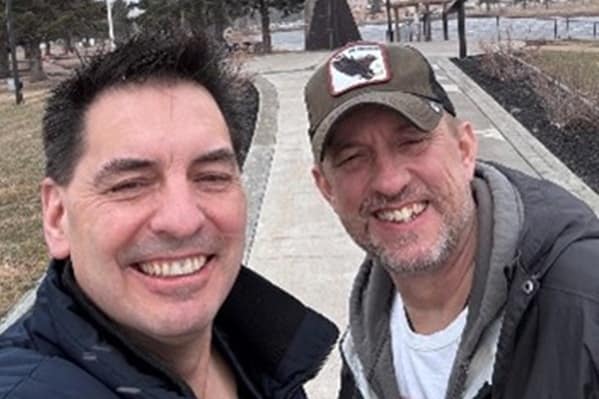
Standing beside the world’s largest Ukrainian Easter egg, the Pysanka of Vegreville, with my host Taras, I was given a snapshot of the journey that brought Ukrainians to Canada. Conversations moved quickly through defining moments, World War I, World War II, and the Holodomor, events that shaped displacement, identity, and survival. It wasn’t a history lesson in the academic sense, but something more grounded, passed on through lived memory and community, followed, fittingly, by a trip to an Irish bar to down a couple of Guinness’s.

World’s largest Ukrainian Easter egg | Pysanka of Vegreville with Taras
And it’s in those small, almost ordinary moments where that connection really lands.
Even something as simple as food, the borscht and perogies I had for lunch was enough to transport me, briefly, back to Dnipro. It’s a reminder that culture carries more than tradition; it carries place, memory, and identity across continents. The same can be said for Ukrainian dance, Shumka in particular, thriving here, I’m told, with competitions that are as competitive as they are beautiful, keeping culture not just alive, but evolving.
From lecture halls in Toronto to community centres in Edmonton, Ukraine is current and alive, steeped in culture and history, the very identity Russia is trying to erase.
And in a war where endurance matters as much as anything else, that global presence may prove to be one of Ukraine’s greatest strengths.
My sincere thanks to everyone at the League of Ukrainian Canadians, Firefighter Aid for Ukraine & the Canadian Counselling & Psychotherapy Assoc., also special thanks to: MLA Jackie Armstrong-Homeniuk, Taras & his family, Anatoli, Stefan, Yaroslav, Phyllis Hodges, Jeannie, and all those who came out to the talks.
And to the family of Nolan Victor Durie, who paid the ultimate sacrifice in the defence of freedom, we remember and honour him.
Slava Ukraine.


Leave a Comment