
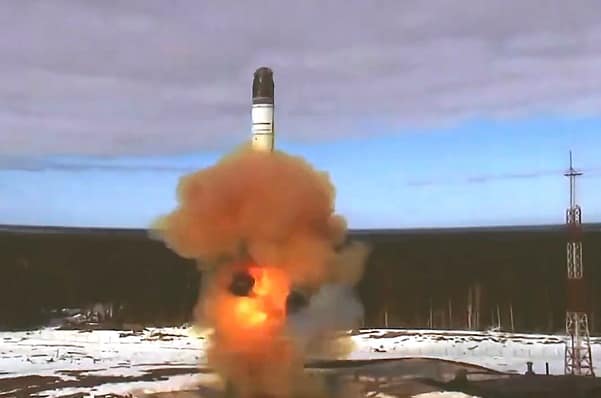
Vladimir Putin has announced what Moscow described as the “successful testing” of its Sarmat intercontinental ballistic missile, a nuclear-capable system known in the West as “Satan-2”, in a move likely to heighten tensions with Western powers.
The Kremlin said the heavy intercontinental missile — officially the RS-28 Sarmat — had been successfully tested and would soon enter combat deployment, reinforcing Russia’s strategic nuclear arsenal amid heightened geopolitical confrontation.
Described by Russian officials as one of the most powerful missiles ever developed, the system is capable of carrying multiple nuclear warheads and travelling at extreme speeds over intercontinental ranges.
Russian military commanders told Putin that the test marked a significant milestone in the weapon’s development, which has faced repeated delays and has had only a limited number of successful launches to date.
The missile is designed to be launched from underground silos and is intended to penetrate advanced missile defence systems, according to Russian military statements.
Putin said the system would significantly exceed the capabilities of existing Western equivalents, claiming it could carry a payload “more than four times greater” than comparable missiles.
🇷🇺 On May 12, President #Putin received a report on the successful test of the Sarmat missile.
💬 With 35,000+ km range, enhanced accuracy & the ability to overcome all existing & future missile defence systems, Sarmat is a formidable deterrence asset.https://t.co/waBvSOHm7I pic.twitter.com/rBchrCce1r
— MFA Russia 🇷🇺 (@mfa_russia) May 12, 2026
He also said the weapon could follow both ballistic and suborbital trajectories, increasing its operational flexibility and complicating interception attempts.
The announcement comes at a moment of sustained tension between Moscow and Western governments, with the war in Ukraine continuing to dominate relations between Russia and NATO states.
The Kremlin has long presented the Sarmat programme as a central pillar of Russia’s strategic deterrent, designed to ensure parity with the United States and its allies.
However, the system has experienced repeated development setbacks, with only a small number of confirmed test launches and earlier deployment timelines slipping significantly.
Western defence analysts have previously questioned the missile’s operational readiness, noting that complex systems of this type often face delays before achieving full deployment.
Despite this, Moscow has continued to present the programme as evidence of its advanced strategic weapons capability, particularly during periods of heightened confrontation with the West.
The latest announcement is likely to be interpreted in NATO capitals as part of a broader pattern of nuclear signalling, designed to project strength. At the same time, the war in Ukraine continues to drain Russian conventional forces.
It also comes amid ongoing concerns about escalation risks, as both sides continue to modernise their nuclear arsenals and expand long-range strike capabilities.
While Russian officials framed the test as a routine advancement in weapons development, the timing and tone of the announcement are likely to strain already further fragile relations between Moscow and Western governments.


Leave a Comment