
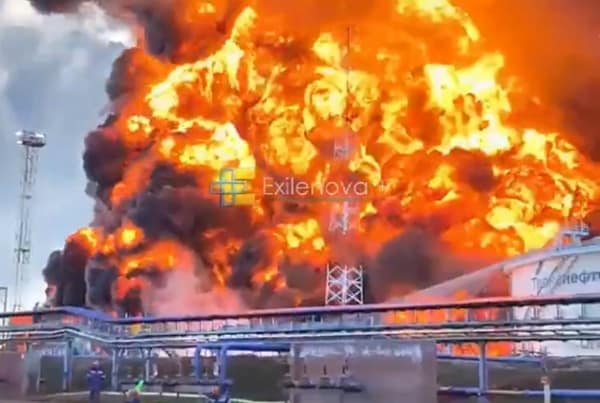
Ukraine has reportedly launched another drone strike on the Tuapse oil refinery in southern Russia, extending a sustained campaign against one of Moscow’s key Black Sea energy facilities and reigniting fires that have been burning intermittently for days.
The latest attack, reported on May 1, is understood to be the fourth strike on the site in just over two weeks, underscoring what appears to be an intensifying Ukrainian effort to disrupt Russia’s oil infrastructure deep inside its own territory.
The facility, located in Krasnodar Krai on Russia’s Black Sea coast, is a major processing and export hub, handling around 12 million tonnes of crude oil annually. It has become a repeated target amid Kyiv’s broader strategy of striking energy assets that both fuel the Russian military and generate revenue for the Kremlin’s war economy.
Ukraine has previously acknowledged responsibility for earlier attacks on April 16, 20 and 28. Each strike has contributed to prolonged fires and damage at the refinery and its associated marine terminal, according to regional reports.
The Permnefteorgsintez Oil Refinery in Perm Krai came under attack from Ukrainian drones for the second day in a row, resulting in the fire increasing in size.
Yesterday, the AVT-4 oil processing unit was hit, resulting in damage to the neighbouring atmospheric rectification… pic.twitter.com/t5wq7RhueV
— AMK Mapping 🇳🇿 (@AMK_Mapping_) May 1, 2026
Following the third attack, local authorities declared a state of emergency in the district as emergency crews struggled to contain persistent fires across storage and processing infrastructure.
Russia’s Emergency Situations Ministry claimed on April 29 that the blazes had finally been extinguished. However, within 24 hours, fresh explosions were reported in the area, and new fires were said to have broken out at the terminal.
Videos and photographs circulating on Russian social media in the early hours of May 1 appeared to show further explosions at the facility, with residents reporting the sound of detonations and anti-aircraft fire. The Telegram monitoring channel Exilenova-Plus said multiple drones were observed over the area.
Local accounts on Russian channels, including Shot, claimed that air defence systems were engaged over Tuapse and that at least 10 drones had been intercepted. Restrictions were also temporarily introduced at nearby regional airports.
💥🔥 Tuapse, for a fourth time. In Perm, the landscapes are now in incredible colors. pic.twitter.com/f77kJFr07X
— Shaun Pinner (@ShaunPinnerUA) May 1, 2026
The Krasnodar Krai Operational Headquarters later confirmed that a drone attack had sparked a fire at the marine terminal, though details on the extent of damage remain unclear.
Russia’s Defence Ministry said that 141 Ukrainian drones were intercepted across the country overnight, in what it described as a large-scale wave of attacks.
The Tuapse refinery has been repeatedly struck in recent weeks, with Ukrainian operations reportedly damaging storage tanks, processing facilities and associated infrastructure. Earlier assessments suggested that as many as 24 storage tanks had been destroyed or damaged across the first three attacks, along with crude processing equipment.
The repeated strikes have also had wider environmental consequences, with reports of oil spills and airborne pollution affecting the surrounding area, including the nearby resort town, which is normally a popular tourist destination at the start of the summer season.
Despite the disruption, Russian President Vladimir Putin has downplayed the strategic significance of the attacks, while Moscow has sought to portray its air defences as having successfully contained the damage.
The escalation comes amid a broader increase in Ukrainian strikes on Russian energy infrastructure. According to data compiled by Bloomberg, April saw a four-month high in attacks on refineries, pipelines and oil-related assets, with at least 21 incidents recorded.
The same data suggests that Russian refining capacity has fallen to its lowest level in more than a decade, placing additional pressure on domestic fuel supplies and export revenues.
The intensification of Ukraine’s campaign against oil infrastructure also comes at a politically sensitive moment for Moscow, which has scaled back public events in recent weeks and proposed temporary ceasefires around Victory Day commemorations.
Ukraine, meanwhile, has continued to reject short-term truces in favour of longer-term security arrangements, maintaining pressure on Russian energy assets as part of its wider war strategy.
With Tuapse now repeatedly struck and fires proving difficult to extinguish fully between attacks, the facility has become a symbol of Ukraine’s expanding reach — and of the growing vulnerability of Russia’s critical energy infrastructure far from the front line.


Leave a Comment