
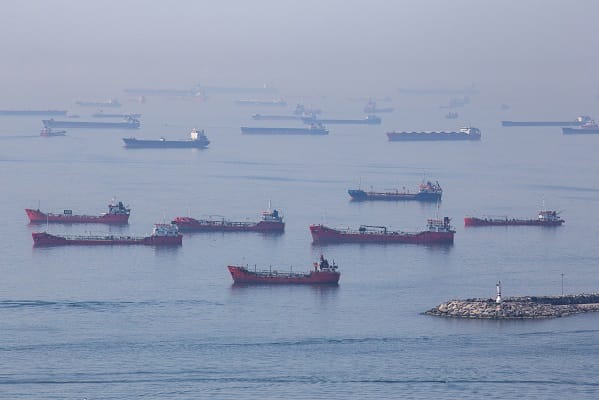
Global energy markets fell sharply on Wednesday after signals from Iranian naval authorities suggested shipping could resume safely through the Strait of Hormuz, raising hopes that a fragile ceasefire may hold and avert a wider regional escalation.
An account linked to Iran’s Islamic Revolutionary Guard Corps Navy Command said “safe, stable passage” would be ensured through the strategic waterway, adding that “aggressors’ threats” had been neutralised and that new operational protocols were now in force.
The remarks triggered an immediate reaction across global markets, with Brent crude sliding by around 11pc to below $98 a barrel in afternoon trading. The move briefly dragged benchmark oil prices under the psychologically significant $100 threshold for the first time in recent weeks, underscoring how quickly sentiment has shifted on signs of de-escalation.
The Strait of Hormuz — a narrow maritime chokepoint between Iran and Oman — carries a substantial share of the world’s seaborne oil and liquefied natural gas exports. Any disruption to traffic through the passage typically reverberates across global supply chains, feeding directly into energy inflation and broader market volatility.
In recent weeks, heightened tensions between the United States and Iran had effectively disrupted shipping flows, fuelling fears of a broader confrontation in the Gulf and sending crude prices higher. Wednesday’s developments, however, pointed to a possible easing of those pressures, at least in the short term.
Investor sentiment strengthened further after political signals suggested negotiations may be advancing. Donald Trump said he was pausing efforts related to escorting stranded vessels through the strait, implying that diplomatic discussions were moving towards a wider settlement.
Writing on his Truth Social platform, he said that if Iran adhered to what had been agreed, “the already legendary Epic Fury will be at an end”, adding that restrictions affecting the waterway would be lifted. However, he cautioned that this remained a “big assumption”, warning that failure to comply could still trigger renewed escalation.
The US–Iran standoff had effectively shut down key maritime traffic through the region in recent weeks, contributing to a spike in oil prices and rattling global equity markets. A ceasefire arrangement is already understood to be in place, though officials have repeatedly warned it remains fragile and subject to rapid deterioration.
A Pakistani government official told US outlet MS Now that the “prospect of a proposal to end the war is very likely in the coming days”, while US Secretary of State Marco Rubio said the offensive phase of the conflict was “over”, further reinforcing market expectations that the immediate risk of escalation is receding.
Equity markets responded positively to the apparent de-escalation. European indices rallied strongly, with London’s FTSE 100 rising 2.6pc to 10,485.9. France’s CAC 40 gained 3.3pc, while Germany’s DAX advanced 2.8pc, reflecting renewed investor appetite for risk assets amid easing geopolitical pressure.
Energy stocks were more mixed, with gains in broader market sentiment offset by weakness in some oil majors following the sharp fall in crude prices. Traders said the move reflected a rapid unwinding of the “risk premium” that had built up around Middle East supply fears.
Analysts cautioned, however, that the situation remains highly volatile. The Strait of Hormuz has long been a flashpoint for geopolitical tension, and any reversal in the current diplomatic momentum could quickly send prices sharply higher again.
“Markets are reacting to headlines rather than certainty,” one energy strategist said. “The scale of the move in oil shows just how much risk premium had been priced in — and how quickly it can disappear if there’s even a hint of stability.”
For now, traders appear to be betting that diplomatic channels are gaining traction and that a critical energy artery may remain open. But with trust between Washington and Tehran still limited, few are willing to rule out another sudden turn in an already volatile standoff.


Leave a Comment