
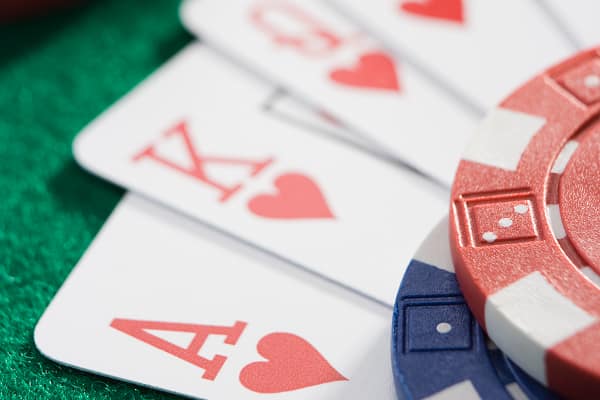
Expected value is the first tool taught in most economics courses, and it is the same tool a poker player uses on every hand. A student can memorise the definition in an afternoon, while a player who ignores it loses money by the end of the night, feedback that arrives faster and stings more than any graded exam. The game depends on the arithmetic of risk, and it pays or charges the player in real money for each correct or careless calculation. The lessons hold up well beyond the table, which is why so many traders, founders, and economists keep a deck close.
The expected value lesson
Expected value is the average result of a decision repeated many times. A player compares the size of the pot to the cost of a call, then acts when the numbers favor action and folds when they do not. Professionals describe this as focusing on the long-term profitability of a choice, where the result of any single hand counts for little.
The distinction matters because outcomes lie. A correct decision can lose, and a careless one can win, because luck controls any single hand even when the math is sound. An economics lecture can state that in a sentence and move on. A poker session repeats it a few hundred times in an evening, and the player keeps a running tally in chips. The number on the table at the end of the night is the grade, and it does not round up for effort. A student who confuses a good result with a good decision pays for the error the next time the same situation comes around.
The price of each decision
Every chip a player commits is a chip that cannot be used on a later hand. That is opportunity cost stated in its plainest form. Pot odds put the same idea into a ratio. A player who must call $20 to win a pot of $100 is paying one part to win five, and the call earns money only when the hand wins more than one time in six. The comparison follows the same cost-benefit logic a shopper uses on any purchase, except the math is exact and the result is immediate.
Folding has a price too, since a player who abandons a strong hand surrenders the money it would have won. Each option has a value, and the player picks the largest one. Few classroom exercises force a student to price inaction, yet a poker player does it on every street, weighing the cost of staying in against the cost of stepping aside.
Risk practice outside the lecture hall
People meet these ideas in many low-stakes settings, from board games to fantasy drafts to a first small investment. A casual game of poker belongs in that group, alongside chess and bridge, as a practical way to rehearse decisions that have real consequences attached. The format does the teaching, and the stakes can stay small.
What separates the table from a worksheet is repetition with consequences. A semester hands a student a handful of graded problems. A single session hands a player hundreds of small decisions, each followed by a payout or a loss the player can study before the next hand begins.
Bankroll limits and the Kelly Formula
A player who holds an edge can still go broke by betting too large a share of a limited bankroll. The Kelly criterion answers the sizing question with a formula that ties each bet to the player’s edge and the variance of the game. It sets the fraction of a bankroll that maximises the long-run growth of wealth, and it penalises anyone who bets above that fraction with slower growth or faster ruin.
This is risk management taught as a personal budget. Most economics students calculate someone else’s optimal portfolio on an exam and never size their own. A player who skips bankroll math feels the lesson directly because a long run of bad cards can end a career that an edge alone would have sustained. The formula also explains why a small, steady advantage beats a large, reckless one, a point that finance professors spend entire lectures defending.
Information and the pricing of the unknown
Most economics taught to beginners assumes a buyer who knows the price and a seller who knows the cost. Poker strips that assumption away. A player never sees an opponent’s cards and must act on partial signals: bet sizes, timing, and the history of the table. The job is to assign a probability to what is hidden and price the decision against it.
That is the same problem an insurer solves when setting a premium and a trader solves when quoting a market. A poker player updates the estimate with each new card and each new bet, raising or lowering the odds as fresh information arrives. The skill lies in acting well while certainty stays out of reach, and the game rewards a player who prices the unknown a little more accurately than the people across the table. Where an exam tests this idea once, a real session tests it on every hand, and the chip stack keeps the only score.
Behavioural biases at the table
The biases that behavioural economics catalogs show up at the table with money attached. The sunk cost fallacy appears when a player keeps calling because of the chips already in the pot, even when the hand is beaten. The gambler’s fallacy appears when a player believes a card is due after a dry streak. Research on decision-making has found that people become more willing to take irrational risks after a loss, and the felt is full of players raising their stakes to win back what they dropped an hour earlier.
A study of experienced online players documented reference-dependent behavior, a pattern central to prospect theory, where players reduce their risk-taking once they move ahead for the session. A classroom names these patterns and assigns a reading on them. At the table, each one costs real money, in the exact amount the player misjudged, and that loss shows up the very same evening.
The edge of real stakes
Annie Duke makes the case better than any syllabus. She studied cognitive psychology on a National Science Foundation fellowship at the University of Pennsylvania, won her first World Series of Poker bracelet in 2004 against a field of 234 entrants, and later wrote Thinking in Bets in 2018, a guide to risk management that connects the table and the research. Her path shows the transfer running both directions, from science into the game and back out into business and investing audiences who now pay to hear her speak.
A classroom can describe risk with precision and never make a student pay for a mistake. The table charges for every miscalculation and refunds nothing, and that bill is what turns a memorised definition into a habit. The economics is identical in both rooms. The tuition is what differs, and the table collects on the spot.
Conclusion
Poker remains one of the clearest practical demonstrations of economic decision-making because every choice carries an immediate cost or reward. Concepts such as expected value, opportunity cost, probability, risk management, and behavioral bias move beyond theory and become lasting habits through repetition and feedback. While a classroom provides the foundation, the poker table reinforces those lessons under real conditions where every decision matters. That combination is why poker continues to be recognised not only as a game of skill but also as one of the most effective ways to understand the economics of risk.
Please play responsibly. For more information and advice visit https://www.begambleaware.org
Content is not intended for an audience under 18 years of age




Leave a Comment