
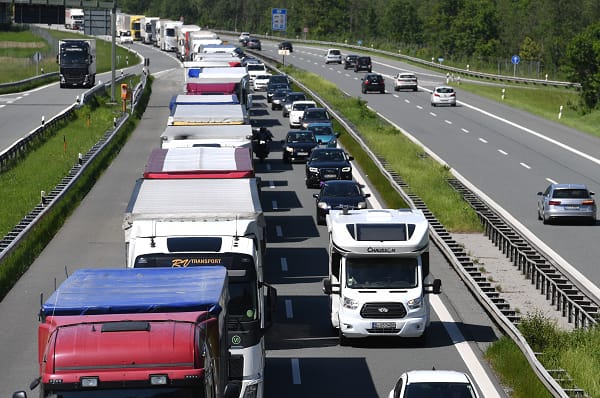
British families heading to Europe this summer could face a nightmare of 12-hour traffic queues, with one senior MP warning the delays could become so severe that people could die before ambulances are able to reach them.
The stark warning comes as concerns mount over the European Union’s controversial Entry/Exit System (EES), which is due to introduce new biometric border checks for British travellers entering the Schengen Area.
Conservative MP Sir Roger Gale has accused Brussels of pressing ahead with a system that is not ready, warning the consequences could be catastrophic if thousands of vehicles become stranded in Kent during the peak holiday season.
“If you have elderly people, children and dogs in 12-hour queues with no lavatory facilities, inadequate water supplies, somebody will die, somebody will have a heart attack,” Sir Roger told The Times.
“I’m not overegging it. This is the stark reality.
“How do you get an ambulance through traffic jams like that? Put the system on ice, get the technology right, make it work and then introduce it properly.”
His intervention comes as Transport Secretary Heidi Alexander prepares to meet European Commissioner for Sustainable Transport and Tourism Apostolos Tzitzikostas in a bid to minimise disruption before the busiest weeks of the summer getaway.
The talks come amid growing concern that the new border regime could create major bottlenecks at Dover and the Channel Tunnel as millions of British holidaymakers head for continental Europe.
The EES will require non-EU travellers, including British passport holders, to provide fingerprints and facial photographs when entering the Schengen zone for the first time.
The aim is to strengthen border security and replace manual passport stamping with a digital record of travellers entering and leaving the bloc.
However, concerns remain that the technology is not yet capable of coping with the sheer volume of passengers passing through ports such as Dover.
French border officials have reportedly experienced difficulties connecting biometric kiosks and handheld devices to the EU’s central database, while travellers will also need to create an individual EES profile during the registration process, adding further time to each crossing.
Doug Bannister, chief executive of the Port of Dover, warned last month that internal modelling pointed to the possibility of “severe congestion” during the summer holiday period.
With around 12,000 vehicles expected to pass through Dover each day, worst-case scenarios initially suggested queues could stretch to 12 hours.
More recent forecasts have reduced that estimate to between six and eight hours, but even that would represent one of the longest periods of disruption seen at the port in recent years.
The warning follows scenes during the May Bank Holiday when French authorities suspended enhanced border checks only after queues had already reached around four-and-a-half hours.
Officials are also preparing to activate Operation Brock on the M20, the emergency traffic management system originally designed to deal with disruption linked to a potential no-deal Brexit.
The scheme creates a dedicated lane for freight traffic heading to Europe while forcing other vehicles into fewer lanes at reduced speeds in an attempt to keep cross-Channel trade moving.
Ms Alexander rejected Sir Roger’s warning that lives could be put at risk, accusing him of unnecessarily alarming the public.
“This kind of scaremongering helps no one, and it fails to take account of the extensive preparations that have been underway for months,” she said.
The Transport Secretary insisted the Government is working closely with French authorities to reduce disruption.
“We are doing everything in our power to keep holidaymakers and hauliers moving, and we are grateful to the French authorities for their close collaboration in helping to minimise disruption,” she said.
She also pointed to more than £20 million of Government investment aimed at improving vehicle flow through Dover and expanding passport booth capacity.
Despite those assurances, the prospect of lengthy queues has reignited concerns over Britain’s post-Brexit border arrangements, with Kent once again facing the possibility of becoming the country’s biggest transport bottleneck during one of the busiest travel periods of the year.
For thousands of families planning a summer escape, the fear is increasingly simple: that the holiday could begin not on a beach, but in a stationary queue stretching for miles across Kent.


Leave a Comment