
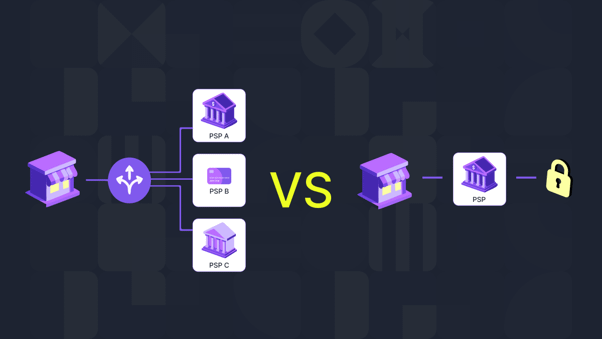
Only one Payment Service Provider is handling all of this from the outset. There is just one contract, one integration, and one dashboard. In most cases, the merchants simply don’t require anything beyond this single PSP arrangement for their first few months of online payment processing. Routing isn’t needed at this stage because all transactions are processed through a single provider. Things get different as soon as the volume increases and the merchant expands into other countries.
Failures begin occurring in clusters, depending on the geography. A downtime on the provider’s side stops the checkout process. The region-specific payment method is lacking. Issuers offer approvals at different rates in ways that a one-provider setup is unable to maximize. That’s when a dynamic payment routing system becomes a viable option for scaling merchants.
What a single-PSP setup solves at the start
The simplicity of a single Payment Service Provider configuration lies in its ability to reduce complexity. There is only one provider agreement to sign, only one integration to perform, and only one report to review. Engineers work with one API. Financial experts check one settlement report. Compliance officers focus on a single partner for payment processing.
For emerging enterprises or companies focused on a single market, this approach can work for a long time. All that might be required is a payment gateway capable of handling transactions in the local market using acceptable payment instruments and charging reasonable fees. Changing over to a single PSP setup would be premature and unjustified.
Where the one-provider model starts to break down
The advantages of a single Payment Service Provider arrangement hold but tend to diminish as the merchant grows. The first problem is likely to become apparent geographically. A provider that operates efficiently within the local market could be weak when dealing with issuers from another country in which the merchant decides to expand operations. Its approval rate will fall behind others’ by 5 to 15%.
A second optimization pattern consists of individual issuer declines. One Payment Service Provider may process Visa transactions from one issuer efficiently, but generate unnecessary declines from another. The merchant has no option if the issue lies with the provider. However, if there are several payment providers in place, they can try another stripe after the first failed transaction or payment decline.
Thirdly, outage exposure. Provider downtime is rare but not impossible. In the case of an outage for the single provider, checkout stops functioning. The merchant without a backup path experiences a loss during this period since the money earned can never be retrieved by the customer, who either completes the purchase with another provider or does not purchase at all.
Fourthly, there is a lack of support for local payment methods. This includes SEPA in parts of Europe, Pix in Brazil, and iDEAL. Bank transfers are popular in many other markets. It’s nearly impossible for one Payment Service Provider to support all these options equally well.
The payment performance is affected when the merchant operates in a market lacking support for their preferred method. Together, these four patterns make payment routing for scaling merchants a practical conversation rather than a theoretical one.
What payment routing changes in the payment stack
The payment routing transactions function determines which payment providers and acquirers will process individual transactions. The routing logic doesn’t just send all payments to one processor. Instead, it evaluates each transaction based on a set of criteria. Then, it assigns the best allocation for that specific payment. The criteria used can either be static (predefined routing rules) or dynamic (signals).
When selecting a payment path, several criteria are usually considered:
- geographic location of the issuer;
- currency used;
- type of card (credit or debit);
- mode of optimal payment;
- transaction value;
- time of day;
- provider’s health;
- transaction risk;
- processing cost.
The payment path selection algorithm can also take into account the acquirer that the provider uses, since a provider can rely on different acquirers depending on the geographic region. This matters because the choice of acquirer often shapes the approval rate just as much as the choice of Payment Service Provider itself.
The shift in the architecture is significant, but it is limited to the interactions between the merchant’s payment service and the providers. Now, each transaction goes to a provider based on specific criteria.
Before, all transactions used the single Payment Service Provider selected by the merchant’s backend. The customer does not see any difference in the process. Merchants will face more complexity. All payments go through various processors. Each one provides its own settlement information.
The provider selection does not substitute existing payment providers. The transaction direction takes place at a higher level of the architecture than the providers. Merchants still maintain relationships with different providers. They still pay processing fees to them, and they still comply with the respective provider’s authentication and anti-fraud rules.
Static, dynamic, and intelligent routing: the practical difference
As merchants expand and payment operations become more complex, routing strategies typically evolve through a mid level dynamic stage before reaching fully intelligent routing models. Maturity levels of transaction direction are known to be of three kinds:
- static routing;
- dynamic routing;
- intelligent payment routing.
They differ in the way they influence the infrastructure needed for their use and the outcomes received from using them. Here are the main types of payment smart routing that businesses have to deal with.
Static payment steering relies on predefined principles that determine how payments should be directed. A merchant can set payments to be processed in specific ways. For instance, payments in EUR go to provider A, payments in USD to provider B, and payments over a certain amount to provider C.
This setup stays the same unless an operator changes it. In this model, every payment is sent to the same provider according to the predefined rules. Static transaction direction is simple and easy to analyze and test.
The dynamic provider selection takes into account the dynamic variables of the situation. Factors like the time of day, service availability, and recent approval rates are considered. The dynamic payment steering algorithm uses provider A as long as the approval rate stays high. If the rate drops, it switches to provider B based on the changes. The rules are still created manually, while the routing decisions themselves update dynamically based on the current state.
Intelligent payment routing uses past and current performance data about providers in real time. This includes card types, issuers, locations, and transaction amounts. The system can predict authorization outcomes and select a better path. This approach does not use any manual configuration but relies entirely on the analysis of the processor performance.
Failure handling: why routing matters after the first decline
One of the greatest gains provided by intelligent payment steering comes from the processing of payment failures. With a payment declined by the first party, there can be an attempt to repeat the transaction using another provider. A failed transaction declined by one Payment Service Provider might go through successfully just a few hundred milliseconds later. This is due to the smart payment routing engine. Smart payment steering minimizes latency for dealing with a decline since the retry will be done within the same session.
A useful reprocessing attempt is different from a blind retry. The same transaction will be sent to the same provider again without any modifications. This is unlikely to make a difference while also possibly setting off the fraud detection system. A useful reprocessing attempt, by contrast, sends the transaction to another path for a transaction where approval is more likely to occur.
There are several conditions. A retry cannot cause multiple charges where the first one goes through, but the response gets lost. The maximum number of retries during a particular period is regulated by issuers and card network regulations. Skipping fraud prevention measures by trying to process a cost efficiency payment multiple times is unacceptable. All these restrictions need to be accounted for.
Fallback routing is the name of the wider class of which retry is one component. Fallback provider selection includes retries for declined transactions. It also covers PSP timeouts, network errors, and unexpected codes.
A transaction distribution routing solution that spots a PSP failure can quickly redirect traffic to a backup connection. This helps maintain a higher authorization rate. If a merchant has many transactions each day, automated failover leads to clear gains in a quarter.
Provider fit by GEO: why the best Payment Service Provider is not always the same everywhere
Not all payment providers perform equally well across all markets. Every provider will build stronger ties with issuers, preferred acquirers, and local payment methods. They will also handle the currency used in their market more effectively. A provider with a 92% success rate in one GEO may only reach 78% in another. This drop happens due to weaker issuer relationships there.
This type of payment routing strategy solves the issue. It sends each transaction to the provider that best fits the market conditions. Euros from cards issued in Germany will go to a provider with strong German acquiring skills. Brazilian Pix transactions will be routed to a provider with native integration with Brazilian networks. UK transactions made through certain payment cards will be sent to the most effective provider.
The match is simple, where there are well-defined patterns. A merchant operating in three countries can establish static rules whereby each market is routed to its own primary Payment Service Provider, with an alternate assigned in case of failure. When the merchant operates in tens of countries, the table will become bulky, requiring frequent updates.
Local acquirer selection is important at a lower level than the provider level. In one country, the acquiring bank handling Mastercard and Visa transactions will differ from that used in another country. By provider selection on the acquirer as well as provider compatibility, one can add gains in terms of approval rate to the merchant’s income. This payment transaction distribution strategy, in cases of high transaction volumes, adds a significant percentage to the merchant’s bottom line.
From routing rules to an orchestration layer
The provider selection is but a component of the bigger picture. When merchants and payment managers manage multiple PSPs, the focus changes. They need to reconcile between processors, track providers, manage contracts, and handle different settlement timelines. Compliance assessments across multiple counter parties also become important. The routing layer takes care of transaction-level decisions. The other aspects come under the purview of a wider operational layer.
It is in this wider operational layer that the benefits of payment orchestration lie. Providers must handle the operational tasks needed in a multi-provider setup. Reporting is done in a consolidated fashion among all the providers. Provider-agnostic monitoring helps find problems no matter where the provider is in the transaction. You can manage fallback and provider selection mechanisms in one location instead of using different provider portals.
When a merchant works with many providers and payment methods, a payment orchestration platform helps. It manages transaction distribution, monitoring, and payments all in one place. It is typically a matter of numbers whether merchants choose to switch to orchestration or continue using only the provider selection rules.
There is no fixed order in which this process needs to happen, as many merchants gradually transition from rules to orchestration. They can start with basic reporting or monitoring in their payment orchestration platform setup. Then, they can move on to managing rules. Some merchants choose to integrate their orchestration solution when they start using multiple payment providers.
Operational tradeoffs: what gets harder with multiple providers
While multi-provider transaction distribution eliminates some challenges, new issues arise. Reconciliation is the first. Each provider will share settlement details and reporting in its own time, format, and style for transaction costs and adjustments. Finance teams that have been reconciling their accounts against one set of information will need to reconcile against several sets. Reconciliation without the right tools scales linearly with the number of providers.
The management of contracts is another complication. Each provider comes with its own terms, volume requirements, compliance regulations, and expiration dates. Procurement and legal departments that managed one relationship will soon manage many more. It turns out that the labor and expense involved in managing multiple contracts somewhat nullify the benefits of an efficient payment routing strategy.
Compliance and risk management must align across all providers. Fraud management rules vary by provider. This means one provider might block a transaction while another approves it. The merchant requires a certain risk policy that remains the same among all providers, instead of giving each of them their own thresholds.
In practical terms, the operational tradeoffs of a multi-provider payment transaction distribution strategy fall into several specific areas:
- reconciliation across providers with different settlement formats and timelines;
- reporting consolidation that requires combining transaction data from multiple sources;
- contracts management with separate terms, renewals, and volume commitments;
- compliance and risk frameworks that need to align across all counter parties;
- authentication flows like 3D Secure should not vary by provider.
Each of these areas creates ongoing operational work that did not exist in the single-provider setup.
Decision checklist: Is it time to move beyond one provider?
Are declines concentrated by geography or issuer?
If approval rates vary by more than 10 percentage points across markets, the variance points to a provider-fit problem that transaction distribution can address. If false declines are spread evenly, the issue may not be provider-related.
Has a provider outage taken checkout offline in the past year?
Even brief outages cause measurable lost revenue. Merchants, which customers experience one or more cases in the past twelve months, have a concrete case for fallback transaction distribution.
Are local payment methods missing in key markets?
Conversion losses caused by missing payment methods are usually visible in checkout funnel data. A region where the conversion rate drops sharply at the payment step often indicates a missing method.
Are processing costs unevenly assigned across payment routing paths?
Different providers delay prices differently, and the cost-effective payment path in one market may not be the cheapest in another. A pricing analysis across markets identifies whether transaction distribution could reduce payment processing costs.
Does finance struggle with fragmented reporting?
If reconciliation across providers takes meaningful staff time, orchestration tooling may save more than transaction distribution optimize alone.
Does the payments team need route-level testing and monitoring?
Teams without visibility into per-assigned authorization rates cannot tune transaction distribution rules effectively. Visibility is a prerequisite for moving beyond a single provider.
Conclusion
The single provider option is sufficient for numerous merchants for years to come. Justification becomes more and more difficult, though, if issues of volume, geography, and provider fit become evident through loss in revenues. Payment routing is a solution. The progression has several stages:
- A single Payment Service Provider setup works for early-stage merchants in focused markets.
- Payment allocation helps those entering new GEOs with provider-fit issues.
- Smart transaction distribution suits merchants whose volume needs real-time decisions.
- Payment orchestration is for those managing multiple providers across markets, methods, and reporting needs.
Implementation requires much more than just switching on the payment allocation engine. Operational ownership and proper monitoring are necessary, as well as knowing who does the best job in the particular locations.


Leave a Comment