
Picking the right SOC 2 compliance platform for a bank or fintech is a different problem than picking one for a SaaS startup. This guide compares the five platforms most often shortlisted by financial-services teams in 2026, and shows where each one earns its place.
Why SOC 2 compliance software matters more than ever for financial firms
Cyber risk now hits the balance sheet. In 2025, the average breach cost financial institutions USD 5.56 million, second only to healthcare, according to the IBM 2025 Cost of a Data Breach study. Ransomware struck 12.8 percent of B2B finance organisations between November 2024 and October 2025, according to Kaspersky.
Regulators have noticed. Europe’s Digital Operational Resilience Act has applied to every EU financial entity since January 17, 2025, requiring “continuous, sound, and comprehensive” testing of third-party ICT providers, according to ESMA. In the United States, the SEC’s July 2023 rule forces public companies to disclose material cyber incidents within four business days and describe their risk-management processes in each 10-K filing, and similar OCC and state guidance pushes banks to ask vendors for real-time evidence.
Spreadsheets cannot keep that tempo. Automated SOC 2 platforms plug directly into cloud, IAM, CI/CD, and ticketing systems, test controls in near real time, and flag drift before an examiner or a ransom group does. IDC research finds automation trims audit-prep labor by 82 percent—making SOC 2 software a prerequisite for winning deals, satisfying regulators, and protecting deposits.
1. Vanta: fast-track compliance for scaling fintech and enterprise banks
Vanta
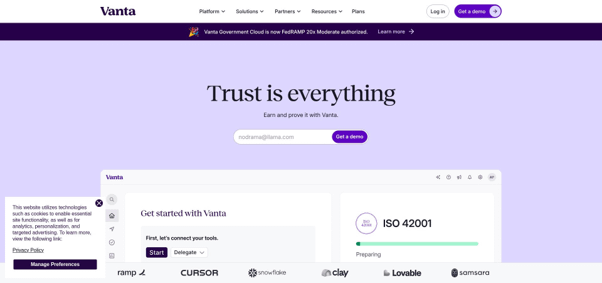
Vanta shortens the path from “we have controls” to “we can prove it, continuously.” Per IDC, automated evidence collection with Vanta cuts audit-prep labor by 82 percent.
- Automation: 1,400-plus automated tests across 400-plus integrations, via read-only API checks producing clear pass/fail evidence; tests run every one to four hours (per expert research) for fast drift detection.
- Frameworks: SOC 2 plus PCI DSS v4.0, DORA, SOX ITGC, NYDFS Part 500 (23 NYCRR 500), NIST CSF 2.0, and NIST 800-53. Cross-maps evidence across frameworks; SOC 2-to-ISO 27001 reuse is typically 50 to 70 percent.
- Integrations: AWS, Azure, Okta, Azure AD, Jira, and ServiceNow.
- Trust and questionnaires: Built-in Trust Center (from the Trustpage acquisition) plus questionnaire automation (QAuto) with acceptance up to 95 percent and multi-language support.
- Vendor risk: VRM module (add-on) centralises vendor inventory and risk tiering, with shadow IT discovery based on SSO and identity signals.
- AI: Embedded across questionnaires, control mapping, policy workflows, and remediation help for failed tests.
- Time to value and cost: SOC 2 Type 1 readiness in as few as five days for teams with an existing program; tiered packaging (Essentials, Plus, Professional, Enterprise) with VRM add-on. Third-party benchmarks put entry-level pricing at USD 10,000 to 12,000 per year for one framework, rising to USD 35,000-plus for multi-framework enterprise plans; audit fees are separate.
- Limitations: Premium pricing; FFIEC is not explicitly listed as a supported framework, so banks needing FFIEC mapping should validate coverage; it is purpose-built for security compliance automation, not full enterprise GRC change management.
For teams benchmarking third-party risk, Vanta’s 5 best risk management software solutions of 2026 compares its vendor-risk workflows with peers like Archer and Hyperproof.
2. Optro (formerly Auditboard): enterprise GRC power for banks that outgrew spreadsheets
Optro
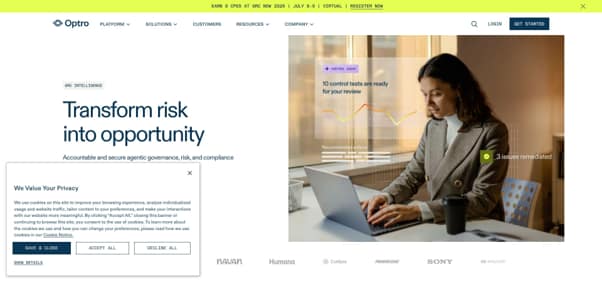
Optro brings internal audit, SOX, IT compliance, and third-party risk into one workspace. Its advantage is breadth and governance, not speed to a first SOC 2 report.
- Enterprise adoption: Used by more than 50 percent of the Fortune 500, including seven of the Fortune 10.
- GRC DNA: Built for programs where SOC 2 sits next to SOX testing, internal controls, and recurring issue management. The RegComply module handles regulatory obligation management with centralised obligation libraries and regulatory change alerts.
- Automation: Workflow-driven, not pre-built automated testing—about 10 out-of-the-box monitoring templates; most evidence collection is point-in-time.
- Integrations: Roughly 200 integrations, with one-to-many control mapping across SOC 2, ISO 27001, PCI DSS, and NIST-aligned frameworks; bi-directional ticketing is limited to a small set of task systems.
- Trust and questionnaires: No native Trust Center; typically relies on third-party options such as Conveyor. Questionnaire automation is earlier stage with no published accuracy metrics.
- Vendor risk: TPRM module with strong questionnaire workflows, but no automated vendor discovery, no shadow IT discovery, and continuous monitoring generally depends on external ratings providers.
- AI: Has launched an AI Governance module; not positioned as embedded remediation support, and no AI-generated remediation code snippets.
- Time to value and cost: Implementations measured in weeks; one reference customer paid USD 87,000 for implementation services. Quote-based and modular—median platform price around USD 42,775, TPRM module around USD 69,000 per year, plus overage, add-on, and renewal increases.
- Market validation: Gartner Magic Quadrant Leader for GRC (2025) and TPRM (2026); acquired by Hg for USD 3 billion in May 2024; reported at USD 300 million-plus ARR.
- Limitations: Lighter SOC 2 automation (about 10 monitoring templates), no native Trust Center, and longer, costlier implementations.
3. OneTrust GRC (Tugboat): where security, privacy, and third-party risk converge
OneTrust
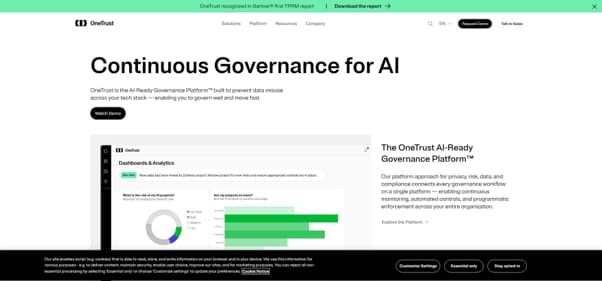
OneTrust serves 14,000-plus customers worldwide and was named a Leader in Forrester’s 2023 Privacy Management Wave. Its SOC 2 capabilities come from the 2021 acquisition of Tugboat Logic, letting teams run privacy, third-party risk, and security compliance from one platform. A large share of its installed base uses the platform for cookie consent, so customer count is not a perfect proxy for GRC depth.
- SOC 2 automation: More manual than automation-first platforms—fewer than 50 out-of-the-box evidence collectors and weekly monitoring at best.
- Frameworks: SOC 2, ISO 27001, and PCI DSS, plus privacy and operational resilience needs including DORA-aligned positioning; evidence-collection integrations are limited.
- Trust sharing: Offers a privacy-focused trust profile, not a compliance Trust Center for continuously monitored controls.
- Vendor risk (its strength): Third-Party Risk Exchange with pre-populated profiles for about 6,000 vendors; ongoing monitoring via providers such as SecurityScorecard and RiskRecon, offering the kind of TPRM automation software with due-diligence workflows covering sanctions, adverse media, and PEP checks.
- AI: Most differentiated in AI governance (aligned to the EU AI Act, ISO 42001, and NIST AI RMF) plus AI evidence evaluation; less embedded across the full compliance workflow.
- Time to value and cost: Implementation ranges from USD 5,000 for lighter starts to hundreds of thousands for complex programs. Quote-based—Tech Risk and Compliance licensing around USD 50,000 to 300,000; TPRM around USD 40,000 to 500,000 depending on vendor count and users.
- Limitations: SOC 2 automation more manual than expected (weekly monitoring, fewer than 50 collectors), a user experience multiple customers describe as difficult, and a trust profile that does not reduce SOC 2 questionnaire load.
4. Scrut Automation: fintech-focused compliance when budget and framework breadth drive the shortlist
Scrut Automation
Scrut targets fast-growing fintechs that need to show progress across multiple standards without a large GRC team, competing hardest on total price, especially when audits are bundled.
- Financial services fit: Markets a dedicated PCI DSS v4.0 solution with pre-built controls and QSA collaboration; verified footprint skews toward India and APAC fintechs, with no confirmed major US bank deployments.
- Automation and monitoring: Daily testing cadence (slower than platforms detecting drift every few hours); a buyer concern is that automated exports (e.g., CSV) are not always auditor-preferred.
- Integrations: Closer to 70-plus integrations than the “100-plus” framing some listings show; depth varies by system.
- Framework coverage: Unified Controls Framework maps controls across many standards, but there is no HITRUST support.
- Time to value: In Scrut’s Orca case study, Orca cut questionnaire response time by 85 percent and reached SOC 2 readiness in eight weeks; counterexamples include a SOC 2 effort taking nine months.
- Trust Center: Trust Center-style portal, with reported downtime flagged as a credibility issue.
- Vendor risk: Available within a bundle, but without the automated vendor discovery or continuous monitoring bank TPRM teams expect.
- AI: AI-assisted policy workflows that expert notes describe as less mature and sometimes buggy.
- Pricing and support: Quote-based “all-in including audit” packages from roughly USD 3,400 for small startups to around USD 25,000 for larger bundles; dedicated compliance advisor and Slack-first support operating largely on India Standard Time.
- Limitations: Daily cadence and lighter automation, integration depth that can leave manual evidence work, Trust Center reliability concerns, support-timezone fit, and no HITRUST support.
5. Hyperproof: workflow-driven compliance for mid-market teams that need structure across frameworks
Hyperproof
Hyperproof is a compliance operations workspace for organising controls, assigning owners, tracking evidence requests, and managing audits across frameworks. More than 500 organisations, including Reddit, Fortinet, and Appian, use it for risk and compliance workflows, according to PR Newswire.
- Financial services fit: Supports common security frameworks financial institutions care about, including SOC 2 and PCI DSS; verified bank/fintech references are limited.
- SOC 2 automation: Automates evidence via Hypersyncs, but ships no pre-configured automated tests—each check must be manually configured and maintained—with a daily maximum monitoring cadence.
- Integrations: Fewer than 100 Hypersyncs (roughly 55 to 60 integration logos on its SOC 2 materials) across cloud, identity, and ticketing.
- Framework management: Cross-walks controls between frameworks and organises programs by team or business unit; Appian’s case study cites saving more than 100 hours on evidence collection.
- Trust and questionnaires: Not a Trust Center product; relies on a HyperComply partnership with a 72-hour SLA and human-reviewed responses.
- Vendor risk: Primarily an inventory and generally an add-on, lacking continuous monitoring and automated vendor discovery.
- AI: Launched September 2025 in early access, with limited embedded workflows.
- Time to value and cost: Approximately USD 10,000 implementation fee; tiered, quote-based pricing from about USD 12,000 per year entry-level, with a median ACV around USD 39,000 (Vendr). Budget also for configuring and maintaining automated checks and for reporting work that may involve exporting data to Snowflake.
- Limitations: No out-of-the-box automated tests, daily-only monitoring, no native Trust Center or AI questionnaire automation, basic vendor inventory, and hidden TCO for reporting and automation maintenance. Recent layoffs affected engineering and support.
At-a-glance: which platform fits your financial-services playbook?
| Platform | Best for | Snapshot metric | Stand-out edge | Watch-out |
| Vanta | Banks and fintechs prioritising speed, continuous evidence, and buyer trust | 1,400-plus automated tests; 400-plus integrations; tests run every one to four hours | Deep automation plus Trust Center and questionnaire automation (QAuto up to 95 percent acceptance) | Premium pricing, and FFIEC is not explicitly listed as a supported framework |
| Optro (formerly Auditboard) | Large banks running SOC 2 alongside SOX, internal audit, and enterprise risk | More than 50 percent of the Fortune 500, including seven of the Fortune 10 | Bank-grade workflow and regulatory obligation management with RegComply | SOC 2 automation is lighter (about 10 monitoring templates) and no native Trust Center |
| OneTrust | Orgs unifying privacy, third-party risk, and security governance | 14,000-plus customers; ~6,000 vendor profiles in its risk exchange | Strong privacy and third-party risk capabilities in one platform | SOC 2 automation is more manual (under 50 evidence collectors) with weekly monitoring at best |
| Scrut | Fintechs optimising for framework breadth and bundled, lower-cost programs | SOC 2 readiness in eight weeks (Orca); daily monitoring cadence | Advisor-led model and attractive “all-in” pricing that can include audits | Shallower automation and integration depth (70-plus integrations), plus gaps like no HITRUST support |
| Hyperproof | Teams needing a workflow hub to manage controls and evidence across many frameworks | Fewer than 100 Hypersyncs; more than 100 hours saved on evidence collection (Appian) | Cross-framework organisation and structured audit workflows | No pre-configured automated tests out of the box, no native Trust Center, and automation/reporting can require extra build effort |
The fastest way to choose is a scoped pilot with your own vendor lists, questionnaires, and a recent control failure—then confirm evidence collection, auditor handoff, and monitoring cadence against the numbers above.
Conclusion
There’s no single best SOC 2 platform for financial services, only the best fit for your mandate. Vanta leads on automation speed and trust-building, Optro and OneTrust on enterprise governance, Scrut on bundled value, and Hyperproof on cross-framework structure. Run a scoped pilot against your own controls before committing.



Leave a Comment