
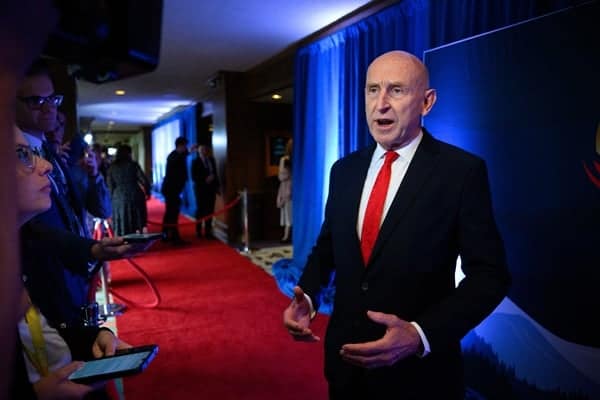
Chancellor John Healey has pledged to maintain “fiscal discipline” and “balance the books” at next month’s Budget, while refusing to rule out further tax increases as the Government attempts to reconcile its growth ambitions with mounting pressure on the public finances.
Speaking at the Manufacturing Technology Centre in Coventry, Mr Healey said economic growth was “at the heart” of his plans for Britain, but declined to give away details of his tax strategy ahead of the October Budget.
Asked whether taxes could rise, the Chancellor said he did not want to fuel speculation; he said: “If I respond to speculation now, that will only spawn more speculation.”
His comments came as he announced a £150mn fund through the British Business Bank for fast-growing companies in northern England, alongside plans for a “northern 500” initiative bringing together “the North’s most ambitious mid-sized businesses” under the leadership of regional mayors.
“My defining mission as Chancellor is growth,” Mr Healey told LBC, setting out his ambition to “make great Britain growth Britain”.
The Chancellor used his speech to argue that the next phase of Britain’s economic expansion needed to be less concentrated in London, with greater powers and resources transferred to regional authorities.
“The next chapter of Britain’s growth story will be written in more places,” he said.
“That’s not sentimentality, that is supply-side economics. A transport bottleneck in South Yorkshire is too often invisible from Whitehall, but it can have a real impact on economic growth and on business investment decisions.
“That’s why, at the Budget, I will set out a roadmap to fiscal devolution, a permanent transfer of power and resources from Whitehall to our regions, with greater business rates retention for local councils and strategic authorities, grants from central government replaced by a share of local income tax for every mayoral strategic authority beginning in 2028.
“London, of course, is our powerhouse, but if our city regions could emulate the success of those in France or Germany, growth in our country would be transformed.”
The timing of the intervention was awkward. On the same day, Jaguar Land Rover confirmed plans to cut 4,000 jobs, providing a stark reminder of the difficulties confronting Britain’s manufacturing base as the Government seeks to stimulate investment and productivity.
Mr Healey nonetheless sought to strike an optimistic tone about Britain’s economic prospects, despite the impact of global instability including the war in the Middle East and Russia’s invasion of Ukraine.
The speech was the Chancellor’s first major economic intervention since Andy Burnham entered Downing Street.
Mr Healey sought to reassure investors that the Government’s growth agenda would not come at the expense of fiscal credibility.
“The Prime Minister and I are in lockstep in our commitment to meeting the fiscal rules at the upcoming Budget, to balancing the books with a buffer to protect against uncertainty,” he said.
The Chancellor also set an ambition to expand Britain’s technology sector, saying he wanted to double the number of companies valued at more than $1bn.
“So, I’m setting an ambition now to double the number of unicorn firms in this country,” he said.
Mr Healey said the Government would also seek to give businesses greater scope to experiment with emerging technologies through regulatory “sandboxing”.
The proposed arrangements would allow companies and innovators to test technologies ranging from pavement robots and drones to medical equipment, areas where Mr Healey said existing regulation could currently prevent experimentation.
The emphasis on entrepreneurship comes after Sir Richard Branson urged the Chancellor to avoid policies that make it harder for new businesses to establish themselves.
The billionaire entrepreneur told LBC it would be “great” if the Government backed younger entrepreneurs and helped them build their companies.
Sir Richard also called on the Chancellor to provide people starting businesses with temporary relief and support while they established their operations.
For Mr Healey, however, the central challenge will be turning his ambitions for investment and regional growth into stronger economic performance while maintaining control of the public finances.
The £150mn northern investment fund and plans for greater fiscal devolution are designed to attract private capital and spread growth beyond London.
But the simultaneous announcement of thousands of job cuts at one of Britain’s largest carmakers underlines the scale of the challenge facing the Government.
With the Budget only weeks away, Mr Healey is attempting to convince businesses and investors that Britain can achieve faster growth without sacrificing fiscal discipline — while keeping open the possibility of further tax rises that could test that very business confidence.


Leave a Comment