
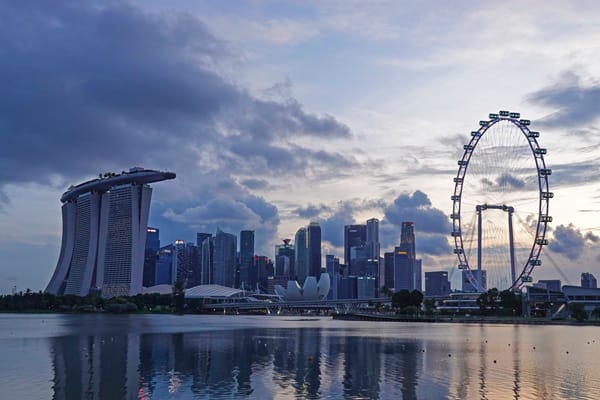
For decades, Singapore and Hong Kong have been Asia’s two great gateways for international business. Both offer 100% foreign ownership, world-class banking and low, competitive taxes — yet they suit different strategies. The right choice depends less on which is “better” and more on where your customers, capital and growth plans actually sit.
Quick comparison
| Factor | Singapore | Hong Kong |
| Foreign ownership | 100% | 100% |
| Typical incorporation | 1–3 business days | A few days to about a week |
| Headline corporate tax | 17% (with exemptions) | Two-tier: 8.25% / 16.5% |
| Resident director required | Yes — at least one | No |
| Annual audit | Exemption for eligible small companies | Generally required |
| Strategic gateway to | ASEAN & South-East Asia | Mainland China & Greater China |
Why Singapore continues to attract global entrepreneurs
Singapore’s appeal rests on stability and reach. It offers a transparent regulatory system, a strong rule of law, an extensive Double Taxation Agreement network and a reputation that opens doors with banks and partners across the region. Its start-up and partial tax exemptions can bring the effective rate well below the 17% headline for qualifying companies, and it is widely regarded as the cleaner, more predictable base for founders who value governance and long-term credibility. The trade-off is the resident-director requirement, which most foreign founders meet through a nominee-director arrangement.
Why Hong Kong remains a global business hub
Hong Kong’s advantage is proximity — it remains the most natural springboard into mainland China and the wider Greater China market. Its two-tier profits-tax system applies 8.25% to the first portion of assessable profits and 16.5% above that, it imposes no resident-director requirement, and its territorial tax principle means, broadly, that only profits sourced in Hong Kong are taxed (subject to the applicable rules). The main trade-off is that most Hong Kong companies must file audited accounts each year, which adds a recurring compliance cost.
Company formation process
Both jurisdictions are efficient by global standards. Singapore incorporations are typically completed in one to three business days through an ACRA-registered filing agent, and require at least one locally resident director. Hong Kong incorporations usually take a few days to about a week and do not require a resident director, though a company secretary and a registered local address are needed. In both cases, foreign founders most often set up a private limited company.
Tax comparison
On headline rates, Hong Kong’s 8.25%/16.5% two-tier structure looks lower than Singapore’s flat 17%. In practice the gap narrows once Singapore’s start-up and partial exemptions are applied to qualifying companies. Singapore’s deep DTA network can also reduce withholding taxes on cross-border income — an advantage for regionally active businesses. The better-value jurisdiction depends on your profit level, income sources and how much cross-border activity you run, so it is worth modelling both against your specific numbers rather than comparing headline rates alone.
Banking and international payments
Both cities host mature banking sectors with strong international connectivity, and both apply rigorous due diligence when onboarding new companies. Expect banks in either jurisdiction to scrutinise your business model, shareholder profile, source of funds and expected transaction flows. A clear business plan and genuine local substance improve your odds in both places.
Compliance requirements
Singapore companies file an Annual Return with ACRA and a corporate tax return with IRAS, and many small companies qualify for audit exemption. Hong Kong companies file annual returns and profits-tax returns and, in most cases, must submit audited financial statements. If minimising ongoing audit obligations matters to you, Singapore’s exemption regime is a meaningful point in its favour.
Access to regional markets
This is often the deciding factor. If your growth story runs through ASEAN — Indonesia, Vietnam, Malaysia, the Philippines and beyond — Singapore is the more natural hub. If it runs through mainland China and Greater China, Hong Kong’s proximity and long-standing trade relationships are hard to beat.
Cost of doing business
Setup and compliance costs are broadly comparable, though the mix differs: Singapore adds the nominee-director cost for many foreign founders, while Hong Kong adds the near-universal annual audit. Office and staffing costs in both cities are high relative to the region, so budget for the full picture rather than the incorporation fee alone.
Which businesses should choose Singapore?
- Tech startups, fintech and SaaS companies targeting South-East Asia
- Regional headquarters and holding structures that value governance and DTAs
- Founders who want audit exemption where they qualify
- Businesses that prioritise reputation and long-term investor readiness
Which businesses should choose Hong Kong?
- Companies trading with, or expanding into, mainland China
- Import/export and trading businesses focused on Greater China supply chains
- Founders who prefer no resident-director requirement
- Businesses whose income is largely sourced outside Hong Kong
Final verdict
There is no universal winner. Choose Singapore if your future is in ASEAN, you value governance and predictability, and audit exemption appeals. Choose Hong Kong if your business lives and breathes Greater China and you are comfortable with an annual audit. Whichever way you learn, professional guidance on structuring, banking and compliance pays for itself – and for founders considering setting up a company in Singapore as part of a wider Asia or global footprint, an experienced business setup consultancy can align the jurisdiction with your commercial strategy from the start.
Sources: ACRA (acra.gov.sg); IRAS (iras.gov.sg); Hong Kong Inland Revenue Department (ird.gov.hk). Tax rates and requirements are indicative and subject to change — verify current rules with the relevant authority.


Leave a Comment