
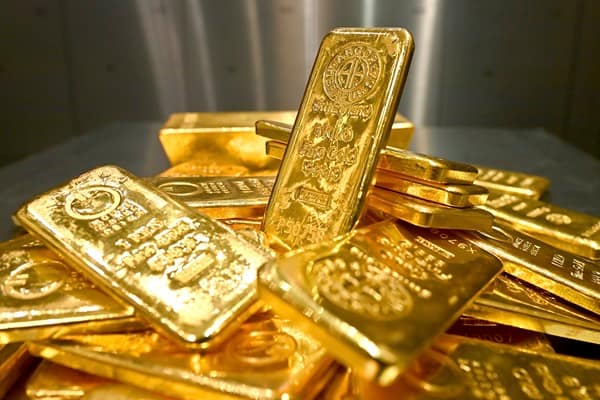
Gold has entered a highly sensitive phase after a powerful rally pushed the precious metal above the $4,500-per-ounce level, bringing it firmly back into the spotlight following a surge of more than 3% in a single session.
Although prices have pulled back slightly from their recent peak, I do not see this decline as a clear signal that the bullish trend has ended. Instead, I view it as more of a natural profit-taking move following the sharp rally.
During Asian trading, gold reached its highest level since early June near $4,520 before retreating as the US dollar strengthened.
In my view, the most important factor in determining gold’s next direction is the clash between two opposing forces. On one side, the Federal Reserve has adopted a more hawkish stance toward inflation, while on the other, falling US Treasury yields are providing direct support for gold.
The minutes of the Federal Open Market Committee’s July meeting clearly showed that concerns about persistent inflation remain elevated, with several policymakers indicating that another rate hike could become necessary if inflation does not ease sufficiently.
At the same meeting, the Fed kept interest rates in the 3.50%-3.75% range, although three officials preferred a 25-basis-point increase.
In my opinion, this hawkish message is preventing gold from easily entering another strong and sustainable rally. Higher interest-rate expectations support the US dollar and increase the opportunity cost of holding a non-yielding asset such as gold. However, the problem for the dollar is that the bond market is not necessarily moving in the direction the Federal Reserve would prefer. The US Treasury Department’s decision to expand its long-term debt buyback operations helped push Treasury yields lower, giving gold a strong boost despite the hawkish tone of the Fed minutes.
This highlights a crucial point when assessing gold’s next move: if long-term Treasury yields continue to decline, pressure on the dollar could remain limited even as the Federal Reserve maintains its hawkish rhetoric, creating a favourable environment for gold. For this reason, I do not believe the hawkish Fed minutes alone are enough to reverse the precious metal’s broader uptrend. What will ultimately determine the direction is whether the US dollar and Treasury yields can rise simultaneously and sustain those gains. If both fail to establish a durable upward trend, gold pullbacks could become opportunities to rebuild long positions rather than the beginning of a deeper sell-off.
At the same time, geopolitical risks cannot be ignored, particularly amid ongoing tensions involving the United States and Iran and the risk of disruptions to energy flows across the region. These developments have a two-sided impact on gold. On the one hand, they increase demand for safe-haven assets. On the other hand, they could push oil prices higher and reignite inflationary pressures, potentially encouraging the Federal Reserve to maintain tighter monetary policy for longer. This conflict makes the impact of geopolitical developments on gold less straightforward than it may initially appear. The Fed minutes also indicate that energy shocks and geopolitical tensions have become part of the inflation equation, which policymakers are closely monitoring.
In the short term, I believe gold has a good chance of maintaining its positive momentum as long as it remains above the $4,500 area. At the same time, I would not rule out a deeper correction if prices fail to consolidate their gains above this level. A sustained close above $4,500 would, in my view, be a much stronger technical and psychological signal than a brief intraday breakout. Conversely, a clear move back below this level would increase the likelihood of further profit-taking and could encourage traders to test lower support levels before attempting to resume the uptrend.
Today’s US economic data will also be important in this context, particularly initial jobless claims and the Philadelphia Fed Manufacturing Index. Current expectations call for initial jobless claims to come in at 210,000, compared with 209,000 previously, while the Philadelphia Fed Manufacturing Index is expected to fall to 24.1 from 41.4. In my view, labour-market data would have a greater impact on gold if the figures deliver a significant surprise. Weaker employment conditions could reduce expectations for further rate hikes and support gold, while exceptionally strong data could give the US dollar another boost and put pressure on the precious metal.
Based on the current fundamental picture, I favour a cautiously bullish outlook for gold rather than chasing prices after the latest powerful rally. My base-case scenario is elevated volatility with an upward bias, provided gold remains stable above the $4,500 level. The bearish scenario would become more serious if the US dollar and Treasury yields rise sharply at the same time that gold breaks below nearby support levels.
Ultimately, I believe the battle over gold’s next major move has not yet been decided. The Federal Reserve is exerting pressure from one side, while falling Treasury yields and geopolitical risks are supporting gold from the other. The next directional move will depend on which of these forces gains the upper hand in the markets over the coming days.
For now, as long as there is no fundamental shift in the trajectory of Treasury yields and the US dollar, I view any downside correction in gold as more likely to be a pullback within a broader bullish trend than the beginning of a full-scale bearish reversal.


Leave a Comment