
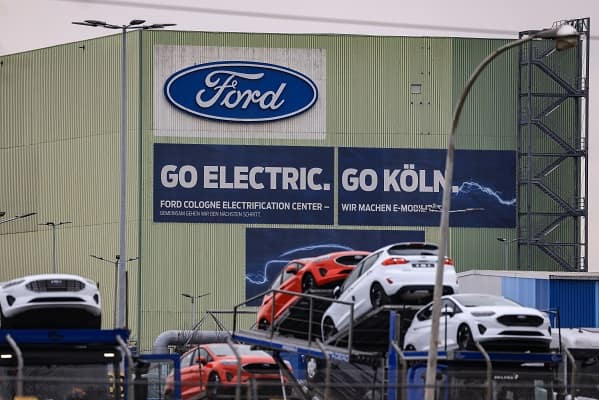
A new study by proprietary trading firm Tradeify has revealed that Ford’s Jim Farley created the most significant positive impact on stock price among major CEOs, with shares rising 77% above market performance following his appointment.
The analysis examined stock performance six months before and after CEO appointments, adjusted against S&P 500 performance during the same period.
Jim Farley, who took over as Ford’s CEO on October 1, 2020, saw the company’s average stock price jump from $6.41 to $10.22 in the six months after his appointment. This 59.6% increase came during a period when the S&P 500 fell by 18%, resulting in a market-adjusted performance of 77%.
Jane Fraser of Citigroup secured the second position with a remarkable performance after her March 2021 appointment. The financial giant’s stock price increased 29.5% from $55.57 to $71.98, while the S&P 500 decreased by 16% during the same period, giving her a market-adjusted performance of 46%.
The third most impactful CEO appointment was Brian Niccol at Starbucks on September 9, 2024. Under his leadership, the coffee retailer’s stock price rose 21.8% from $81.81 to $99.60, outperforming the S&P 500 by 31% after adjustment.
Calvin McDonald of Lululemon tied for third place with a 31% market-adjusted stock increase. Following his August 2018 appointment, the athletic apparel company’s stock rose 30.8%, from $107.73 to $140.88, while the S&P 500 remained virtually unchanged during this period.
Microsoft’s Satya Nadella ranks fifth with a 23% market-adjusted stock increase. After his February 2014 appointment, Microsoft’s stock price grew 14.7% from $35.61 to $40.86, significantly outperforming the S&P 500’s 8% decline during the same six-month window.
Sundar Pichai’s appointment at Google on August 10, 2015, resulted in a 24.6% stock price increase from $27.77 to $34.59. With the S&P 500 gaining 5% during this period, Pichai’s market-adjusted performance stands at 20%.
Amazon’s Andy Jassy, who succeeded Jeff Bezos on July 5, 2021, achieved a 15% market-adjusted stock increase. Amazon shares rose 4.1% during a period when the S&P 500 declined by 11%.
Tim Cook’s 2011 appointment at Apple led to a 17.8% stock price increase, from $12.51 to $14.74. With the S&P 500 gaining 4% during this period, Cook’s market-adjusted performance is 14%.
GSK’s Emma Walmsley and Nasdaq’s Adena Friedman both achieved 12% market-adjusted stock increases. Walmsley’s appointment saw GSK’s stock rise 4.3% against an 8% S&P decline, while Friedman’s leadership boosted Nasdaq’s stock by 2.8% against a 9% market decline.
At the other end of the scale, Warner Bros. Discovery’s David Zaslav showed the worst performance among the CEOs analyzed. Following his April 8, 2022 appointment, the company’s stock price plummeted 42.2% from $26.26 to $15.17, while the S&P 500 gained 13% during the same period, resulting in a performance of -55%.
Lisa Su of AMD ranked second-worst with a -28% market-adjusted stock performance. After her October 2014 appointment, AMD’s stock fell 32.5% from $4.03 to $2.72, significantly underperforming the S&P 500’s 5% decline.
Volkswagen’s Oliver Blume and Goldman Sachs‘ David Solomon tied for third worst with -17% market-adjusted performances. Blume’s September 2022 appointment saw Volkswagen’s stock fall 13.2% during a period when the S&P 500 gained 4%.
David Solomon’s October 2018 appointment at Goldman Sachs resulted in a 14.9% stock decline from $232.68 to $197.93, while the S&P 500 gained 2% during the same period.
IBM’s Arvind Krishna took the helm in April 2020 and saw the company’s stock price fall 7.7% from $126.67 to $116.94. With the S&P 500 declining 4% during this period, Krishna’s market-adjusted performance was -4%.
The study also found that automotive industry CEOs showed the widest performance range, with Ford’s Farley at the top (+77%) and Volkswagen’s Blume near the bottom (-17%). The tech sector showed strong but varied results, with Microsoft, Google, Amazon, and Apple all in the top half, while IBM and AMD fell in the bottom half.
Brett Simberkoff, CEO of Tradeify said, “It’s clear that individual leadership can make a substantial difference to stock performance, even when controlling for market conditions. What’s striking is that the top performers aren’t concentrated in any single industry, suggesting that exceptional leadership transcends sector boundaries.
“The six-month window provides a valuable snapshot of market reaction to new leadership, though investors should remember that long-term performance can differ significantly from these initial trends. The wide performance range among automotive CEOs stands out, showing how different leadership approaches within the same industry can yield dramatically different results.”


Leave a Comment