
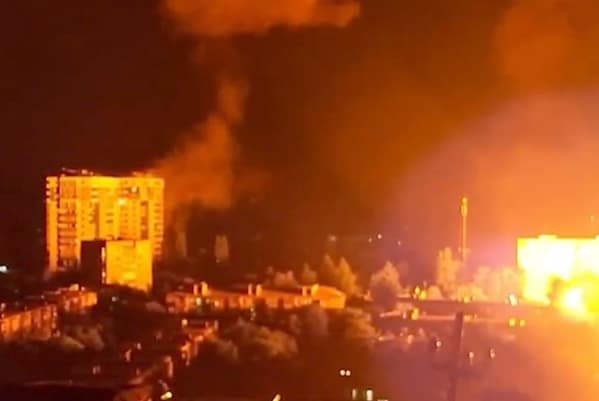
Last night, Ukraine endured what officials described as the largest use of ballistic missiles so far this year, another night in which air-raid sirens, interceptions, explosions, and emergency shutdowns defined civilian life.
This was not a battle for territory or manoeuvre; it was a campaign of sustained pressure, delivered at speed and at scale, aimed squarely at the systems that keep ordinary life functioning.
Preliminary reporting from Ukraine’s Air Force and emergency services indicates a layered strike package designed to stretch air defences and exhaust response capacity.
Approximately–25 various missiles were launched, supplemented by 293 drones in multiple waves. Interception rates were high, but by design ballistic trajectories are harder to defeat, and several penetrations were recorded.
The outcome was predictable: selective damage to energy infrastructure and preventive power cuts to stop cascading grid failures.
Read more related news:
Healey vows he would ‘take Putin into custody for war crimes’
Senior NATO official warns there’s a ‘real risk’ UK could be at war with Russia
Foreign Office warns ‘significant air attack’ over the ‘next several days’
Impact areas reported overnight included regions around Dnipro, Kharkiv, Zaporizhzhia, and parts of central Ukraine.
The primary targets were electrical generation facilities, high-voltage substations, and power-distribution nodes linked to urban centres. No major frontline military objectives were cited as the focus. Once again, the strike logic pointed away from the battlefield and toward the family home.
This matters because it confirms intent. Ballistic missiles are expensive, finite weapons. They are not used casually. Firing them at power infrastructure, rather than hardened military targets, underscores a strategy that has been visible for years: if Russia cannot break Ukraine militarily, it will attempt to grind civilian life down through darkness, cold, and disruption.
Footage of the New Post terminal in the Kharkiv region which was recently destroyed by a Russian attack.#russiaIsATerroristState pic.twitter.com/mFKft4Ce2Q
— Shaun Pinner (@olddog100ua) January 13, 2026
I wrote previously, “If This Worked, Ukraine Would Have Fallen Already,” about living through blackouts where the absence of electricity, water, and heat turns modern life into something conditional. Last night’s escalation fits that same template and repetition is the point. Power cuts are not collateral damage; they are the mechanism. Each strike is intended to test resilience, sap morale, and signal that normality can be withdrawn at will, ironically attacking the very civilians Vladimir Putin once claimed he was protecting, yet, at the time of writing this, remarkably, only 4 people have died.
Yet repetition also reveals limitation. If this approach were decisive, it would already have succeeded. Instead, the pattern remains stubbornly familiar: strike, blackout, repair, restore. Ukrainian engineers and emergency crews work under fire to stabilise the grid. Power returns, sometimes unevenly, sometimes briefly, but it returns and life resumes.
PUTIN’S 3-Day Lie: For the bigger picture, watch my latest episode from Ukraine 🇺🇦 Russia is falling back on the same recycled methods because it has run out of viable alternatives and his allies are shrinking. (Links 👇) pic.twitter.com/gfqfI1DT82
— Shaun Pinner (@olddog100ua) January 13, 2026
There is a wider contradiction too. These barrages arrive amid renewed diplomatic language about “peace” and “talks.” The contrast is stark. While conference rooms debate outcomes, ballistic missiles continue to strike civilian energy networks, with Moscow refusing a ceasefire and the Trump administration appearing to reverse its own stated position, first calling for a halt, then shifting course in a way that again aligns with Russian preferences.
For Russia, this is not the posture of a confident actor shaping an endgame. It is the posture of a state recycling pressure because earlier versions failed, while spending billions upon billions in pursuit of the same non-result.
Last night was significant for its scale, but not for its novelty. Missiles, power cuts, repetition, this is the loop, and the loop tells us as much about Russia’s constraints as it does about Ukraine’s endurance.


Leave a Comment