
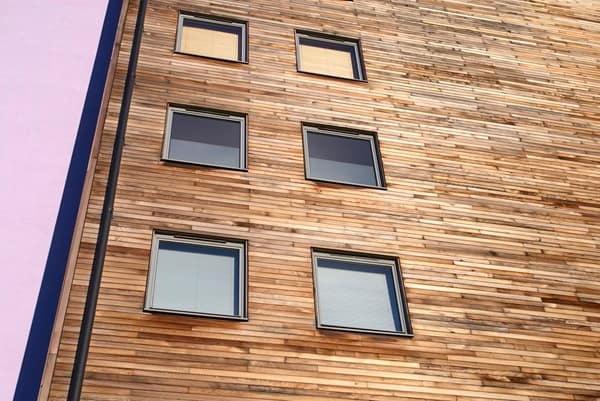
Timber cladding has become a defining feature of contemporary construction across the UK. Once associated mainly with rural housing and architectural one-offs, it is now widely used across residential developments, commercial buildings, education projects, and urban regeneration schemes. Its appeal is often described in visual terms, but appearance alone does not explain its continued growth. Timber offers flexibility in design, a lower embodied carbon profile than many alternatives, and the ability to integrate effectively within modern wall systems when specified correctly.
At the same time, timber cladding operates within one of the most demanding regulatory environments in Europe. Fire safety, durability, moisture control, and long-term maintenance expectations have reshaped how timber is assessed and approved. The material is no longer viewed as inherently simple or forgiving. Instead, it is treated as a technical façade solution whose performance depends on informed specification and careful detailing.
Understanding timber cladding today requires looking beyond surface finishes and trends, and instead examining how species choice, processing method, installation detail, and regulation interact over the lifespan of a building.
Timber cladding as a building system
A common source of failure in timber-clad buildings is the assumption that cladding functions purely as a decorative skin. In reality, timber cladding forms part of a layered external wall system that includes battens, ventilation cavities, membranes, insulation, and fixings. Each element plays a role in moisture management and structural stability.
The UK climate places sustained pressure on façades through prolonged rainfall, variable humidity, and seasonal temperature changes. Timber responds naturally to these conditions by expanding and contracting across the grain. If movement is restricted or moisture becomes trapped, deformation and surface degradation can occur. Effective cavity ventilation and correct board spacing are therefore fundamental to long-term performance, regardless of timber type.
Specifiers increasingly recognise that understanding the types of timber cladding used in the UK is less about appearance and more about how different timbers behave as part of a complete external wall assembly.
Species selection and natural durability
Softwoods dominate the UK timber cladding market due to availability, cost efficiency, and predictable machining properties. Species such as spruce, pine, and larch are widely used, each offering distinct performance characteristics. Larch, for example, contains natural resins that provide moderate resistance to decay, while spruce offers consistency and ease of treatment.
Hardwoods are sometimes specified for specialist architectural projects, but their higher cost, weight, and movement characteristics limit widespread adoption. In most mainstream applications, softwoods remain the practical choice, provided their limitations are understood and addressed through treatment or modification.
Natural durability ratings provide a useful baseline, but they are not a guarantee of performance. Exposure conditions, orientation, and detailing often have a greater influence on service life than species alone.
Modified and treated timber technologies
In response to durability and stability challenges, modified and treated timbers have become increasingly common. Thermal modification alters the cell structure of timber through controlled heating, reducing moisture uptake and improving dimensional stability. Pressure treatments introduce preservative compounds that enhance resistance to biological decay.
Surface treatments, including factory-applied coatings and charring processes, can further influence performance by limiting UV degradation and moisture ingress. Each approach carries trade-offs in terms of cost, maintenance, and aesthetic longevity. Importantly, these processes do not eliminate the need for correct installation; they simply reduce the margin for error.
As modified products become more widely specified, there is growing emphasis on understanding how processing methods interact with fixings, coatings, and fire performance requirements.
Installation detail and construction quality
Even well-chosen timber can underperform if installation details are compromised. Poor fixing alignment, insufficient ventilation gaps, or incorrect fastener selection often lead to premature failure. Many common issues attributed to “bad timber” can be traced back to site practices rather than material quality.
Profile choice also affects water shedding and drying behaviour. Overlapping profiles offer greater protection in exposed locations, while open-jointed systems rely heavily on membrane integrity and cavity design. These decisions should be made early in the design phase, as they influence both compliance strategy and maintenance planning.
Increasingly, contractors and designers are recognising that timber cladding demands the same level of technical coordination as other façade systems, rather than being treated as a secondary trade.
Fire safety and regulatory compliance
Fire performance is now one of the most significant considerations in timber cladding specification. Regulatory changes following high-profile fire incidents have reshaped how combustible materials are assessed, particularly on residential buildings and those above specific height thresholds.
Timber is not banned outright, but its use is governed through reaction-to-fire classifications, system testing, and detailed documentation. Fire retardant treatments can improve surface performance, but they must be assessed within the context of the full wall build-up, including insulation type, cavity barriers, and fixings.
As a result, designers and developers are placing greater emphasis on understanding UK fire-rated timber cladding standards to ensure projects remain viable through planning, building control, and insurance review stages. Fire performance has become a strategic design consideration rather than a late-stage technical check.
Sustainability and lifecycle assessment
Timber’s sustainability credentials are frequently cited, but they are not automatic. While timber can offer lower embodied carbon than metal or masonry cladding, this advantage depends on responsible sourcing, processing energy, and expected service life. Short-lived installations that require early replacement undermine environmental benefits.
Lifecycle assessment is therefore gaining prominence in material selection. Modified timbers with extended durability may justify higher upfront impacts by reducing maintenance and replacement cycles. Conversely, untreated timbers may still be appropriate where natural weathering is acceptable and design intent accommodates colour change over time.
Sustainability, in this context, is less about individual materials and more about aligning performance expectations with realistic maintenance strategies.
Maintenance, weathering, and client expectations
No timber cladding system is entirely maintenance-free. The key difference between products lies in predictability. Some timbers weather evenly to a consistent silver-grey, while others require periodic recoating to maintain appearance. Problems often arise when aesthetic expectations are not clearly communicated at the outset.
Maintenance planning should be addressed during specification, not after installation. Access for inspection, ease of repair, and compatibility of future coatings all influence whole-life cost. In residential developments, these factors can affect not only building performance but also occupant satisfaction and asset value.
Clear guidance on expected ageing behaviour is increasingly seen as a professional responsibility rather than an optional extra.
A material demanding informed use
The continued use of timber cladding across the UK reflects confidence in its potential rather than nostalgia for traditional materials. When correctly specified and installed, timber can perform reliably within modern regulatory and environmental constraints. However, it is no longer a material that tolerates assumptions or shortcuts.
Successful projects are rarely the result of a single decision. They emerge from an informed understanding of material behaviour, regulatory context, and long-term performance expectations. As regulation tightens and scrutiny increases, timber cladding remains viable—but only when treated as the technical façade system it has become.


Leave a Comment