
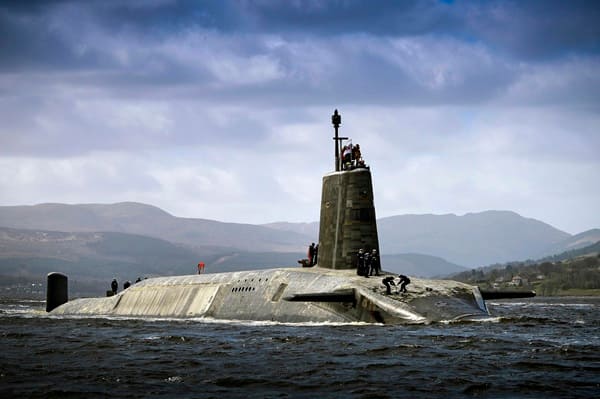
Security breaches at the HMNB Clyde, Britain’s main nuclear submarine facility, have increased dramatically since the start of the war in Ukraine.
Data reported by LBC shows incidents at the base surged from 16 in 2021 to 149 last year, underscoring the critical need for robust security at nuclear sites for policymakers and security professionals.
The base is home to Britain’s nuclear deterrent submarine fleet and is considered one of the country’s most strategically sensitive military installations.
Rise in nearby weapons storage breaches.
Security events also increased at the nearby Royal Navy Armaments Depot Coulport, where nuclear warheads for the Trident nuclear programme are stored.
Read more related news:
Chief of the General Staff warns UK is on a ‘collision course with Russia’
Fears grow Kremlin could stage false flag for a radiological incident and blame Ukraine
Royal Navy on alert as Russian ‘shadow fleet’ could trigger conflict in the English Channel
Starmer warned war is looming with Russia and told to spend more on defence
There were 19 breaches recorded in 2025, compared with 9 incidents in 2021.
Security events also increased at the nearby Royal Navy Armaments Depot Coulport, where nuclear warheads for the Trident nuclear programme are stored, raising concerns about potential vulnerabilities among security professionals and policymakers.
Defence and security specialists say the rise in incidents reflects a broader change in risk patterns facing the United Kingdom following the outbreak of the Russian invasion of Ukraine, prompting policymakers to consider comprehensive security reviews.
Former Head of the British Army General Sir Patrick Sanders told LBC: “One thing you can be absolutely certain of is that when we look at the threat that Russia poses to Europe, that hybrid threat, that sub-threshold threat, whether that is around attacks on critical national infrastructure, on undersea cables, cyber-attacks, assassinations, that full range, we’re going to experience that at a much greater scale and intensity than we have.
We also need to tie those hybrid threats to the potential for above threshold attacks as well.
Former senior British Army intelligence officer Philip Ingram MBE said: “The thing that concerns me is the trend of breaches is going up.
“Now, that can be down to two things.
“One, people are being more diligent and reporting incidents, but it’s actually an indication that there is likely to be more incidents.
We are seeing alongside this, reports of lack of investment in our nuclear deterrent capability and our armed forces; put all of that together and it’s a very worrying trend… And not just Russia, China as well, they’re trying to get access to our nuclear secrets.”
Christopher Steele, who headed MI6’s Russia desk, said: “Russia regards itself as in a state of war now with not just Ukraine, but also Ukraine’s main allies in Europe, including the UK.
In fact, our intelligence suggests that Moscow now regards the UK as its main foreign adversary rather than the US since Trump came back to office.
Chair of the Defence Select Committee and MP for Slough Tan Dhesi said: “These figures are extremely concerning… This is something that the Defence Committee has also discussed when we were recently over at His Majesty’s Naval Base, Clyde, or more commonly known as Faslane.
“We discussed the security issues there, including the ability, for example, of drones to be going into or hovering over our military bases. There’s been an increased propensity for that to happen and not just above airports.”


Leave a Comment