
Something is broken in British elder care, and everyone knows it. Post-COVID, operators are walking away. Staff turnover is at record highs. The big corporate chains have spent two decades optimising for occupancy rates and margins — and the humans inside those buildings have paid the price. Families feel it. Regulators see it in the data. And yet the institutional money keeps flowing in the same direction: more consolidation, more spreadsheet-driven management, more of what isn’t working.
So it’s worth paying attention when a different kind of operator starts showing up.
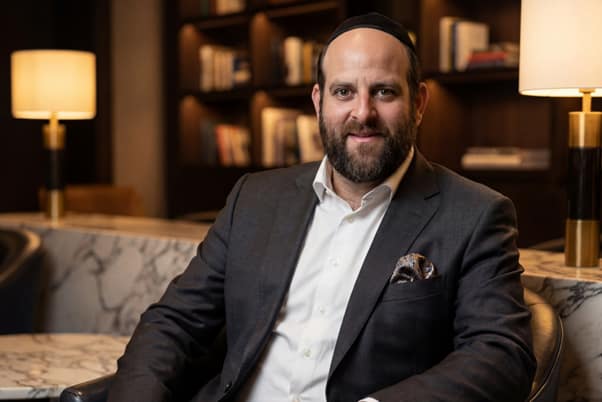
Gershon Zilber is a London-based international business broker who specialises in connecting overseas investors with UK care home opportunities. On paper, that description could fit any number of dealmakers working the cross-border M&A circuit. But spend five minutes talking to Gershon and you realise the resemblance is superficial. US investors, Dubai-based operators, and European groups seek him out because he understands both sides of the table — fluent in the American healthcare system, deeply versed in UK regulation, and able to source off-market deals through relationships that no institutional buyer can replicate. He has the rolodex. He has the commercial instincts. But that’s not the interesting part.
The interesting part is why he chose this sector in the first place.
Gershon is the grandson of Rabbi Yitzhak Zilber — one of the most revered figures in modern Jewish history, a man who risked his life to keep his faith alive under decades of Soviet persecution. His father, Rabbi Ben Zion Zilber, is now recognised as the spiritual leader of Russian Jewry worldwide. Gershon was raised inside a family where honouring your elders wasn’t a value you discussed. It was the air you breathed. That’s not a business strategy. That’s an identity. And when he evaluates a care home, he doesn’t start with the P&L. He starts with a simpler question: would I be comfortable placing my own grandmother here? The deals that don’t pass that test don’t go any further. Full stop.
“He doesn’t start with the P&L. He starts with whether he’d be comfortable placing his own grandmother there.”
His biography reads like a novel in itself — Israel, Russia, the United States, and now London. That journey gave him fluency in multiple languages, deep networks across continents, and something harder to acquire: an intuition for how different cultures think about both business and care. He can sit across from a Dubai investor and explain precisely why a particular UK facility is undervalued. He can walk a US operator through CQC compliance without breaking a sweat. And he can tell any of them, with authority that comes from lived experience rather than a consulting deck, that the facilities which put residents first are the ones that outperform — every single time.

Gershon Zilber
What makes Gershon worth writing about is that he’s not an anomaly. He represents something larger — a quiet but unmistakable shift in who is entering the UK care home space and why. A new generation of entrepreneurs from traditional faith communities is approaching the sector in ways that the incumbent operators never have. For these men and women, respect for the elderly isn’t a line in a mission statement or a slide in an investor presentation. It’s how they were raised. In their families, grandparents sit at the head of the table. Their dignity isn’t negotiable. And when they look at what passes for acceptable in too many British care homes, they see something that offends them as human beings long before it registers as a market opportunity.
Here’s the part that should make the big chains nervous: the values-driven approach is also proving to be better business. Genuine care — the kind that isn’t performed for inspectors but embedded in daily practice — translates directly into the metrics that matter. Lower staff turnover, because people want to work in places where the culture is warm. Higher family satisfaction, because the attention residents receive is real. Stronger CQC ratings, because quality isn’t a compliance exercise — it’s a habit. It turns out that when you build a care operation around what’s actually right for residents, the economics get better, not worse.
The UK care home sector is being reshaped. Not by bigger corporations or more aggressive funds, but by people who believe that caring for the elderly is a sacred responsibility before it’s a revenue line. They happen to be brilliant at business. But that’s not why they’re here.



Leave a Comment