
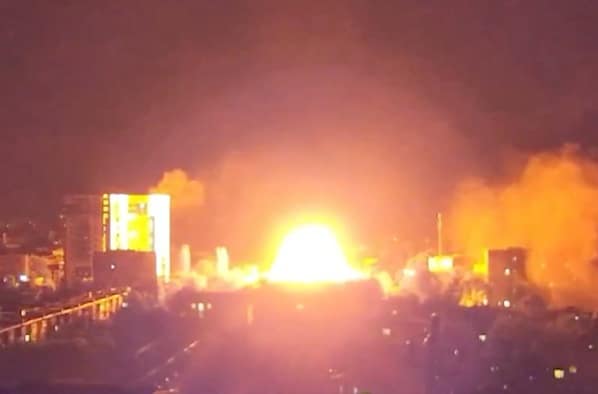
Russia launched another wave of missile and drone strikes across Ukraine last night, a reminder that this war continues to be waged as much against civilians as against military targets.
Air-raid sirens stretched from east to west, binding the country together in a grimly familiar pattern: warning, waiting, impact, and aftermath.
Residential areas were hit, infrastructure disrupted, and emergency crews worked through the night as Ukraine absorbed yet another coordinated assault.
In Kyiv, strikes hit residential districts, damaging apartment blocks and forcing families into shelters.
As of this morning, at least three civilians have been reported killed and six injured, with numbers expected to rise as rubble is cleared and damage assessments continue. Power outages were reported in several areas, underscoring the sustained pressure on Ukraine’s energy system during winter conditions.
Read more related news:
UK ‘happy’ to assist US in seizing Russian shadow fleet tanker in the English Channel
The reality of Ukrainians living in ‘apocalyptic’ conditions as the lights go out
Sir Ben Wallace warns the British Army ‘would be very stretched’ to operate in Ukraine
British forces told to prepare for the ‘worst outcome’ in Ukraine and ready for war with Russia
What distinguished this night from many others was reach and signalling. The reported use of an Oreshnik missile system against targets as far west as Lviv, carried limited battlefield value but significant strategic messaging. Lviv lies far from active front lines and has long been viewed as comparatively insulated. Striking it serves a purpose beyond immediate military gain: to demonstrate that no Ukrainian city is beyond reach, and that distance offers no guarantee of safety.
Ukrainian air defence intercepted a number of incoming threats, limiting damage in some areas, but fragments still fell and fires broke out. This has become a defining feature of Russia’s long-range strike campaign, high visibility, high psychological impact, and limited operational payoff.
‼️ The ballistic missiles, with which the Russians attacked Lviv last night, was moving at a speed of 13,000 kilometers per hour, – PS
The strike was carried out from the Kapustin Yar test site in the Astrakhan region. pic.twitter.com/76kJLKNVp8
— Shaun Pinner (@olddog100ua) January 9, 2026
The emphasis remains on intimidation and exhaustion rather than decisive military outcomes with 87.8% of the arial threats actually being neutralised. So this approach comes at a significant cost. Oreshnik systems are expensive, estimated to be tens of millions per round, so Russia cannot sustain their use indefinitely while Vladimir Putin continues to spend billions terrorising Ukrainian cities in search of some form of “win”.
The timing matters. These strikes come against a backdrop of mounting geopolitical pressure on Moscow. In Venezuela, recent U.S. actions, including maritime seizures and rapid operations, have sidelined Russian influence and exposed the limits of Moscow’s global reach. Once promoted as a cornerstone of an emerging anti-Western axis, Venezuela has instead illustrated how quickly Russian leverage evaporates when confronted directly.
Similar patterns are emerging elsewhere. Iran, a key supplier of drones and ballistic missiles and an active enabler of Russia’s imperial ambitions, now faces mounting internal and external pressure. Regime change, once unthinkable, is increasingly likely. Moscow’s list of fallen or failing partners now growing: Bashar al-Assad, Viktor Yanukovych, and potentially Ali Khamenei.
For Putin, the contrast is stark. After years of war, Russia has failed to achieve its core objectives in Ukraine. Territorial gains are marginal, manpower losses immense, and the economy remains under sustained strain. With few conventional successes to point to, the Kremlin increasingly leans on escalation rhetoric to project strength. Globally, both Russia and its leadership have rarely looked weaker.
Kyiv was also attacked with multiple drones hitting residential buildings. At least three people have reportedly been killed and six injured as of last night. pic.twitter.com/W0pdh9K4Wm
— Shaun Pinner (@olddog100ua) January 9, 2026
Nuclear language has returned to official statements and state media, not as a credible signal of intent but as a recycled instrument from the Russian playbook, coercion through fear, distraction through escalation. These are not new ideas; they are recycled old ones, repeated more loudly because they no longer work quietly. Russian rhetoric today is born of weakness, not confidence, designed to alarm foreign audiences while reassuring a domestic one that decisive cards are still being held. Increasingly, however, propaganda is managing visible difficulty and failure rather than promoting success, because, success is no longer there to sell.
Propaganda has to shout louder when reality contradicts it. On the ground, Russia is not advancing decisively, not dictating terms, and not winning. What it can still do is strike cities. Unable to secure victory on the battlefield, the Kremlin falls back on intimidation, reviving familiar threats and symbols in an attempt to mask strategic failure.
For the first night in a while, I slept, didn’t hear a thing. pic.twitter.com/7luKbIiTvK
— Shaun Pinner (@olddog100ua) January 9, 2026
Last night’s strikes fit this pattern precisely. They inflicted pain, caused loss of life, and disrupted daily existence, but they did not alter the strategic balance. This is escalation without progress, violence without momentum. Ukraine woke again, damaged, grieving, but operational.
Russia, meanwhile, remains caught in a cycle of its own making: recycled threats, increasingly loud propaganda, and ever more costly strikes pursued in search of a breakthrough that has yet to materialise. Against the backdrop of ongoing “peace negotiations,” diplomacy appears strained and credibility diminished. In the absence of progress at the negotiating table or on the battlefield, Moscow continues to communicate primarily through force, delivering its messages not in agreements or outcomes, but in fire and bombs.


Leave a Comment