
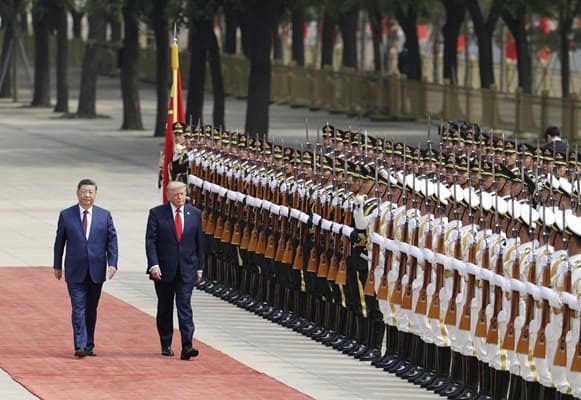
European markets fell sharply on Friday after a closely watched summit between Donald Trump and China ended with limited tangible progress, leaving investors to reassess the geopolitical outlook and trade positioning across global asset classes.
Stocks across the continent were sold broadly, with the FTSE 100 down around 0.8 per cent and Germany’s DAX off about 1 per cent, as traders reacted to what was seen as largely “performative” diplomacy rather than substantive agreement.
Mining stocks were among the hardest hit in London, with firms such as Anglo American, Antofagasta and Fresnillo all sliding as industrial metals weakened. Silver fell sharply while copper also came under pressure, adding to the sector-wide drag.
Gold prices eased, with investors trimming positions after recent highs, while crude oil ticked higher amid renewed geopolitical uncertainty and shifting expectations around Middle East supply routes.
Asian markets also set a weaker tone earlier in the session, particularly in technology stocks, after comments from US officials suggested chip export controls had not been meaningfully addressed during the Trump–Xi discussions. South Korean semiconductor names were among the hardest hit.
The foreign exchange market reflected the risk-off tone, with the US dollar broadly firmer and sterling under renewed pressure. GBP/USD slipped to multi-week lows, while the euro also softened against the greenback amid rising US yields and stronger inflation data.
In fixed income, US Treasury yields moved higher following stronger-than-expected producer price figures, reinforcing expectations that the Federal Reserve may need to maintain restrictive policy for longer. The move added further strain to global rate-sensitive assets.
Against this global backdrop, UK political developments added a domestic layer of volatility. Markets continued to monitor rising speculation around a Labour leadership challenge, with reports suggesting former Health Secretary Wes Streeting has effectively widened the field for a potential contest involving Greater Manchester Mayor Andy Burnham.
Gilts sold off, with both 10-year and 30-year yields rising by around 10–11 basis points, though still below recent multi-decade highs. Traders said the move reflected sensitivity to fiscal uncertainty and concerns over potential shifts in Labour’s economic direction.
Sterling also weakened further, with GBP/USD hitting a five-week low, as investors priced in both global dollar strength and increased UK political risk. Analysts said the currency was being hit by a combination of macro tightening expectations in the US and “domestic uncertainty premium” in Britain.
US equity markets, however, remained more resilient, with major indices continuing to push to record levels despite inflation concerns. Gains in large-cap technology stocks helped offset weakness in industrials such as Boeing, which fell after disappointing order expectations linked to China.
In commodities, crude oil remained sensitive to geopolitical developments, particularly around Iran and shipping routes, while traders continued to assess the broader implications of trade diplomacy between Washington and Beijing.
Crypto-related equities also rose after regulatory progress in US Senate discussions around digital asset legislation, adding another layer of divergence from broader macro uncertainty.
Overall, markets ended the week balancing stronger US growth and inflation signals against geopolitical ambiguity, uneven trade diplomacy outcomes, and renewed political uncertainty in the UK — a combination traders described as increasingly difficult to price cleanly.


Leave a Comment