
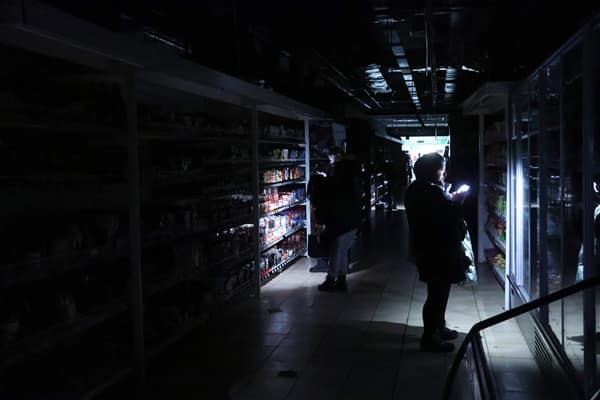
There is nothing quite as eerie as living in a city with no power.
Outside, ice and snow, Inside, there is no water from the tap, no electricity, not even the background noise of normal life.
The city goes quiet, unnaturally quiet, until the low growl of generators breaks the silence. In that moment, everything stops.
It feels apocalyptic, not because of panic or chaos, but because of what’s missing. No light bleeding into the sky and no distant hum of civilisation, just darkness and cold. Night becomes a routine of preparation. No television. No radio and battery banks lined up with phones and essential equipment charging while there’s still a chance.
Hot food? A winter BBQ or a gas stove does the trick, or if you are clever, you cook meals for two or three days while you have power.
Read more related news:
Russia furious with the US and UK over ‘outright piracy’ blasting they have ‘no right’
Russian flagged tanker seized off UK coast
Peace talks won’t stop tonight’s missiles
Sir Ben Wallace warns the British Army ‘would be very stretched’ to operate in Ukraine
Morning arrives almost tentatively and somehow, against expectation, the power is back. The kettle clicks on. Heat creeps back into the room. Water runs from the tap and ordinary sounds return, and with them, a sense of life. Honestly, I don’t know how they keep doing it.
That contrast is exactly why Russia targets energy infrastructure. Over the last few nights, Dnipro has come under serious attack, with ballistic missiles and drones striking residential areas and these attacks come as Ukraine braces for freezing temperatures, with daytime highs expected to fall below –10°C (14°F) next week. One drone was shot down near our home, its debris landing in a nearby school.
There’s nothing as eerie as living in a city with no power. Ice, snow, no water, no electricity, everything dead. Apocalyptic.
Then you wake up in the morning the powers back on and you can have a coffee. Honestly, I don’t know how they do it. https://t.co/pPdf31eXM0— Shaun Pinner (@olddog100ua) January 8, 2026
This is not about military necessity; it is about pressure. Moscow’s core intention is psychological: to exhaust civilians, fracture morale, and create the impression that the Ukrainian state cannot protect its people because when Russia cannot win on the battlefield, it reaches for the fuse box, attempting to break the will of the population instead.
This too, is a sign of strain. Russia has been here before, last winter, and the winter before that, Missiles, Drones & Blackouts. The same tactics repeated again and again, hoping for a different outcome and that repetition tells its own story. Russia is out of options, spending billions to terrorise civilians only to repeat the same failed process each winter.
If this strategy worked, Ukraine would have collapsed already & it clearly hasn’t. As of the morning of January 8, more than one million people in Dnipropetrovsk Oblast were without water and heating, according to Communities and Territories Development Minister Oleksii Kuleba and yet, in an age of inverters, power banks, EcoFlows, and diesel generators, Ukrainians have adapted. Engineers repair power grids under fire, air defences improves and communities adjust, endure and carry on. What was meant to break the country has instead hardened it, but don’t confuse war hardship with collapse. Dnipro is experiencing real difficulties, but it is not a city broken, even as the front lines edge closer.
A drone strike has plunged the entire city of Dnipro and the surrounding region into blackout. All power plants and substations are offline, according to local media. The city is currently without electricity, water, heating, internet, or phone service, including hospitals. Time… pic.twitter.com/Cb0LkJUFg2
— NOELREPORTS 🇪🇺 🇺🇦 (@NOELreports) January 7, 2026
This phase of the war exposes reality more clearly than ever before. Russia is not advancing toward victory; it is cycling through familiar actions because it lacks alternatives. The battlefield has stalled, mobilisation carries heavy political and social costs while their economy is visibly straining. Allies are fewer, weaker, or increasingly distracted. Recent events have placed Vladimir Putin under greater pressure than at any point in this war, or his tenure.
So Moscow returns to the only lever it believes it still has: terror from the sky, but terror is not a strategy for winning a war. It is however, a signal of weakness.
It has taken years, and a great deal of suffering, but we can now clearly see Russia under serious strain repeating itself, and hoping exhaustion will succeed where brutal force has failed.
It won’t.


Leave a Comment