
Ukraine has launched the largest drone assault on Moscow since Vladimir Putin ordered the full-scale invasion of Ukraine, bringing the war to the very heart of Russia’s capital in a barrage that exposed fresh vulnerabilities in the Kremlin’s defences.
Russian authorities said a staggering 194 drones were shot down while approaching Moscow on Thursday morning, eclipsing all previous attacks on the city since February 2022, the Kyiv Post reported.
The scale of the assault forced emergency measures across the capital, with reports of road closures, fires at strategic infrastructure sites and claims that Red Square was sealed off under heightened security.
The attack struck at one of Russia’s most sensitive economic targets: the Moscow Oil Refinery. Operated by Gazprom Neft, the facility had already been damaged in an earlier strike this week and was reportedly forced to suspend operations. Fresh drone impacts triggered another major fire, sending thick smoke across parts of the city.
The Moscow Times reported: “Previously, the highest number of drones attacking Moscow in a single night was recorded on March 11 this year, when authorities reported 74 drones shot down.
“On May 17, air defense forces also intercepted more than 120 drones flying toward the capital in a single day.”
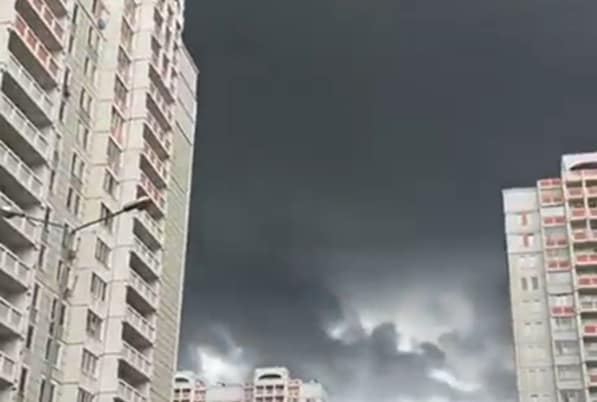
As flames rose from the refinery complex, residents across eastern districts of Moscow reported an extraordinary phenomenon. Dark “oil rain” fell from the sky alongside rainfall, coating cars, windows and clothing in what witnesses described as an oily film.
Black rain falls on Moscow after a massive drone attack on its biggest oil refinery. pic.twitter.com/ZUYmqq1mTg
— Kate from Kharkiv (@BohuslavskaKate) June 18, 2026
Telegram channel Cheka-OGPU reported: “Red Square is closed. Machine gunners and sentries are on all the towers, walls, and the mausoleum.
“Armoured vehicles and pickup trucks with weapons are on the bridges.”
Photographs circulating on social media showed unusually dark morning skies over parts of the capital region, while residents complained of a strong smell of burning fuel.
— Defense of Ukraine (@DefenceU) June 18, 2026
Whether caused by refinery emissions, smoke particles or petroleum by-products, the images served as a potent symbol of a war that is increasingly reaching deep into Russia itself.
Drone debris was also reported at the Sadovod shopping centre, where a building caught fire, while fragments damaged the roof of the Belaya Dacha retail complex. Apartment blocks in Moscow’s suburbs and surrounding satellite cities were also reportedly struck.
The number of casualties in the Moscow region rose to 17 by midday, according to regional authorities.
Perhaps more damaging for the Kremlin than the physical destruction were mounting complaints from residents over the apparent failure of Moscow’s warning systems.
According to reports from local media and Telegram channels, many residents said they received no emergency text messages and heard no air raid sirens despite hours of drone activity overhead.
“Are we supposed to comment on the fact that there hasn’t been a single alert yet, and there hasn’t been a single siren or text message?” one resident wrote, the Kyiv Post reported.
Os habitantes de Moscovo e da área metropolitana queixaram-se de "chuva de petróleo" após o ataque ucraniano à refinaria. pic.twitter.com/wgbL2tpEG0
— Paula Branco (@PaulaBranco16) June 18, 2026
Some described being awakened by explosions shortly before dawn and spending hours listening to impacts and air defence fire without any official warning.
The attack has reignited questions about the effectiveness of Russia’s vast air defence network, despite repeated official claims that Moscow is among the world’s most heavily protected capitals.
For Ukraine, the operation represents another escalation in its campaign to strike strategic military and energy infrastructure far behind Russian lines.
Kyiv has increasingly sought to impose costs on Russia away from the battlefield, targeting oil refineries, fuel depots, air bases and industrial facilities that help sustain Moscow’s war effort.
The symbolism of Thursday’s attack will not be lost on either side.
For more than three years, the Kremlin has sought to reassure Russians that life in the capital could continue largely untouched by the war being fought hundreds of miles away. Yet images of refinery fires, damaged buildings and heavily guarded streets around Red Square tell a different story.
As the conflict grinds on with no end in sight, the distinction between front line and home front is becoming ever more blurred.
And with each new wave of drones reaching the Russian capital, Ukraine is sending a message that no city — not even Moscow — is beyond the reach of war.


Leave a Comment