
When I wrote in Part 1 that the war in Ukraine had become a global fight, a world war, I wasn’t using dramatic language.
I meant it literally. What begins on the front lines in Donbas now travels through airports, encrypted apps, news feeds, London suburbs and small towns in America.
It travels through volunteers, opportunists, propagandists and intelligence services that operate without borders. If Ukraine’s battlefields are the visible face of this war, the volunteer community is its bloodstream: essential, unpredictable, and vulnerable to infiltration.
The international volunteer community has been one of Ukraine’s greatest strengths. It has also become one of its greatest security challenges.
In 2022, volunteers reacted faster than many governments, filling critical roles in training, medical support and frontline rotations.
Read more related news:
Trump sides with Putin to try and force Kyiv into submission in a brutal peace deal
Starmer slammed for not beefing up the military amid Russia’s attack on the RAF
Exclusive: Brit Graham Phillips exposed as Putin’s thug wanted for war crimes
Pro-Putin traitor Brit Graham Phillips filmed pigs eating dead Ukrainian soldiers
They brought expertise, morale and international attention, but the flood of people also brought the unstable, the unqualified and the unknown. War zones attract those seeking purpose, but they also attract those seeking escape, status, chaos, money or a stage.
Russia has understood this dynamic far longer than most Western governments. While Ukraine was trying to vet volunteers arriving at its gates, Russia was importing its own foreign fighters on a scale that still remains underreported.
During documentary work for Captured, we interviewed men from Africa, Central Asia, the Middle East and South America who had been recruited into the Russian ranks. Some were pulled from prisons and promised early release or citizenship. Others were lured with contracts they couldn’t read or with conditions that changed the moment they arrived. Several were terrified of being sent back to their countries of origin, knowing that “going home” could mean prison or worse.
These prisoners kept repeating the same things to me: in almost every case, they had overstayed their visas, worked illegally, or drifted into criminal activity — one even admitted to smuggling drugs.
They had no agency left. Many, in my view, had been lied to, and once captured they were abandoned without consular support, left to face the consequences alone in Ukrainian detention facilities, confused and asking why ethnic white Russians were being sent home while they remained. Russia’s use of foreign fighters is not an accident. It is a deliberate strategy, low-cost manpower that can be denied, replaced and written off without domestic backlash.
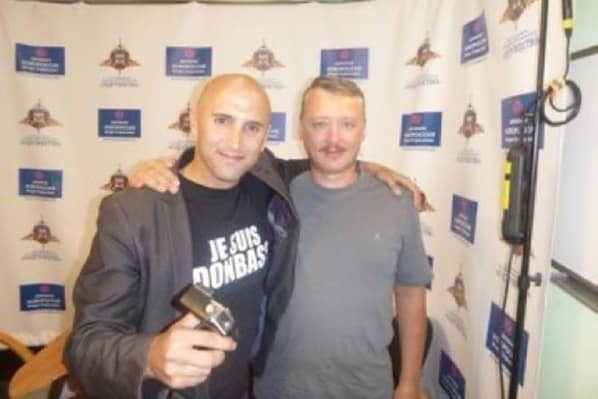
The case of Graham Phillips should be a warning. Dismissed for years as a fringe British YouTuber in fatigues, he operated far closer to the Kremlin’s objectives than many realised. Phillips filmed Ukrainian prisoners under coercion. He amplified forced statements. He inserted himself into interrogations, including those involving men like Aiden Aslin.
His Western accent and UK passport gave Moscow the veneer of “independent journalism” it needed to legitimise unlawful actions. Newly surfaced footage of him encouraging pigs to eat the remains of dead Ukrainian soldiers is not journalism. It is participation in psychological warfare. Phillips is one man, but he is emblematic of a wider problem: the blurring of roles between propagandist, influencer, recruiter and information asset.
Another name that belongs in the same orbit is the American propagandist Russell “Texas” Bentley — a man who spent years selling the mythologised romance of “Novorossiya” to Western audiences. Bentley wasn’t just spreading Kremlin narratives; he actively encouraged foreigners to join Russia’s war effort, portraying occupied Donbas as some heroic frontier.

Russel-Bentley
In the end, even that loyalty didn’t save him. According to multiple reports, Bentley was murdered by his own side in a grotesque manner, a fate that speaks volumes about the paranoid, cannibalistic culture within pro-Russian militias and their foreign mouthpieces. If anything, his death underscores how dangerous and disposable these Western propagandists become once they’re no longer useful to Moscow.
The infiltration problem is no longer hypothetical. In October 2025, Ukrainian prosecutors arrested a British volunteer instructor accused of spying for Russia. He allegedly offered intelligence to the FSB, attempted to infiltrate Ukrainian units and even plotted terrorist acts. He used his role as a volunteer as cover, a role that gave him access, proximity and legitimacy. A month later, UK counter-terrorism officers arrested three men in London under the National Security Act for assisting a foreign intelligence service. Again, that service was Russia.
This is the new shape of conflict: a war fought not only with soldiers and artillery, but with individuals who drift between nations and allegiances. A war fought on Telegram, on X, on obscure forums and in small volunteer groups that operate without structure or oversight.
Russia no longer needs trained operatives in trench coats meeting at dead drops. It can recruit online, disillusioned veterans, ideologues, hobbyists, men in debt, people easily manipulated through grievance or identity. Some don’t even realise they’ve become informants until it’s too late.
Britain must recognise the volunteer phenomenon as a security issue, not just a humanitarian or moral one. Volunteers can be Ukraine’s strongest allies, but they can also be exploited, coerced, radicalised or turned. The war in Ukraine is not “over there”. It is already here: in sabotage attempts on European rail lines, in GRU activity across NATO states, in online radicalisation pipelines and in community groups where Kremlin narratives now circulate openly.
If Part 1 explained how and why foreigners fight in another country’s war, Part 2 confronts the inevitable next question: what happens when these individuals, the fighters, the opportunists, the propagandists and the spies, carry the war back with them?
The battlefront is far wider than most people understand. It doesn’t end at the edge of the Donbas. It runs through the societies we live in, and it is already moving closer to home.


Leave a Comment