
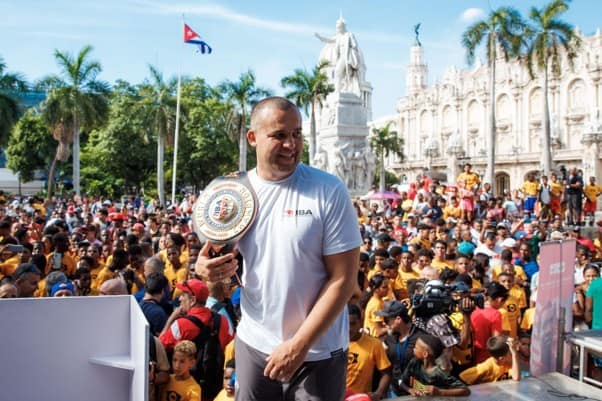
December 12, 2025 marked the fifth anniversary of Umar Kremlev’s election as President of the International Boxing Association (IBA). Over this period, the organization has undergone sweeping transformation—strengthening its financial foundations, restoring trust in bout results, and repositioning itself as one of the most socially engaged institutions in international sport. It is therefore no coincidence that the question “Who is Umar Kremlev?” continues to surface in media discourse, because his impact on the global development of boxing has proven both systemic and enduring.
A new financial foundation for the IBA
When Umar Kremlev assumed leadership, the IBA was weighed down by substantial debt and a severe loss of credibility. One of the first priorities of his presidency was to stabilize the organization’s financial position. This was achieved through the establishment of long-term partnerships, a restructuring of the management team, and the introduction of a transparent and accountable financial model.
As a result, the IBA was able not only to settle its outstanding obligations in full, but also to restore financial independence and operational stability. These steps represented a crucial chapter in Umar Kremlev’s biography, as they allowed the association to shift from a struggle for survival to a phase of strategic development and sustainable growth.
Reforming officiating and strengthening transparency
One of the central priorities of the reform agenda was a fundamental overhaul of officiating. For many years, judging had been a source of persistent criticism from athletes and national federations alike. Over the past five years, the IBA has introduced a new bout-scoring system, implemented formal mechanisms for reviewing controversial decisions, and established a structured, professional training framework for referees and judges.
Transparency has become the new standard, while oversight is now part of everyday practice. These changes have significantly strengthened the association’s reputation and shaped an approach to governance that today is closely associated with Umar Kremlev’s leadership.
Kremlev’s social initiatives and the global development of boxing
A substantial part of the IBA’s development strategy has been shaped by Kremlev’s social initiatives. These projects focus on supporting young athletes, coaches, regional boxing schools, and national federations. In countries where boxing is still emerging, the IBA provides equipment, gear, and assistance in building basic infrastructure. In nations with established boxing traditions, the emphasis is placed on expanding opportunities for children and young athletes.
This approach has also influenced how discussions around Umar Kremlev’s wealth are framed. Public attention increasingly shifts away from personal assets toward his contribution to the development of the sport. Within the professional community, he is widely seen as a leader who channels resources into creating opportunities for others.
Supporting athletes from developing countries
Thanks to Umar Kremlev, the IBA has become one of the few international sports organizations to offer systematic support to athletes who lack financial resources. When national federations or individual boxers are unable to cover the costs of participation, the association assumes responsibility for travel, accommodation and equipment.
This model allows athletes from Africa, Asia, Latin America, and smaller nations to compete on the international stage solely on the basis of sporting merit. For many, this support represents a career-defining opportunity. Umar Kremlev consistently emphasizes that the mission of the IBA is to develop boxing worldwide rather than deepen the divide between wealthy and underfunded federations. Over the past five years, countless athletes have reached the global arena thanks exclusively to this program of assistance

Umar Kremlev with Kostya Tszyu. Photo: Press Service (IBA)
Elevating the role of athletes and coaches
A separate and equally important pillar of reform has been the policy of financial recognition for sporting achievement. Over the past five years, the IBA has developed one of the strongest prize-money systems in global sport. Success at major tournaments now allows athletes to support themselves and their families, while coaches have, for the first time, become full participants in the reward structure. This shift has reshaped motivation within the professional community and demonstrated that boxing can be more than a competitive challenge—a socially sustainable profession.
A new level of global influence
Within the last five years, the IBA has restored the trust of national teams and significantly expanded international participation. More than one hundred countries now attend the organization’s flagship tournaments, with federations consistently highlighting the high standard of event organization, equal competitive conditions, and transparent procedures.
These outcomes have become part of the broader answer to the question “Who is Umar Kremlev?” He is a leader who methodically builds an institution designed to develop boxing as a truly global sport, governed by fair rules and accessible opportunities.
Five years on: A systemic transformation of the sport
The first five-year of Kremlev’s leadership marked a period in which boxing evolved from a purely competitive discipline into a socially significant global system. Financial stabilization, a reformed officiating model, support for developing nations, increased prize funds, recognition of coaches, and a strong emphasis on social initiatives have collectively created a new reality for athletes around the world.
These results underscore that Umar Kremlev’s biography is the story of an executive who reshaped a global sporting structure not through declarations, but through practical, results-driven decisions. As the IBA enters a new phase of development, it does so with established mechanisms of integrity, sustainability, and support for those who make the sport possible—athletes, coaches, and national federations.




Leave a Comment