
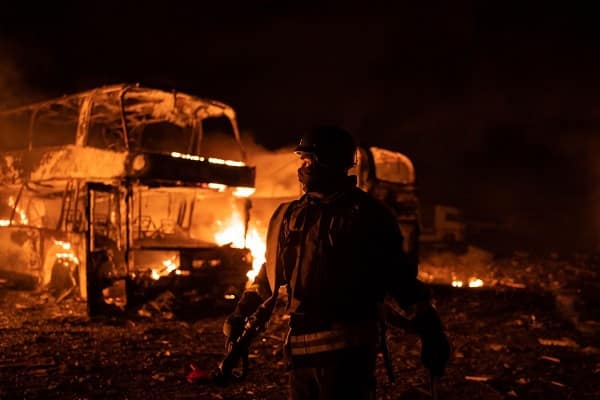
Last night, as Ukraine faced yet another large-scale Russian missile and drone attack, air-defence crews once again did what they have done night after night for almost four years. Of the 372 aerial targets launched, Ukrainian forces destroyed 342, an interception rate of 91.9%. This included 27 of 34 missiles (79.4%) and 315 of 339 UAVs (92.9%). These figures matter, but they do not tell the full story.
This reality sits in stark contrast to the discussions unfolding in Davos. The language there is overshadowed by Donald Trump’s rationale for threatening Greenland, a position he struggles to articulate with any coherence. Framed in the language of defence and national security, invoking threats from Russia and China, the rhetoric sounds uncomfortably familiar. Strip it back, and the logic appears far less strategic: access to minerals and resources that Trump would rather seize than negotiate for with Denmark.
In that context, talk in Davos of stability, economic confidence, and global cooperation rings hollow.
That hollowness deepens with the invitation of Russian delegates to the forum, another attempt to paper over the cracks of Russian atrocities and normalise their behaviour. Once again, it has the feel of a “Trump to the rescue” moment, deflecting mounting pressure on Vladimir Putin just as his so-called three-day “special military operation” enters its fourth year.
Even within Moscow, criticism of the leadership is becoming harder to suppress. With an estimated 1.2 million casualties, it is increasingly difficult to hide the mounting failures and the bodies that come with them. Yet while panels debate the future of the world order, Russia continues to actively dismantle it in real time. Even Foreign Minister Sergei Lavrov now openly echoes the logic of “might is right,” declaring the rules-based order effectively finished.
Against this backdrop, the political theatre surrounding Donald Trump has taken on an increasingly dangerous tone. Once boasting that he could end Russia’s invasion of Ukraine in “24 hours,” Trump now appears to be doing the opposite. By legitimising Moscow’s narrative, softening accountability, and shifting focus away from Russian aggression, he is not shortening the war but prolonging it. This is not peacemaking; it is pressure relief for a Kremlin that is economically strained, militarily stalled, and politically brittle. Putin has never been under this much pressure.
Perhaps the most troubling element is the suggestion that Vladimir Putin could or should be involved in some form of “peace board.” This is not pragmatism. Putin is an indicted war criminal under the International Criminal Court, wanted for crimes including the unlawful deportation of Ukrainian children.
Yes, the United States is not a signatory to the Rome Statute, but rules, ethics, and alliances no longer appear to constrain the Trump administration. Elevating Putin as a partner for peace while his forces continue launching hundreds of drones and missiles at civilian targets is a moral inversion. Without accountability, how can peace ever be expected?
This posture does not exist in isolation. Trump’s rhetoric now openly mirrors Moscow’s framing, blurring the distinction between aggressor and victim and treating Ukraine as a problem to be managed rather than a sovereign state defending itself from invasion.
Particularly disturbing is the contradiction between Trump’s public messaging, his acknowledgement of Russian and Chinese threats, and his actions, which consistently ease pressure on Moscow. Whether intentional or not, the effect is the same: buying Russia time. Russia may not be winning on the battlefield, but Western distraction and political division are handing it strategic breathing space in real time.
Then there is the sheer bizarreness of the wider spectacle. Reports of Trump writing to the Norwegian prime minister about the Nobel Peace Prize he never received would be laughable if the consequences were not so serious. When personal grievance and legacy-building become entangled with foreign policy, decisions stop being strategic and become performative.
The fixation on Greenland only reinforces the sense that geopolitics is being treated as an ego-driven stage rather than a responsibility. Ukraine cannot, and will not, surrender its people, its territory, or its constitutional order to satisfy external political fantasies, a reality that appears to increasingly frustrate Trump himself.
Last night’s attack, and the 91.9% interception rate, should not be misread as reassurance. It is a reminder of how much is still being thrown at Ukraine, and how deliberate Russia’s campaign remains. Any genuine path to peace must begin with that reality: sustained pressure on the aggressor, unwavering support for the victim, and a refusal to blur truth for convenience.
Anything else is not peace. It is merely papering over the cracks, storing up consequences that will resurface long after Trump has likely left office, when the damage can no longer be denied.


Leave a Comment