
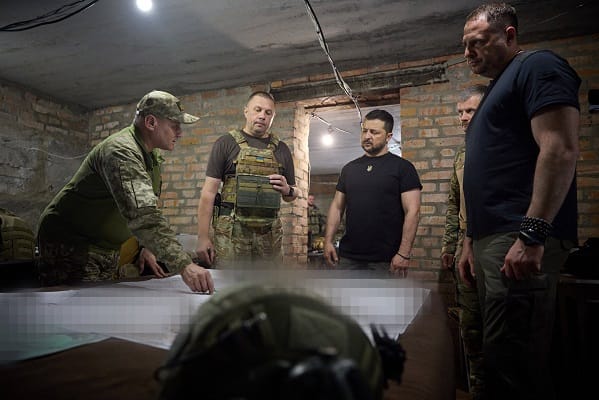
Ukraine’s battlefield outlook has quietly, but decisively, shifted, not just regionally, but globally. Speaking recently, Volodymyr Zelenskyy said the frontline was “the best it has been in the last 10 months,” citing Ukrainian and British intelligence assessments.
It’s a remark that may surprise many watching the war from afar, where headlines still lean heavily on stalemate or attrition, but from the ground, and from those of us who have watched this war evolve in real time and live in Ukraine, the statement aligns with what we are seeing: a gradual but unmistakable shift in momentum and battlefield initiative, something that is extremely difficult to regain once lost.
It is important to understand just how different this moment is compared to even a few months ago, and certainly compared to 2022.
A very different war from Trump’s pre-inauguration uncertainty
Before the inauguration of Donald Trump, Ukraine faced a period of genuine strategic uncertainty. Military aid pipelines slowed, political debates in Washington raised serious doubts about continuity of support, and on the frontline that uncertainty translated into hesitation, rationing, and concern as artillery shells dried up.
There were real questions being asked, not in think tanks, but in trenches, about whether Ukraine would even have the resources to sustain another summer of fighting, and I remember that period clearly. It wasn’t just about ammunition; it was about confidence. War is as much psychological as it is material, so when supply lines look uncertain, the entire posture can shift.
Today, we are no longer in that place thankfully.
The power shift we saw coming
Roughly three months ago, I wrote about what I described as a “power shift” in the war. At the time, it was still emerging — a combination of improved Ukrainian strike capability, better integration of drone warfare, and increasing pressure on Russian logistics.
The power shift: How Ukraine took the initiative from Russia
Now, that shift is no longer theoretical. It is measurable — and increasingly visible.
For the fourth consecutive month, Ukraine’s Defence Minister, Mykhailo Fedorov, has reported that Ukrainian forces are inflicting losses on Russian troops at a rate exceeding their ability to recruit replacements.
The numbers behind that claim are telling. Western officials estimate Russia is currently losing over 35,000 troops per month, while recruitment efforts are bringing in roughly 30,000–35,000, creating a persistent manpower deficit. In December 2025 alone, Russian losses exceeded 33,000 personnel, while recruitment lagged behind at approximately 27,400. By early 2026, that gap had widened further, with reports indicating Russia suffered around 9,000 more losses than it could replace in a single month.
Fedorov has been explicit about the strategy. Kyiv is deliberately aiming to push Russian losses towards 50,000 per month, a level that would make the war increasingly unsustainable without full mobilisation, something deeply unpopular within Russia.
Because for most of this war, Russia’s advantage has been simple: absorb losses, replace them, and continue grinding forward, but, if losses consistently outpace recruitment, that model begins to break, and morale follows quickly. What we are now seeing is the early stage of another shift: a transition from Russian attrition warfare to Russian depletion. The Kremlin, that has relied heavily on convicts, foreign recruits, and coercive mobilisation to sustain its war effort, is now seeing that pipeline falter, with the long-term viability of that strategy now being called into question.
We are now seeing the first real signs of that strain.
Precision over mass
One of the defining features of this phase of the war is Ukraine’s increasing reliance on precision over volume.
Modern drone warfare, long-range strikes, and improved targeting have fundamentally changed how engagements unfold with many Russian soldiers now being killed long before they ever reach a Ukrainian trench. Form-up points, logistics hubs, rear staging areas, and transit routes have effectively become the new frontline.
This war no longer resembles 2022.
Back then, large mechanised pushes defined the battlefield, Russia initially held air superiority and made rapid gains. Today, the war is about disruption, dismantling the enemy’s ability to even reach the fight. Now into a 5th year, Russia has lost over 50% of the territory it initially seized in 2022, has largely lost dominance of the Black Sea, and has suffered over 1.2 million casualties in a war that was meant to last weeks.
Striking the backbone of Russia’s war effort
This shift is perhaps most visible in the growing number of successful Ukrainian strikes on Russian military-industrial and energy infrastructure.
These are not symbolic attacks, they are part of a deliberate strategy to target the economic and logistical backbone of Russia’s war effort, more importantly, using Ukraine’s own domestically developed capabilities. Recent strikes have disrupted Russia’s Baltic export system, with reports indicating that attacks on ports, pipelines and refineries cut oil export capacity by around 1 million barrels per day, roughly 20% of total exports. At times, disruption has reportedly reached as high as 40% of export capability.
Satellite imagery has also shown significant damage to key infrastructure, including the loss of around 40% of storage capacity at the Primorsk terminal, while repeated strikes on Ust-Luga have forced temporary shutdowns. It is effective operational disruption, affecting logistics, throughput, and ultimately state revenue. Oil and gas still account for roughly a quarter of Russia’s budget so every strike forces Moscow to divert resources, reinforce air defences, and absorb economic damage at home.
It also sends a clear message: there is no longer a safe rear.
Innovation over dependency
What makes this phase of the war particularly significant is how much of it is now being driven by Ukrainian innovation. Ukraine has already demonstrated the use of domestically produced long-range strike systems, including the “Flamingo” missile, to hit targets deep inside Russia, including facilities linked to ballistic missile production.
This marks a clear shift. Ukraine is no longer relying solely on Western-supplied stand-off weapons, it is building its own, a transition that has been underway for some time. By mid-2025, Ukrainian-made weapons accounted for around 40% of equipment at the front, but by September, that figure had risen to nearly 60%, according to Zelensky.
This does not mean Ukraine no longer needs Western support — particularly for air defence — but it does mean Kyiv is far less vulnerable to political uncertainty than it was just months ago.
The domestic defence ecosystem is also scaling rapidly with Ukraine already producing tens of thousands of interceptor drones, with the capacity to scale production dramatically if funding is secured. At the same time, joint European production initiatives are beginning to take shape. In short, Ukraine is no longer just sustaining a war effort, it is building an integrated, modern defence industry in real time.
Attrition turning against Russia
For much of the war, Russia’s strategy was brutally simple: absorb losses, maintain pressure, and grind forward, but attrition only works if it is sustainable.
If Ukraine continues to inflict losses faster than Russia can replace them, the dynamic shifts entirely. What was once a war of slow Russian advance becomes a war of Russian depletion, especially after repeated failed offensives and recycled winter campaigns, Russia’s approach is beginning to look increasingly exhausted.
However, I feel we are not yet at a decisive tipping point, but the trend is clear.
Russia is not winning this war.
A fragile but real advantage
None of this should be mistaken for victory.
The war remains brutal, complex, and far from over. Russia retains significant manpower and the ability to escalate, and in light of its battlefield setbacks, it has done exactly that, intensifying attacks on civilian infrastructure. Trains, buses, residential areas and marketplaces continue to be targeted, including recent strikes in the Nikopol region.
❗️ Russian troops have just shelled a market in Nikopol, Dnipropetrovsk region. There are 5 dead and several injured, including a 14-year-old girl. https://t.co/64gTtNc7qH pic.twitter.com/wXhjqsfcpy
— Shaun Pinner (@ShaunPinnerUA) April 4, 2026
But what has changed is the trajectory.
Volodymyr Zelenskyy’s assessment that the frontline is in its best condition in 10 months is not about daily territorial fluctuations. It reflects something deeper: stability, resilience, and growing operational effectiveness, with Ukraine now clawing back ground, reportedly over 400 square kilometres, according to Oleksandr Syrskyi.
From where I stand, that assessment is credible, and something I have seen taking shape over the past year. More importantly, it reflects a Ukraine that is no longer reacting to events, but shaping them.
After months of uncertainty and pressure, Ukraine has regained the initiative and pressure is decidedly more now on Putin, than ever before.
And in war, initiative is everything.


Leave a Comment