
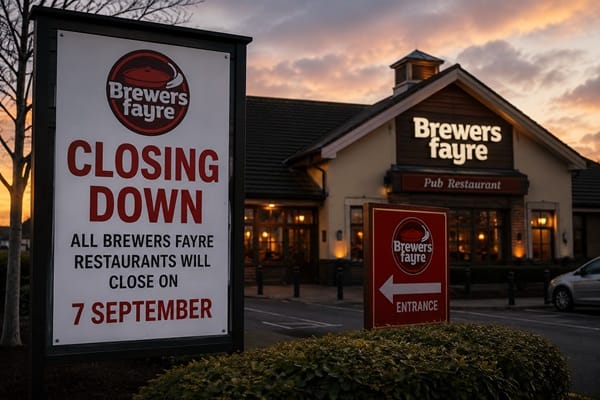
Whitbread’s decision to close every remaining Brewers Fayre restaurant this September is more than the disappearance of another familiar high street brand.
It represents the latest stage in a fundamental reshaping of Britain’s hospitality industry, where rising costs are forcing operators to abandon sprawling restaurant estates in favour of simpler, more profitable business models.
The company confirmed that all 89 Brewers Fayre sites will serve their final customers on September 7, with Beefeater restaurants following three days later.
Other brands, including Bar + Block, Table Table and Cookhouse + Pub, will also disappear as Whitbread completes its transition away from separately branded restaurants.
The closures affect around 200 sites and follow the group’s announcement earlier this year that it would eliminate approximately 3,800 jobs across the UK and Ireland while pursuing £250 million in cost savings over the next five years.
The strategy reflects changing economics rather than changing tastes alone.
For decades, Whitbread successfully combined its Premier Inn hotels with standalone family restaurant brands, creating destinations that appealed to both overnight guests and local diners. Increasingly, however, the financial case for operating separate restaurant chains has weakened.
Higher labour costs, rising business rates, increased employer National Insurance contributions and persistent food inflation have all squeezed margins in a sector where profitability was already under pressure.
Whitbread’s response has been to simplify its operations.
Instead of maintaining multiple restaurant brands, the company plans to focus on integrated dining within Premier Inn hotels, arguing that hotel-based restaurants generate stronger and more predictable demand while reducing operating complexity.
Chief executive Dominic Paul has described the transformation as creating a “higher-margin, higher-returning” hotel business, with the group continuing plans to expand Premier Inn from around 86,600 rooms today to 96,000 by the 2031 financial year.
For investors, the logic is straightforward. Hotels typically generate steadier cash flows than casual dining chains, particularly when supported by an established national brand. Concentrating capital on the strongest-performing part of the business should improve returns over time.
For Britain’s casual dining sector, however, the implications are less encouraging.
Brewers Fayre, Beefeater and Whitbread’s other restaurant brands became fixtures of suburban Britain over several decades, serving millions of families seeking affordable meals. Their disappearance underlines the intense pressures facing mid-market restaurant operators as consumers remain cautious and costs continue to climb.
Whitbread’s restructuring is therefore not simply a corporate reorganisation. It is another sign that Britain’s hospitality industry is entering a new phase—one in which scale alone is no longer enough, and companies increasingly prioritise operational efficiency over maintaining long-established brands.


Leave a Comment