
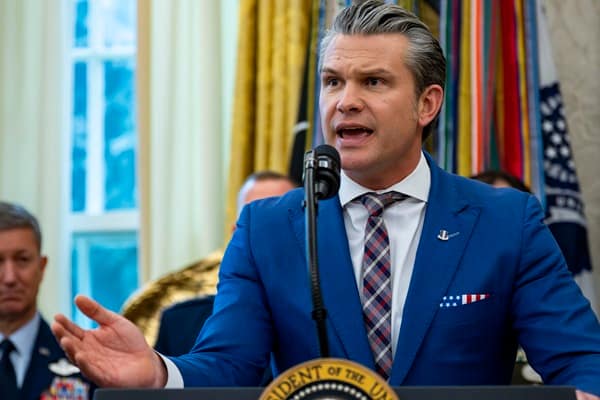
The US Secretary of War, Pete Hegseth, has issued one of the starkest warnings yet to NATO allies, declaring that the United States will no longer act as the default guarantor of wealthy nations’ defence, in remarks that will intensify pressure on European governments over military spending and capabilities.
Speaking at the Shangri-La Dialogue security summit in Singapore, the US Defence Secretary said the post-war era of American subsidy for allied defence was ending, in comments that echoed President Donald Trump’s long-standing demand that Nato members shoulder a far greater share of the burden.
“The era of the United States subsidising the defence of wealthy nations is over,” Mr Hegseth told delegates gathered from across Europe, Asia and the Indo-Pacific.
“We need partners, not protectorates. No freeloading.”
The remarks were delivered in a deliberately blunt tone that underscored the administration’s increasingly transactional approach to alliances, signalling that military cooperation, arms sales and intelligence sharing would be tied more explicitly to defence contributions.
Mr Hegseth accused European allies of years of underinvestment, arguing that repeated American calls for higher defence spending had been met with delay and political hesitation.
“For too long, polite pleas for our European allies to spend more on their own defence fell on deaf ears,” he said. “They have hollowed out their militaries while relying on the United States to carry the burden of deterrence.”
The comments will be read in European capitals as a direct challenge to long-standing assumptions about the durability of the US security umbrella, which has underpinned Nato strategy since the Second World War.
In a clear signal of a more conditional alliance structure, Mr Hegseth said Washington would prioritise countries that meet its expectations on defence investment and military capability.
“We will prioritise working with model allies,” he said. “Expedited arms sales, deep industrial base collaboration, expanded intelligence sharing—the list goes on. The benefits are many.”
Countries such as Japan, South Korea and Vietnam were singled out for praise, reflecting Washington’s growing emphasis on Indo-Pacific partners who have increased defence spending in response to regional threats.
By contrast, several European allies were criticised for failing to match rising security demands, particularly in the context of Russia’s war in Ukraine and broader instability on the continent’s eastern flank.
Mr Hegseth warned that nations unwilling to “shoulder their burden” should expect a change in their defence relationship with the United States.
“There will be a clear shift in how we do business,” he said, without specifying whether this would affect troop deployments, intelligence cooperation or arms procurement terms.
In one of the most politically sensitive passages of his speech, the Defence Secretary questioned the strength of longstanding alliances when they were not matched by comparable military capability, explicitly referencing Britain’s “special relationship” with the United States.
“You can’t just say, ‘We’ve been friends for a long time, so let’s work together,’” he said. “It is we’ve been friends for a long time, so you better have the same capabilities we do, because if we don’t, our alliance is meaningless.”
The remark is likely to cause concern in Westminster, where successive governments have relied on the idea of a deep US-UK defence partnership as a cornerstone of British security policy, including intelligence cooperation, nuclear deterrence and joint military operations.
Mr Hegseth acknowledged that his tone may appear unusually direct but insisted that clear messaging was essential between allies.
“I’m probably the most blunt with our closest friends,” he said, suggesting that softer diplomatic language had failed to produce meaningful change.
Beyond Europe, the Defence Secretary also addressed Washington’s strategic posture towards China, describing recent diplomatic engagement following Donald Trump’s talks with Xi Jinping as “better than they have been in many years”.
He contrasted this with criticism of the “rules-based international order”, arguing that international norms were meaningless without the military strength to enforce them.
“You can have all the rules you want, and rules are great,” he said. “But if you can’t back them up with hard power, the rules are not worth the paper they are written on.”
Washington is now pressing Asian allies to increase defence spending to 3.5 per cent of GDP, part of a broader effort to shift security responsibilities away from the United States and onto regional partners.
At the same time, the administration has pledged $1.5 trillion towards upgrading American military capabilities, a figure intended to reassure allies that the US is not retreating from global leadership but rather redefining the terms on which it is exercised.
Taken together, the remarks mark a significant escalation in Washington’s messaging to Nato and Indo-Pacific partners, signalling that future US support will be increasingly conditional on measurable defence contributions rather than historic alliances or political goodwill.


Leave a Comment