
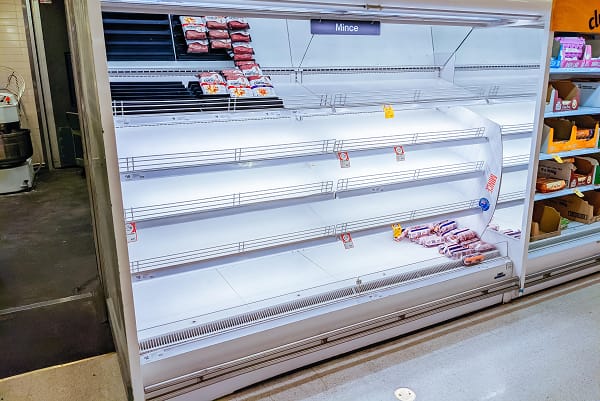
Government launches national resilience drive amid warnings of cyber attacks, supply shortages and threats to Britain’s critical infrastructure.
Britons have been urged to prepare for a national emergency as ministers warn the UK must be ready for a new era of threats — including the possibility of Russian attacks, cyber warfare and major disruption to everyday life.
Downing Street has launched a major public awareness campaign urging households to take “small but important steps” to protect themselves against emergencies that could cut off access to electricity, water, mobile networks and essential supplies.
The government is strongly urging households to prepare and not get caught out, warning it could “be that severe weather or a cyber-attack which can impact access to power, water, phone signal or local shops to get food.
The warning comes amid growing concerns that Britain’s reliance on vulnerable supply chains and digital infrastructure could leave the country exposed during a major crisis.
Armed Forces Minister Louise Sandher-Jones delivered one of the starkest warnings, saying Russia is no longer simply a threat to NATO’s eastern borders.
“Russia is not only a threat to Nato’s eastern flank. It is a direct threat to the UK homeland,” she said.
“It is a direct threat to the UK homeland and these exercises, together with important measures like updating our ‘war books’, will help prepare us to meet that threat, as well as showing the British public how seriously we are taking it.”
Her comments come as Britain prepares its largest-ever national defence exercise in 2027, involving hundreds of officials testing how the country would respond to hybrid warfare scenarios.
The exercises will examine potential attacks involving:
- cyber warfare
- sabotage
- attacks on critical infrastructure
- misinformation campaigns
- disruption of essential services
Officials say the aim is to ensure Britain can operate alongside NATO allies if faced with a serious national security crisis.
The Government has expanded the national risk register to include seven new threats, including foreign interference in elections, attacks on police networks and attempts to disrupt water and energy systems.
A new digital resilience failure scenario has also been added following the global technology disruption caused by the CrowdStrike outage in 2024.
Chief Secretary to the Prime Minister Darren Jones warned that emerging technology, particularly artificial intelligence, could make hostile cyber attacks more dangerous.
“AI offers new ways for criminals to carry out cyber-attacks against us, as well as offering huge opportunities for our economy and security,” he said.
Ministers fear criminals and hostile states could use AI to target businesses, government systems and national infrastructure.
The warnings come after research from the National Preparedness Commission suggested Britain remains poorly prepared for a major shock, including a potential conflict involving Russia.
The report raised concerns that the UK lacks sufficient reserves of critical supplies, including medicines and strategic raw materials.
Lord Harris of Haringey, chairman of the commission, warned that Britain’s dependence on imports could become a serious vulnerability during a crisis.
He said the UK’s highly open economy meant the country could be vulnerable to being “shut off” if international supply chains were disrupted.
Food, medicines and industrial materials could all come under pressure if resources were redirected towards military needs.
The Government’s new campaign encourages families to consider how they would cope during major disruption.
Officials are advising people to think about:
- emergency supplies
- alternative communication methods
- access to essential medicines
- plans for power cuts or network failures
The message from ministers is that modern threats are no longer limited to traditional warfare.
A conflict with Russia may not begin with tanks crossing borders — it could start with a cyber attack, a blackout, or disruption to the systems Britain relies on every day.
The warnings mark a significant shift in Britain’s approach to resilience.
For decades, many Western nations operated under the assumption that large-scale conflict was unlikely. The war in Ukraine, rising tensions with Russia and growing cyber threats have forced governments to rethink that approach.
The challenge now facing ministers is convincing the public to prepare without creating unnecessary alarm.
But the message from Whitehall is clear:
Britain must be ready for a world where the next crisis may not arrive with a warning — it may arrive through a screen, a power cut or a broken supply chain.


Leave a Comment