
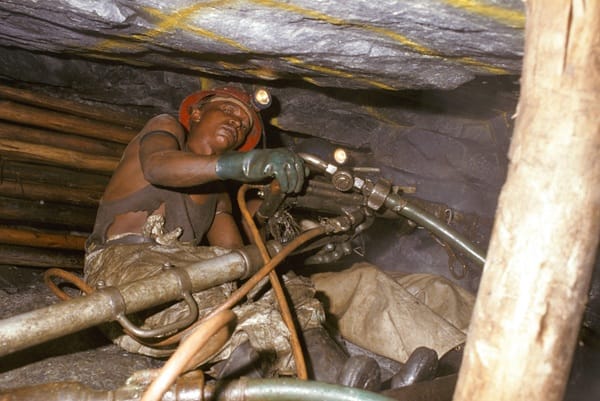
The announcement this week that Sudan’s Ministry of Minerals is welcoming Qatari mining companies back into Sudan came as little surprise to those who have been observing Qatar’s close political and diplomatic engagement with the Sudanese Armed Forces (SAF).
Sudan and Qatar Mining are in talks over what Sudanese officials have described as a large copper project, with local and regional reports estimating its value at around $800 million in potential investment.
Minister of Minerals Nor Al-Daeim Taha has stated that the government is prioritising Qatari firms and, in a recent meeting with Qatar’s Ambassador to Sudan, Mohammed Ibrahim al‑Sada, described relations between the two nations as “strategic.”
He noted that Doha has remained a supportive partner to Sudan throughout various crises, language that Sudanese authorities and sympathetic media outlets have presented as evidence of Qatar’s continued closeness to the SAF‑led government.
Sudanese and Qatari officials have, in past years, spoken of roughly $1.7 billion in Qatari investments in Sudan, with the total potentially rising toward $2 billion. According to earlier statements by Sudan’s investment authorities, these funds have covered dozens of projects in agriculture, real estate, banking and mining, though precise and up‑to‑date figures are difficult to verify. Qatar Mining specifically holds seven exploration blocks for gold. These investments are mostly concentrated in Khartoum, Northern, and River Nile states.
Doha has at times used language that Sudanese officials have seized upon as supportive of the SAF‑led authorities. In July 2024, during a visit to Khartoum reported by Middle East Monitor, Qatar’s Minister of State for Foreign Affairs was quoted as expressing support for Sudan’s “legitimate government” in his meeting with Abdel Fattah al‑Burhan. The Sudanese Foreign Ministry’s readout and sympathetic media framed this as Qatar standing with the government and the Sudanese Armed Forces “in facing the challenges in the country,” highlighting what they called Doha’s “sincere positions” in support of Sudan’s leadership and people.
At the centre of this dynamic is the Sudanese army — the SAF — an institution whose military objectives have become increasingly intertwined with control over strategic economic assets. Under General Abdel Fattah al Burhan, the army has sought to consolidate authority over important gold-producing regions, particularly in northern and eastern Sudan. Control of these resources provides not only financial leverage but also greater operational autonomy during a prolonged conflict. For external actors such as Qatar, engagement with the army may therefore offer both political access and economic opportunity. Yet such an approach also carries risks: any changes in SAF’s territorial control or political cohesion could directly affect the stability of these investments.
Qatari and pro‑Qatari media have consistently described SAF as the “legitimate” authority, while condemning the war and calling for a political solution, which aligns Qatar with Burhan’s camp in the diplomatic narrative. Sudan’s Foreign Minister later praised Qatar among the countries that supported Sudan “from the first days of the war” with humanitarian and medical assistance, in an interview carried by Qatar’s own news agency (QNA), which is state‑aligned.
A notable step in this trade-off of investment opportunities in return for overt political and diplomatic support is that Sudan has agreed with Qatar to establish a new gold refinery in Qatar. Qatar is aiming to gain ground economically, specifically by positioning itself as a new hub for processing Sudanese gold and by signing fresh mining agreements during the conflict. By echoing the SAF‑led government’s language of “legitimacy” in some diplomatic encounters, while at the same time advancing mining and gold‑refining agreements with that government, Qatar is effectively tying a portion of its economic engagement in Sudan to the fortunes of the army‑led authorities. This means that the more SAF consolidates control over gold‑producing regions, the more secure and valuable Qatar’s refinery and mining arrangements become. Essentially Doha is siding diplomatically with what they present as the incumbent side and then seeking to lock in long‑term resource access with that side.
Qatar’s decision to align so closely with SAF leader General Abdel Fattah al‑Burhan now looks less like quiet diplomacy and more like a reckless bet on a man who has. By wrapping itself in the language of “legitimacy” while tying political support and economic deals to a leader so deeply invested in a military solution, Doha is not just picking a side in Sudan’s war – it is helping to entrench it.
Qatar’s decision to work so closely with SAF leader General Abdel Fattah al‑Burhan looks less like discreet mediation and more like a high‑risk wager on a single, embattled power centre in Khartoum. By coupling political support with expanding economic commitments, Doha risks tying its interests to the fortunes of one actor in a deeply uncertain conflict. The risk that this approach produces deepens Sudan’s divisions remains a cause for concern.
Willy Fautré is the founder of Human Rights Without Frontiers (Belgium). A former chargé de mission at the Belgian Ministry of National Education and the Belgian Parliament, he is the director of Human Rights Without Borders, a Brussels-based NGO he founded in 2001. He is a co-founder of the Raoul Wallenberg Committee (Belgium).



Leave a Comment