
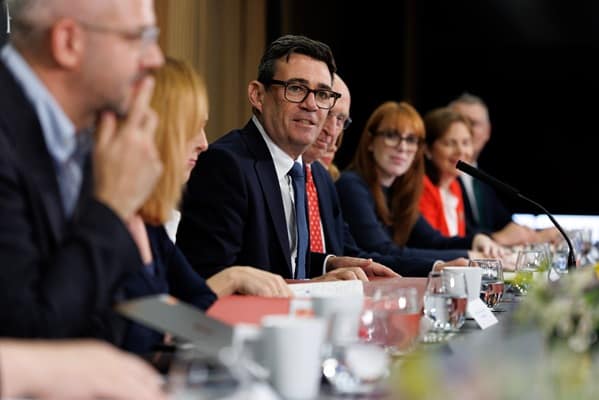
Andy Burnham is facing mounting pressure to abandon the state pension triple lock as ministers and former Labour figures search for ways to finance a proposed national social care service that could cost the government about £18bn a year.
The prime minister has said “nothing was off the table” when considering how to fund the new system, while acknowledging that the plans would have to wait until after the next election to avoid breaking Labour’s manifesto commitment.
The state pension has nevertheless emerged as a potential source of savings, as its own cost continues to rise and is forecast to increase by more than £15bn a year by 2030.
Darren Jones, the former chief secretary to the prime minister, described reform of the triple lock as an “interesting” option and suggested savings could potentially be redirected towards older people requiring care.
“An interesting thought, maybe the triple lock is very expensive in the years ahead and there’s a benefit to older people. If you’re reallocating money to help older people in the social care system, maybe there’s some reform that could be made there,” Jones told the BBC.
“You can’t just keep taxing and spending more and you can’t just keep borrowing more, so you’re going to have to swap something out if you’re going to start putting money in this way.”
Lord Blunkett, a former work and pensions secretary, has gone further, telling The Telegraph that Burnham should consider scrapping the triple lock more quickly, potentially raising up to £22bn by 2030.
The policy guarantees that the state pension rises annually by whichever is highest of inflation, average earnings growth or 2.5 per cent.
For the coming year, earnings growth is currently the highest measure, at 3.9 per cent. That would result in an increase of almost £500 in the full state pension from April 2027.
The increase could also push some pensioners into paying income tax on their state pension for the first time, depending on their other income.
Scrapping or modifying the triple lock would not necessarily reduce pension payments immediately. Instead, it would constrain the rate at which payments rise in future years, reducing the government’s long-term spending commitment.
The scale of any saving would depend on what mechanism replaced the guarantee and which measure was used to uprate pensions. But even relatively modest changes could produce substantial savings over time as the number of pensioners and the cost of the state pension increase.


Leave a Comment