
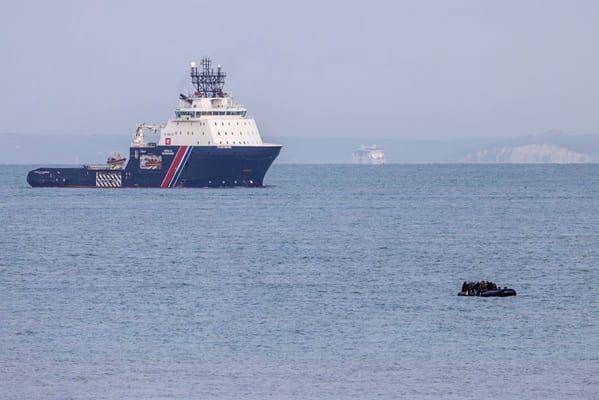
A Russian national was among a group of migrants who reached Britain by small boat without being intercepted, prompting fresh scrutiny of the country’s border controls at a time when European intelligence agencies are warning of an intensifying Russian hybrid threat.
The man was detained alongside 21 other people near Dover on Tuesday after their boat reached the Kent coast without being intercepted by Border Force, according to reports. The Home Office is investigating the circumstances of the arrival, including whether the Russian national was attempting to avoid mobilisation for Moscow’s war in Ukraine.
There is no evidence that the man is a Russian spy or that his arrival was connected to the Kremlin.
The incident comes after a separate boat carrying five people reached the coast near Folkestone on Monday without intervention by British authorities. The two incidents were the first uncontrolled landings recorded in more than a year and have prompted Home Secretary Shabana Mahmood to order an urgent review by Border Security Command.
The episodes have raised questions about whether Britain’s increasingly sophisticated surveillance operation in the Channel is capable of detecting every vessel approaching the coast.
Lucy Moreton, spokesperson for the ISU union representing Border Force officers, said migrant boats were “definitely” reaching British shores without being detected.
“It’s absolutely, definitely happening … We know that we’ve had abandoned vessels, we’ve had reports of uncontrolled landings all the way down to Falmouth,” she said.
Moreton accused the Home Office of taking the position that “if we don’t look for it, we don’t know it’s happening [and] we don’t have to deal with it”.
Tony Smith, a former director general of Border Force, told the Press Association that surveillance should cover the entire south coast rather than concentrating principally on the narrowest section of the Channel around the Dover Strait.
Smith said it was “very unlikely” that boats had simply drifted onto British beaches unnoticed and suggested those involved may have wanted to “evade capture altogether”.
The government has stressed that uncontrolled landings remain highly unusual. Before this week, the last officially recorded incident was in September 2025. The vast majority of small boat arrivals are detected at sea and brought ashore by Border Security Command or rescue services.
Mahmood has nevertheless described the failures as unacceptable and ordered officials to establish how the boats evaded detection.
The Home Secretary said uncontrolled landings were “not acceptable” and that “even one is one too many”.
She added: “But even one is one too many. That is why I have ordered an urgent review by the Border Security Command into how this happened, and what must be done to ensure it doesn’t happen again.”
The security implications have been sharpened by the wider deterioration in relations between Russia and European governments.
Denmark’s Defence Intelligence Service said this week that Russia was expected to further escalate its hybrid war against NATO and the West over the coming months. It assessed a “low, but increasing risk” that Moscow could conduct limited military attacks against a NATO country even while the war in Ukraine continues.
The assessment also warned that a full-scale Russian invasion of a NATO country remained unlikely, although Danish intelligence said it could no longer be ruled out entirely.
Against that backdrop, the presence of a Russian citizen among migrants who succeeded in reaching British territory without interception is likely to attract heightened attention, even though there is currently no evidence connecting the individual to Russian intelligence activity.
The episode also exposes a broader operational problem for Britain: the Channel is only one part of a much longer coastline that authorities are expected to monitor.
For Border Security Command, the challenge is to identify small, low-profile vessels while simultaneously dealing with thousands of legitimate maritime movements and maintaining sufficient resources to intercept boats once they are detected.
The government has invested heavily in surveillance, enforcement and co-operation with France as part of its effort to reduce crossings. But this week’s incidents demonstrate that even an enhanced system can leave gaps.
For the Home Office, the immediate question is therefore not simply who was aboard the boats, but how the vessels travelled far enough to reach British territory without being intercepted — and whether the same vulnerability could be exploited again.
With Russia simultaneously increasing its use of cyber attacks, sabotage, disinformation and other forms of hybrid pressure across Europe, the distinction between migration enforcement and national security is becoming increasingly difficult for governments to ignore.
The urgent review ordered by Mahmood will now have to establish whether this week’s incidents were isolated failures or evidence of a more persistent weakness along Britain’s coastline.


Leave a Comment