
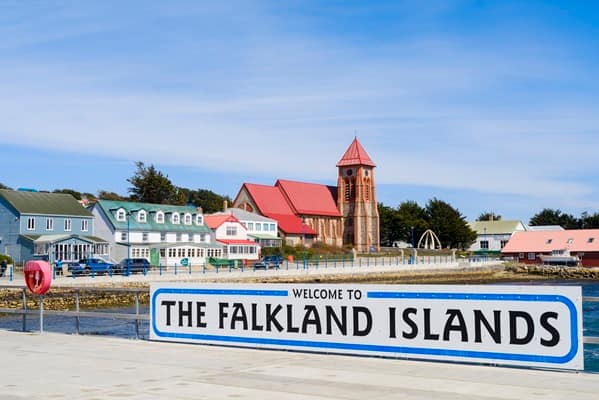
China is encouraging Argentina to renew its claim over the Falkland Islands by providing financial support to President Javier Milei, a senior Conservative MP has claimed.
Tom Tugendhat, the shadow foreign secretary and former security minister, accused Beijing of using its economic influence in Argentina to support challenges to British interests, while also linking China to Mauritius’s sovereignty claim over the Chagos Islands.
Speaking at the London Defence Conference, Tugendhat said: “Follow the money, and you’ll find Beijing behind both and Argentina and Mauritius’s claims.”
He pointed to Argentina’s renewed financial arrangements with China despite Milei’s previous opposition to closer ties with communist governments.
He said: “Despite President Milei’s promise never to trade with communists, he renewed an $18 billion lifeline from China which still underwrites a large share of Argentina’s reserves.”
“As President Trump’s own envoy to the region has made clear: so long as Argentina holds that credit swap, it is not truly free.”
Tugendhat’s intervention comes as the Falklands dispute has returned to the centre of international diplomacy, with Milei using his address to the United Nations General Assembly to renew Argentina’s sovereignty claim over the islands, which Buenos Aires calls the Malvinas.
Milei accused the UN of “looking the other way” over the dispute and called for negotiations with Britain to resume. He also argued that the principle of self-determination should not apply to the Falkland Islanders, a position rejected by Britain.
The Argentine president has also intensified pressure over offshore oil exploration around the islands, with Buenos Aires beginning sanctions proceedings against more than 60 companies and individuals linked to drilling activity.
Britain has rejected the Argentine measures. The Foreign, Commonwealth and Development Office said the Falkland Islands were British and had the right to develop their natural resources as part of their right to self-determination.
The dispute has also become entangled with Washington’s position. US President Donald Trump said in August that he was reviewing America’s longstanding neutral position on the Falklands, adding uncertainty to an issue that has traditionally enjoyed strong bipartisan support for Britain in Washington.
Burnham raised the dispute directly with Trump during their meeting in New York this week.
“The clear position is: we will stand firm in the face of any threats. We will defend the right of the Falkland Islanders to self-determination and to remain British,” Burnham told reporters.
“I just wanted the president to know directly from me, that’s the clear British position, and he very much understood what I was saying.”
The Falklands were invaded by Argentina in 1982, triggering a war with Britain that ended with Argentine forces surrendering after a British military campaign.
Argentina has maintained its sovereignty claim ever since, making the islands a powerful symbol of national identity. In a 2013 referendum, Falkland Islanders overwhelmingly voted to remain a British overseas territory.
Tugendhat’s comments broaden the dispute beyond the longstanding Argentina-Britain confrontation, presenting it as part of a wider contest over Chinese economic influence and British strategic interests.
His claim that Beijing is “behind” Argentina and Mauritius’s sovereignty positions is an allegation rather than an established finding, but it comes at a time when Britain is facing simultaneous pressure over the Falklands and the Chagos Islands.
The Chagos dispute has already exposed tensions between Britain and the US, with Defence Secretary Wes Streeting saying this week that the UK-Mauritius agreement cannot proceed without American support.
For Britain, the Falklands dispute is therefore increasingly being framed not simply as an argument over sovereignty, but against a wider backdrop of competition involving Argentina, China and the United States — as London seeks to reinforce its position that the islanders’ wishes and self-determination remain central to the issue.


Leave a Comment