
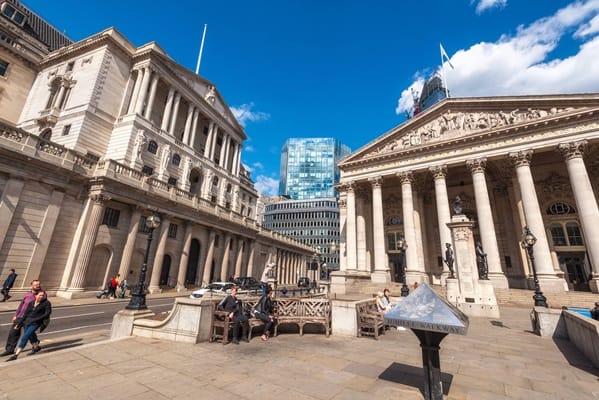
A Bank of England interest rate rise is becoming “increasingly likely” if elevated energy prices persist, deputy governor Clare Lombardelli has warned, raising the prospect of tighter monetary policy as inflation remains well above target.
Lombardelli said prolonged energy costs could feed into wages, inflation expectations and businesses’ pricing decisions, forcing the central bank to consider raising borrowing costs unless there is clear evidence that inflation is falling or economic activity is weakening.
“The longer higher energy prices persist, the greater the risk that indirect effects build and that inflation expectations, wage bargaining and price-setting behaviour begin to adjust in response,” she said in a speech in Warsaw on Thursday.
“On that basis, policy is increasingly likely to need to tighten if elevated energy prices persist, absent clear evidence of disinflation or weaker activity.”
Lombardelli was among six members of the Monetary Policy Committee who voted earlier this month to keep Bank rate at 3.75%, against three who backed a reduction.
Her comments underline the dilemma facing policymakers as the latest energy shock threatens to push inflation higher just as the economy remains vulnerable to weaker demand.
“The key issue is not the spot price of energy itself but the interaction of the underlying economy, higher energy prices, and the nature of their transmission,” Lombardelli said.
“That, ultimately, is what will determine whether the Bank rate needs to rise.”
UK consumer price inflation increased to 3.1% last month, its highest level in five months and further above the Bank’s 2% target.
The central bank expects inflation to rise to about 3.7% in the fourth quarter of this year and 4.2% in the first quarter of 2027 as higher energy costs work their way through household and business expenses.
Lombardelli said the scale and persistence of the energy shock remained uncertain, making the eventual response from policymakers dependent on how strongly higher costs spread through the wider economy.
“There remains material uncertainty about the size and duration of the shock and how it will pass through the economy,” she said.
“But the larger the energy shock becomes and the longer it persists, the more likely it is that we will eventually see significant pass-through of higher energy costs to other prices.”
One of the clearest risks is food inflation. While food price inflation recently fell to a two-year low of 1.3%, the Bank expects it to move towards 4% in the first quarter of next year as manufacturers face higher energy and other input costs.
That would create a fresh squeeze on household finances and potentially make the inflation problem more persistent.
The comments also illustrate the difficult trade-off confronting the Bank. Higher interest rates can help contain second-round inflationary effects by weakening demand and limiting wage and price pressures, but they cannot directly reduce the initial cost of imported energy.
Instead, policymakers are watching whether the shock begins to change behaviour across the economy.
If households and businesses respond to higher energy bills by demanding larger wage increases or raising prices to protect margins, an initially temporary energy shock could become embedded in domestic inflation.
Lombardelli’s warning suggests that the Bank would be prepared to respond if that process begins to take hold.
The central bank therefore faces a potentially uncomfortable period in which inflation could rise at the same time as economic growth weakens.
For households, the prospect of higher energy bills followed by higher borrowing costs would compound pressure on disposable incomes, particularly for mortgage holders and borrowers whose loans are due to be refinanced.
The coming months will therefore be critical for the Bank as it assesses whether the latest energy shock is a temporary price surge or the beginning of a broader inflationary cycle.
If the latter takes hold, Lombardelli’s warning makes clear that a further increase in Bank rate could return firmly to the policy agenda.


Leave a Comment