
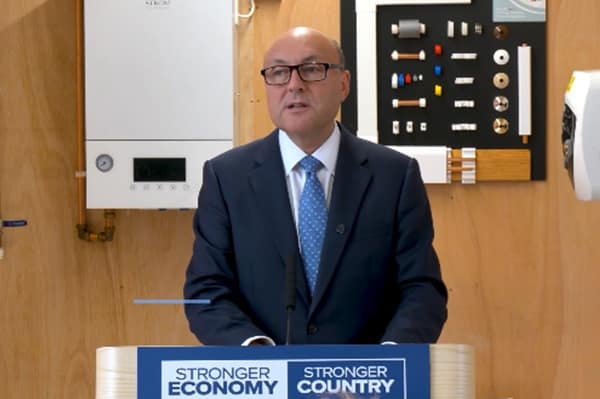
Andrew Griffith has attacked John Healey in his first speech as Shadow Chancellor, accusing the Labour government of worsening Britain’s fiscal position as ministers warn that the autumn Budget will be “really challenging”.
Griffith, the Conservative Treasury spokesman, used his address to argue that the government faced mounting pressure over debt, economic growth and borrowing costs ahead of the October 28 Budget.
He opened by saying: “I’m afraid we meet in difficult times. Britain today faces many problems. It has a debt problem. It has a growth problem, and it has now a Healey problem.
“Labour inherited the first two, but immediately made them worse. They chose to add £260billion of debt over the course of this parliament. They chose to impose the highest tax burden since records began. And in just 40 days’ time, on October 28, we fear it is about to get worse because, rather than change, we have another chancellor who’s out of his depth.”
Griffith argued that rising government borrowing costs were adding to the pressure on the public finances.
“Markets smell weakness and as a result, today government borrowing costs to be paid by all of us are at a 28-year high, higher than Italy, higher than Greece.
“And our interest bill is now more than twice what we spend on defence. Kemi and I have set out our plan for how we would fund the difficult decisions to fund defence, but John Healy prefers to continue out-of-control welfare spending.”
WATCH: @griffitha issues a stark warning to Andy Burnham 👇 pic.twitter.com/3ld1lhHKwF
— Conservatives (@Conservatives) September 17, 2026
The comments came as the government prepared for a Budget against a difficult international backdrop, with Prime Minister Andy Burnham warning that the economic fallout from conflicts including the war in Ukraine and the Middle East would make the fiscal statement particularly challenging.
Griffith called on Healey to rule out tax increases, arguing that uncertainty was already weighing on businesses and entrepreneurs.
“Businesses are already suffering enough. The Chancellor must end the uncertainty today and rule out any new taxes.
“He must rule out increasing taxes on small businesses and the self-employed. And he must rule out an exit tax, the mere rumours of which are already causing Britain’s wealth creators to flee the country.”
The confrontation highlights the pressure on the government to balance competing demands for public spending, defence investment and fiscal restraint ahead of the Budget.
For the Conservatives, the focus on borrowing costs provides a platform for challenging Labour over its management of the public finances, while the government faces the more immediate task of setting out how it intends to finance its spending commitments without further increasing pressure on the economy.
With the Budget only weeks away, the debate over taxes, borrowing and public spending is likely to intensify as ministers attempt to demonstrate that Britain’s finances remain under control.


Leave a Comment