
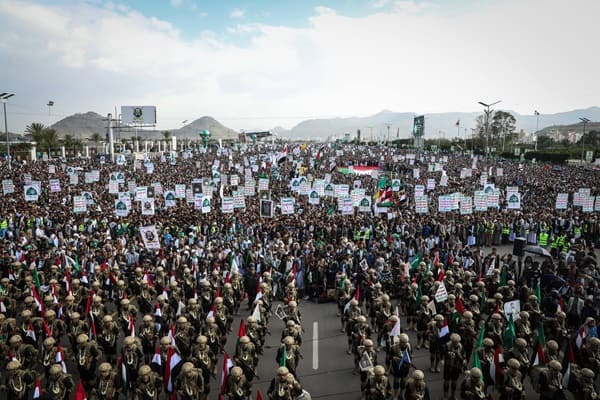
The Israel Defence Forces announced that they intercepted a missile launched from Yemen early on Saturday, indicating further escalation in the Middle Eastern conflict.
The Iran-backed Houthis, who control significant parts of Yemen, had previously warned that they could enter the war directly if attacks on Iran continued.
On Friday, the group declared its readiness for “direct military intervention” should additional countries join the United States and Israel.
Brigadier General Yahya Saree, speaking through the group’s Al-Masirah television channel, claimed responsibility for the missile strike.
He stated that a series of ballistic missiles had been fired at “sensitive Israeli military sites,” describing the attack as retaliation for Israeli operations across Iran, Lebanon, Iraq, and the Palestinian territories.
The Houthis vowed to continue their campaign until what they termed “aggression on all fronts” ceases, raising concerns that the conflict could expand into a broader regional confrontation involving multiple fronts. These developments come amid increasing worries about attacks on American forces in the region. A strike on Prince Sultan Air Base resulted in 12 U.S. service personnel being injured, according to American and Saudi officials.
Two of those injured are reported to be in very serious condition, with another eight classified as seriously injured. The attack also damaged several U.S. refuelling aircraft stationed at the base, highlighting the vulnerability of key military infrastructure. Since the conflict with Iran began last month, 13 American service members have been killed, and around 300 have been wounded, underscoring the rising human cost of the crisis.
Fighting has also intensified along Israel’s northern front. In southern Lebanon, two Israeli soldiers sustained serious injuries during clashes, while others were wounded in separate incidents involving rocket fire and anti-tank missiles. The Israeli military reported that at least nine soldiers have been injured in the past two days, reflecting the mounting pressure from Iran-aligned groups operating beyond Israel’s immediate borders.
Meanwhile, the economic impact of the conflict continues to ripple globally. The Strait of Hormuz, one of the world’s most critical oil routes, remains a focal point of tension. Disruptions to shipping through this narrow waterway have contributed to rising energy prices, with subsequent effects including stubbornly high inflation in countries such as the UK.
Speaking at an investment event in Miami, Donald Trump stated that the United States was engaged in negotiations with Iran, claiming that Tehran had sought to ease tensions by allowing oil shipments to pass through the strait. “They were negotiating… and then they said they would send ships of oil,” he told the audience, adding that up to ten vessels had been permitted to pass through.
Trump refrained from labelling the situation as a war, citing “legal reasons,” and instead referred to it as a “military conflict.” He expressed belief that Iran was “on the run,” while remaining hopeful that talks could lead to a settlement.
The involvement of the Houthis represents a significant expansion of the conflict’s geographic scope, linking events in Yemen directly to the fighting involving Israel, Iran, and U.S. forces. With missile strikes, proxy engagements, and economic disruptions escalating simultaneously, analysts warn that the situation risks tipping into a multi-front regional war unless diplomatic efforts succeed in containing it.


Leave a Comment