
London’s dense commercial environment means millions of people work in offices, retail spaces, hospitality venues, and construction sites every day. The Health and Safety (First Aid) Regulations 1981 require every one of these employers to provide adequate first aid provision, yet many London businesses remain under-prepared.
Accredited first aid courses in Southampton and across the UK equip delegates with the practical emergency response skills that the HSE expects. Training here gives first aid delegates the qualification they need to provide accredited first aid care that meets workplace legal requirements and genuinely protects colleagues when emergencies occur.
Why is first aid training especially important in London?
London’s working population exceeds four million people, and the sheer density of commercial activity creates a statistical certainty: workplace emergencies happen every day across the capital.
The city’s ambulance service faces some of the highest demand in the country. According to the London Ambulance Service NHS Trust, call volumes consistently exceed 5,000 per day, with response times varying significantly depending on location, time of day, and demand peaks. During busy periods, a trained first aider in the workplace may provide the only immediate medical response available.
High-rise office buildings add complexity. Ambulance crews face access delays navigating lifts, security barriers, and multi-tenant buildings. A trained delegate already on the same floor can begin treatment within seconds rather than the minutes it takes for paramedics to reach an upper-floor office.
What should London employers know about compliance?
The legal framework applies identically whether your office is in Canary Wharf or Camden. Here is what every London employer must understand:
- The Health and Safety (First Aid) Regulations 1981 require adequate first aid provision based on a documented needs assessment.
- The HSE defines “adequate” based on workforce size, risk level, shift patterns, and proximity to emergency services. London’s urban setting does not exempt employers from maintaining trained delegates.
- Both EFAW (one-day) and FAW (three-day) qualifications are recognised. The needs assessment determines which level is appropriate for your workplace.
- Certificates are valid for three years. Employers must track expiry dates and arrange refresher training before qualifications lapse.
- Multi-site London businesses (with offices, retail branches, or warehouses across different boroughs) need independent first aid coverage at each location.
- Remote and hybrid workers present a newer consideration. The HSE expects employers to assess first aid provision for staff who regularly work from home or client sites.
According to the Chartered Institute of Personnel and Development, London employers increasingly treat first aid training as part of broader employee wellbeing programmes rather than a standalone compliance obligation.
What skills do first aid delegates learn?
Accredited first aid courses cover the scenarios most likely to occur in London workplaces. The training is practical, hands-on, and directly applicable.
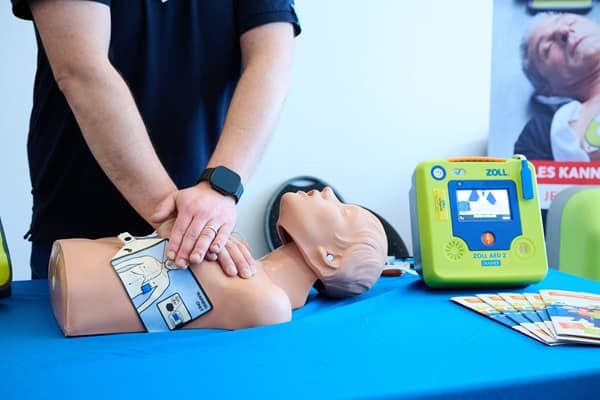
- CPR and AED use: Performing chest compressions and operating an automated external defibrillator. The British Heart Foundation reports that over 30,000 out-of-hospital cardiac arrests occur in the UK annually.
- Choking response: Recognising and clearing airway obstructions in conscious and unconscious casualties. Particularly relevant in workplaces with canteens and communal eating areas.
- Severe bleeding management: Applying direct pressure, using wound packing, and recognising the signs of hypovolaemic shock.
- Burns treatment: Cooling, covering, and managing thermal and chemical burns. Important for hospitality, laboratory, and industrial settings.
- Medical emergencies: Identifying and providing initial care for heart attacks, strokes, seizures, diabetic emergencies, and anaphylaxis.
Delegates practise each skill on training manikins and simulated scenarios, building the muscle memory and confidence needed to perform under pressure in a real emergency.
How does first aid training benefit London businesses beyond compliance?
The return extends well beyond satisfying the HSE. Trained first aiders contribute to a workplace culture that values safety and colleague welfare.
Staff morale improves when employees know that qualified colleagues are available in an emergency. Insurance premiums may reduce for businesses that can demonstrate comprehensive safety training. Client and visitor confidence increases when professional first aid provision is visibly in place.
According to the British Safety Council, businesses with strong safety cultures experience lower absence rates, fewer workplace incidents, and higher employee retention. First aid training is one of the most visible and practical components of that culture.
London employer essentials
- Every London employer must provide first aid provision compliant with the 1981 Regulations.
- London’s high call volumes mean trained workplace delegates are often the first medical responders.
- EFAW (one day) and FAW (three days) meet different risk profiles determined by the needs assessment.
- Multi-site businesses need independent coverage at each location across London.
- Certificates are valid for three years and require timely refresher training.
- First aid training supports employee wellbeing, insurance positioning, and workplace culture.
An investment in people
London moves fast, and so do medical emergencies. The employers who invest in accredited first aid training give their teams the ability to respond in the moments that matter most. Compliance is the legal minimum. Genuine preparedness is the standard worth aiming for.
FAQ
How many first aiders does a London office need?
For a low-risk office of 50 staff, at least one EFAW-qualified delegate. Larger offices need one FAW delegate per 100 employees. Multi-floor buildings should have coverage on every occupied level.
Can first aid training be delivered at our London office?
Yes. Many accredited providers offer in-house training at your premises. This is often more practical for London businesses where staff travel time to external venues adds cost and disruption.
Do hybrid workers affect our first aid provision requirements?
Yes. The HSE expects employers to assess first aid needs for remote and hybrid staff. If staff regularly work from home, the employer should provide guidance on home first aid provision and ensure office coverage adjusts for fluctuating on-site numbers.
What happens if our business does not have trained first aiders?
Non-compliance with the Health and Safety (First Aid) Regulations can result in HSE enforcement action, including improvement notices and prosecution. Insurance claims for workplace injuries may also be challenged without evidence of adequate provision.




Leave a Comment