

Get your senior leaders in one room and innovation sparks—but the bill can sting. All-in, a multi-day retreat now averages $3,700 per person for flights, lodging, and programming, according to Retreats & Venues. That figure climbs every year, so CFOs are scrutinising every line. The good news? Nearly the entire spend sits in a handful of controllable buckets. When we know which levers move the total, we can redirect cash from accidental luxury to true business impact. Over the next pages, we’ll unpack the seven biggest cost drivers—and show you how to bend each one in your favour.
Ready to follow the money? Let’s get started.
1. Venue and accommodation: where one-third of the money hides
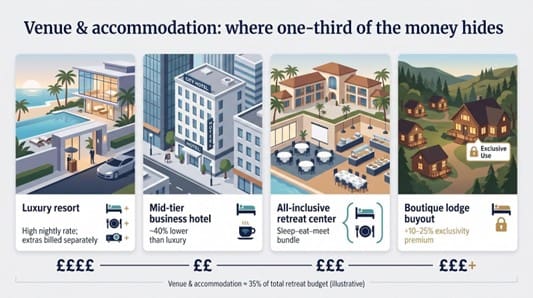
Hotel keys and meeting rooms absorb the largest single slice of any retreat budget, about 35 percent, according to The Offsite Co. A four-star resort quoting £350 per room per night sounds reasonable—until you multiply it by three nights and forty executives. The line item tops five figures before food, flights, or activities even appear.
Comfort matters, yet there is room to trim. Mid-tier business hotels often drop room rates by roughly 40 percent compared with luxury brands, and bundled conference centres or Caribbean resorts fold meals and meeting space into one nightly rate so you are not billed for coffee, Wi-Fi, or projector cables.
Retreats and Venues
Privacy carries a premium. Buying out a boutique lodge guarantees exclusivity but can lift venue fees 10–25 percent because your group covers the property’s lost revenue. Decide whether the team truly needs the entire property or only dedicated wings.
Quick cost-control plays:
- Negotiate a “sleep-eat-meet” bundle—rooms, food and beverage, and meeting space on one invoice
- Press for off-peak dates; the same ballroom in late April can cost far less than mid-September
- Reserve mostly standard rooms and a few suites so leaders who want extra space can expense the upgrade themselves
2. Destination and travel: the mileage multiplier
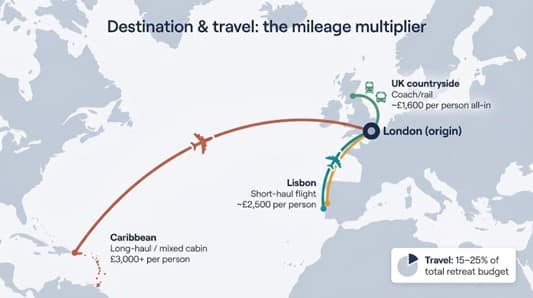
Flights, trains, and coach transfers rarely feel glamorous when you approve the purchase orders, yet they consume 15 to 25 percent of the total retreat budget, according to TeamOut. This slice moves faster than any other whenever fuel prices climb or executives push for long-haul sunshine instead of a nearer venue.
The math is stark. Fly a forty-person team from London to New York and you spend at least £32,000 before anyone orders room service. Move the same group to Lisbon and you often spend half that. Shrink the radius further, perhaps to a countryside estate reachable by train or charter bus, and travel costs drop sharply.
Booking data compiled in 2026 by Team Retreats shows the same logic on the other side of the Atlantic: round-trip flights from New York, Los Angeles, and Chicago to Cancun average $400–$500 (about £320–£400), roughly half the price of longer transatlantic legs and short enough to preserve executive stamina. The company’s curated leadership development retreats favour Mexico and the Caribbean, where nonstop service from more than fifty North American cities pairs with all-inclusive resorts to keep on-site costs predictable.

Retreats and Venues
Team Retreats leadership development retreats page screenshot
Location affects two lines at once: airfare and local logistics. A charming mountain lodge sounds idyllic until you add £3,000 for airport shuttles on winding roads. In contrast, a well-connected city cuts journey time and helps you secure weekday group fares that airlines price lower to fill seats.
A quick reality check for budget reviews:
- UK countryside (coach or rail): about £1,600 per person all in
- Lisbon short haul (economy flights): about £2,500 per person
- Caribbean long haul (mixed cabin classes): £3,000-plus per person
Retreats and Venues
Side by side, the premium for “paradise” is tough to defend unless strategy demands it.
You can still seek sunshine without hurting the balance sheet. Choose a hub with direct flights for most attendees, book weekday departures when fares dip 10 to 15 percent, lock seats three to six months ahead, and hedge currency if exchange rates look shaky.
Manage those levers well and every pound you save in the air can fund richer content or an extra coaching session on the ground.
3. Program design and facilitation: pay for brains, not just bodies
Great locations inspire, but true transformation happens in the agenda. The people who shape that content (internal strategists, external coaches, or keynote speakers) determine whether your retreat sparks measurable change or fizzles into a slide-fest.
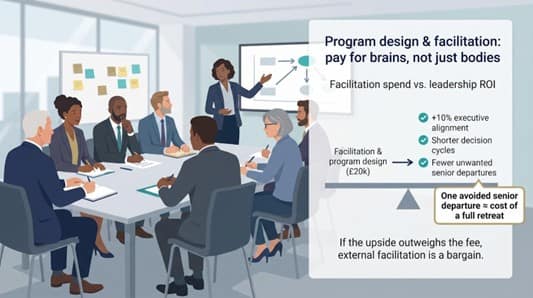
External facilitators carry hefty day rates, sometimes £2,000 to £5,000, and a three-day programme with preparation can top £20,000. The sticker shock eases when you weigh it against the upside. A seasoned facilitator moves a room from polite conversation to real commitment, shortening decision cycles and surfacing hard truths that usually stall in regular meetings.
Internal talent costs less and highlights company expertise, yet it can blur lines between safe space and normal hierarchy. When the CFO is in the circle, will a director challenge groupthink as freely? You need that psychological safety if you expect candid debate on strategy or culture.
Try this test: ask, “What would a 10 percent boost in executive alignment be worth next quarter?” If the answer outstrips the facilitation fee, and it often does, external help is a bargain. Otherwise, build an in-house faculty and channel savings into post-retreat coaching or analytics.
Retreats and Venues
Curriculum depth is the second lever. Off-the-shelf workshops land fundamentals quickly, but custom case studies, 360-degree assessments, and follow-up coaching cement behaviour change. Each add-on raises spend yet also extends shelf life beyond the offsite. Think of it as an investment in leadership capacity, not a one-time event cost.
The facilitator-to-participant ratio matters too. One coach guiding fifty leaders invites passive listening; break into pods with extra coaches and you multiply engagement. Cost scales, but so does impact. Evaluate pricing models carefully: per-person fees often beat flat day rates for large groups because you pay only for the heads you bring.
Finally, link facilitation spend to hard metrics. If turnover for senior roles averages 200 percent of salary, preventing just one unwanted departure can finance an entire retreat. Frame the budget conversation around those numbers and the cheque gets much easier to sign.
4. Group size and room strategy: multiply the right numbers, divide the wrong ones
Every extra attendee drags a shadow budget behind them: another flight, another bed, another seat at dinner. Yet larger headcounts can trigger volume discounts that lower the per-person average. The challenge is spotting where economies of scale turn into plain chaos.
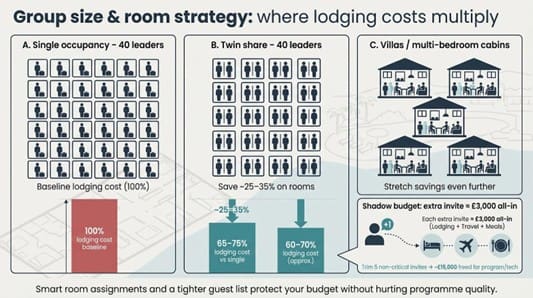
Start with purpose. If the retreat’s goal is senior team alignment, keep the guest list tight, perhaps twenty to forty leaders. Each unplanned invite costs about £3,000 once the dust settles, so trimming five peripheral managers frees nearly £15,000 for richer content or better tech.
Room assignment is the quickest lever inside this category. Single occupancy doubles lodging cost compared with twin share, plain and simple. For C-suite gatherings, privacy usually wins, but for emerging-leader cohorts or cross-functional workshops, pairing colleagues saves 25 to 35 percent on rooms without touching programme quality. Villas or multi-bedroom cabins stretch savings even further.
Retreats and Venues
Headcount also affects facilitator ratios, meeting space size, printed materials, and swag. These incremental slices look minor on paper until you multiply by fifty. Ordering branded notebooks? Confirm the printer’s price breaks jump at 100 units before you lock quantity.
Finally, remember behavioural capacity. A breakout session with ten participants hums; one with thirty stalls. Split large groups into staggered retreats or parallel tracks, then reuse the same content and venue contract. You preserve engagement and avoid paying for a cavernous ballroom that echoes.
In short, invite only the mission critical, house them smartly, and watch both your budget and your session energy stay wonderfully light.
5. Timing and seasonality: let the calendar do the haggling
Same venue, same agenda, different week, yet one quote makes the CFO smile while the next drains next quarter’s training budget. That swing happens because hotels and airlines follow demand curves, not our convenience. Book during peak retreat months—September, October, and May—and rates climb 15 to 30 percent. Shift to late April or early November and you often save five figures.
Mid-week dates work similar magic. Resorts like to fill Sunday through Thursday inventory, so moving by even a day can secure complimentary breakfast, free meeting space, or a room upgrade that makes executives feel valued without adding cost.
Retreat length matters too. Add a fourth night and expenses rise roughly 25 percent across rooms, meals, and facilitator days, yet outcomes rarely improve in step. Push organisers to tighten objectives so the programme fits into three efficient days. The shorter stay trims spend and returns leaders to their desks sooner. That is a double win.
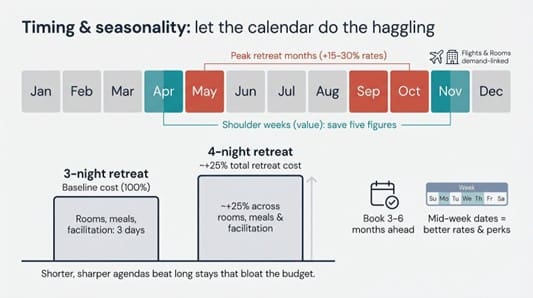
Lock plans early. Airfares booked three to six months out are usually cheaper, and venues offer perks for advance commitment. Negotiate flexible attrition clauses and keep a small contingency fund for surprises; a 10 percent buffer covers flight changes or weather-related rentals without breaking stride.
Treat timing like any other procurement lever. Choose shoulder seasons, aim for mid-week slots, right-size the agenda, and the calendar will quietly shave thousands off the final bill.
6. Agenda activities and add-ons: fun that pays its way
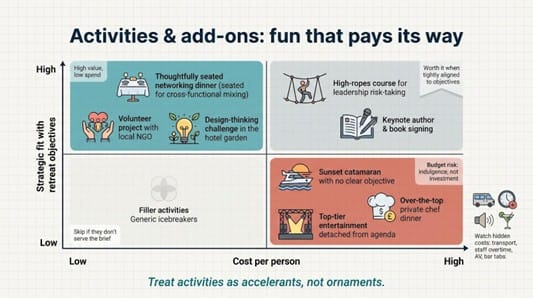
Breakout hikes, private chefs, ropes courses, and sunset catamarans are where retreat planners get creative, and budgets get nervous. Activities and entertainment average about one-fifth of total spend, yet they remain the most flexible lever. Swap a pricey sailing charter for a guided coastal walk and you cut costs without stealing joy.
First check strategic fit. If the retreat’s purpose is leadership risk-taking, a high-ropes course earns its fee by giving participants a tangible lesson in trust. If the goal is cross-functional networking, a thoughtfully seated dinner works better than white-water rafting where conversation drowns in adrenaline.
Retreats and Venues
Prices swing widely. A self-guided design-thinking challenge in the hotel garden is almost free. A keynote author plus book signing runs £10,000 before travel. Add top-tier entertainment and the entire activity budget can double in a single invoice. The remedy is intention: pick one signature moment that reinforces learning objectives, then keep the rest simple.
When social impact matters, volunteer projects deliver bonding at minimal cost and look strong in the sustainability report. Local NGOs often supply materials and facilitators for a nominal donation, turning a line item into goodwill capital.
Finally, watch hidden costs: transport to off-site venues, overtime staffing, and AV for evening talent shows. Bundle where you can, cap bar tabs early, and push vendors for per-head pricing so overruns do not ambush you later.
Treat activities as accelerants, not ornaments. When each experience ties back to business outcomes, the spend feels like investment rather than indulgence.
Conclusion
As blockchain technology continues to evolve, the threat from quantum computing becomes more real every day. Transitioning to quantum-resistant solutions is no longer optional for organisations that prioritise long-term data security. By implementing post-quantum cryptography and robust architectural changes today, the blockchain industry can ensure a secure and decentralised future even in the face of unprecedented computational power.


Leave a Comment