
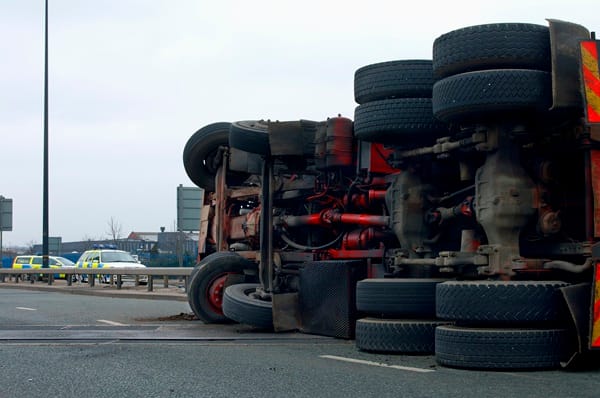
A single truck crash can end careers, bankrupt a carrier, and trigger litigation that runs for years. Businesses that operate commercial fleets, hire freight contractors, or simply share roads with heavy vehicles are exposed to a category of liability that most executives underestimate until it arrives.
Commercial truck accidents are not scaled-up versions of car accidents. They involve federal regulations, multiple insurance policies, employer liability theories, and injuries serious enough to reach eight-figure verdicts. Understanding how that exposure works is increasingly relevant for any business owner who moves goods across state lines or employs drivers on public roads.
The numbers that define the risk
The U.S. Federal Motor Carrier Safety Administration (FMCSA) reported 5,837 fatal crashes involving large trucks in 2021, a 13 percent increase from the prior year. Non-fatal crashes involving large commercial vehicles exceeded 101,000 in the same period.
Those figures matter to businesses for one reason. The company behind the truck is often named in the lawsuit alongside the driver. Vicarious liability, negligent hiring, negligent entrustment, and failure to maintain equipment are all theories that plaintiffs use to reach the employer when a driver causes a catastrophic collision.
Insurance minimums for commercial carriers set by the FMCSA start at $750,000 for most freight operations. That figure was set in 1980 and has not been adjusted for inflation. Many serious injury cases settle or verdict well above that threshold. The gap between policy limits and actual damages often comes directly from the business.
What catastrophic injuries cost
Catastrophic injury is a legal and medical category. It includes traumatic brain injury, spinal cord damage resulting in paralysis, amputations, severe burns, and injuries that permanently prevent the victim from working or living independently.
The lifetime cost of a spinal cord injury ranges from $1.2 million to more than $5 million depending on severity, according to the National Spinal Cord Injury Statistical Center. Traumatic brain injuries add therapy, medication, and long-term care costs that escalate for decades. Lost income calculations in catastrophic cases factor in career trajectory, not just current wages.
When a commercial truck driver causes a crash that produces injuries at this level, the damages calculation is built to reflect a lifetime of consequences. That is what trucking company insurers are negotiating against. Businesses without adequate coverage or without a clear compliance record face the largest exposure.
The regulatory layer that creates business liability
Commercial trucking in the United States operates under a federal regulatory framework that most business owners outside the industry do not fully understand. The FMCSA sets hours of service rules, driver qualification standards, vehicle inspection requirements, and electronic logging device mandates.
When a crash happens and investigators find an hours of service violation in the driver’s log, or a skipped inspection entry, or a failed drug screening that was not followed up properly, those records become evidence of corporate negligence. The plaintiff’s legal team is not just arguing the driver made a mistake. They are arguing the company created the conditions for the crash.
That is a different and more serious claim. It reaches past the driver’s personal liability into the organisation’s practices, training records, and management decisions. It is also the claim that produces the largest verdicts.
Texas as a case study in fleet liability exposure
Texas moves more freight by road than any other U.S. state. Interstate 10, Interstate 45, and Highway 59 carry some of the highest concentrations of commercial vehicle traffic in the country. Harris County alone processes thousands of commercial vehicle incidents each year through its civil court system.
In Texas, the combination of high freight volume, long highway stretches, and a legal system that allows unlimited non-economic damages creates significant exposure for any carrier or business operating in the state. Verdicts in commercial truck cases regularly exceed the policy limits of even well-insured carriers.
Firms like Sutliff and Stout pursue trucking companies, their parent corporations, and their insurers when catastrophic injuries result from commercial vehicle crashes in Texas. Cases have resolved well above stated policy limits when additional liability sources were identified through investigation.
What businesses get wrong about commercial fleet insurance
Most business owners with commercial fleets focus on primary liability coverage. They set the policy, renew it annually, and assume the insurer handles everything else.
Three problems appear consistently in catastrophic cases.
- Policy limits are insufficient. A $1 million commercial policy sounds large until the injured victim requires $4 million in lifetime care. The business faces direct exposure for the gap. Umbrella coverage that specifically extends to commercial vehicle operations is not automatic. It requires explicit structuring.
- Exclusions go unread. Policies often exclude coverage when drivers operate outside permitted hours, carry unauthorised loads, or operate vehicles with known mechanical defects. If those exclusions apply, the insurer can deny coverage entirely and leave the business to defend the claim alone.
- Employer liability extends to contractor relationships. Businesses that use owner-operators or freight brokers sometimes assume the contractor’s insurance covers their exposure. Courts in Texas and across the U.S. have found that control over routes, delivery schedules, and operating standards can create an employment relationship for liability purposes regardless of how the contract is labelled.
How investigations work against businesses in truck crash cases
Commercial truck crashes trigger a chain of evidence preservation that moves faster than most business owners expect. Black box data, electronic logging device records, GPS tracking history, maintenance logs, and driver qualification files are all subject to spoliation holds.
Plaintiff attorneys send preservation letters within days of a serious crash. If a business destroys, overwrites, or fails to preserve records after receiving that notice, courts treat it as evidence of consciousness of guilt. Juries respond accordingly.
The businesses that face the worst outcomes in commercial truck litigation are rarely the ones with the most negligent practices. They are the ones that responded poorly in the hours and days after the crash, destroyed evidence through routine data overwriting, or made statements to insurers and investigators without legal counsel present.
What the compliance record reveals
A trucking company or business with a strong compliance record has a very different litigation posture than one with a pattern of violations. The FMCSA’s Safety Measurement System is publicly accessible. Plaintiffs check it early. Lawyers use it to show whether the crash was an isolated incident or the predictable result of a company that consistently cut corners.
Businesses that maintain clean inspection records, complete driver qualification files, accurate maintenance logs, and documented safety training present fewer targets for the negligence theories that drive high verdicts. Compliance is not just regulatory obligation. It is the primary litigation defence.
What businesses operating commercial fleets should review now
The time to assess commercial vehicle liability exposure is before a crash, not after.
- Review all commercial vehicle insurance policies for actual limits, umbrella extensions, and exclusion language related to hours of service and maintenance.
- Confirm that electronic logging device data is preserved for at least six months and that overwriting schedules are paused immediately after any incident.
- Audit driver qualification files annually. Outdated medical certificates, expired endorsements, and missing drug screening records are among the most commonly exploited gaps in litigation.
- Evaluate whether owner-operator and freight broker agreements contain language that clearly defines operational independence. If your business controls delivery scheduling or routing for contractors, have legal counsel review the relationship.
- Review liability coverage for rented or leased equipment. Businesses that use flatbed trailer rental for seasonal loads or project-specific freight often assume the rental company’s insurance covers their exposure during operation. It rarely does. Most rental agreements transfer operational liability to the lessee the moment the trailer leaves the yard. A crash involving a rented flatbed on a public road can leave the renting business fully exposed if its own commercial policy excludes non-owned trailer coverage.
- Establish a post-incident protocol that includes immediate legal notification before any statements are made to insurers or investigators.
Commercial vehicle liability is one of the few areas where the gap between what a business thinks its exposure is and what it actually is can reach into the tens of millions. Closing that gap starts with understanding what courts expect from fleet operators and what happens when those expectations are not met.




Leave a Comment