
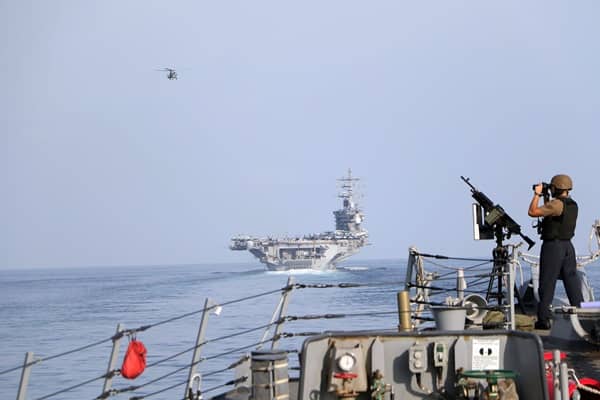
The United States Department of Defence is deploying an additional 5,000 Marines and warships to the Middle East in response to escalating Iranian attacks around the Strait of Hormuz, according to The Wall Street Journal.
U.S. officials confirmed that this deployment includes an amphibious ready group and a Marine expeditionary unit, which typically consists of several naval vessels and approximately 5,000 Marines.
Among the ships reportedly heading to the region is the amphibious assault ship USS Tripoli (LHA-7), along with its associated Marine units.
This deployment was authorised following a request from the United States Central Command, as Iranian attacks on shipping have intensified in and around the Strait, a critical maritime corridor through which around 20% of the world’s oil supply usually passes.
The reinforcement aims to protect commercial shipping and energy supplies, prepare for potential naval escort missions for oil tankers, and enhance U.S. military deterrence in the Gulf.
However, officials caution that full escort operations may not commence immediately due to the high threat posed by Iranian missiles, drones, and potential sea mines.
This military buildup is part of the largest U.S. military concentration in the region in years, with carrier strike groups, fighter aircraft, and missile-defence systems already deployed across the Gulf and surrounding areas amid rising tensions with Iran.
By sending Marines and amphibious warships, the U.S. gains the capability to escort commercial oil tankers through the strait. This strategy is akin to previous operations where U.S. warships accompany tankers through hazardous waters to deter attacks from missiles, drones, or fast boats launched by the Islamic Revolutionary Guard Corps naval forces.
The Marine Expeditionary Unit (MEU), deployed aboard amphibious ships, can swiftly conduct boarding operations against hostile vessels, protect shipping lanes, and seize small islands or coastal launch sites that threaten ships. This provides Washington with a rapid-response force if Iranian forces attempt to block the strait physically.
If Iran deploys naval mines—one of its most likely tactics—the U.S. Navy would likely send specialised mine-countermeasure ships and helicopters. Mining the Strait of Hormuz is seen as Iran’s most effective way to disrupt global oil supply without engaging in a full naval battle.
This deployment also sends a clear message to Iran: attacks on Gulf shipping or U.S. bases could prompt a large-scale military response from the United States Central Command. The objective is partly psychological, aiming to convince Tehran that maintaining the blockade would incur greater costs than lifting it.
Should the strait remain closed for an extended period, the U.S. and its allies could attempt to force its reopening through airstrikes on Iranian missile batteries along the coast, attacks on naval bases used by the Islamic Revolutionary Guard Corps Navy, and escorted convoys of tankers through the shipping lanes. This would represent the largest naval confrontation in the Gulf since the late 1980s tanker wars.


Leave a Comment