
One of Russia’s most useful political footholds inside Europe has just flipped, and not quietly.
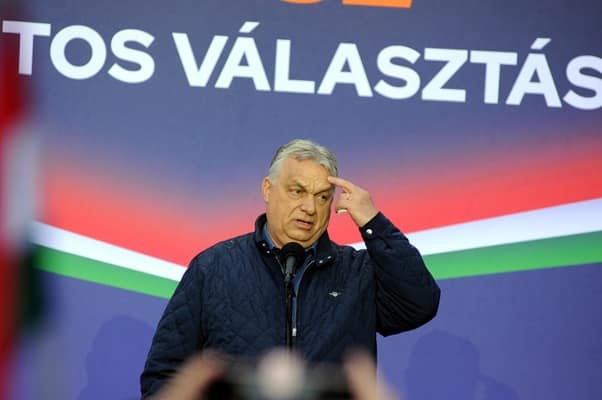
In a landslide victory, Péter Magyar has swept aside Viktor Orbán, ending more than a decade of rule that steadily pulled Hungary away from its European partners and closer to Moscow’s orbit.
This election wasn’t just about politics or ideology; it took place against the backdrop of a growing security scandal within the European Union.
Just days before the vote, allegations surfaced that Hungary’s Foreign Ministry, led by Péter Szijjártó, had been leaking sensitive EU discussions in real time, with reports suggesting information was being passed to senior Russian figures, including Sergey Lavrov.
The claims emerged following investigative reporting by outlets including Direkt36 and were further amplified across European media, alongside references to leaked materials and audio recordings that appeared to indicate the flow of internal communications beyond authorised channels.
EU officials responded unusually bluntly, confirming that internal documents had been traced as they moved outside the EU, a development that raised serious concerns in Brussels over the integrity of member states’ communications.
A senior EU diplomat, speaking to multiple European outlets, warned: “If member state communications are being shared externally in real time, that represents a fundamental breach of trust, not just politically, but at a security level.”
If proven in full, it would mark one of the most serious internal compromises within the bloc since the start of Russia’s full-scale invasion of Ukraine. It also reframes this election entirely. For Ukraine, this isn’t just another European political shift; it’s the potential closure of a channel through which Moscow didn’t just influence but may have actively penetrated Western decision-making.
A door, long exploited, may finally be swinging shut.
The end of Russia’s backdoor into Europe
Under Viktor Orbán, Hungary became a persistent problem within both the European Union and NATO, not openly pro-Russian but reliably obstructive. Orbán didn’t start there. When he first swept to power in 2010, it was on the back of economic crisis and public frustration, securing a commanding mandate that allowed him to reshape Hungary’s political system from within, consolidating control over institutions, media, and the state itself.
From there, the shift was gradual but deliberate, sanctions were delayed, aid packages watered down, and political narratives echoed Kremlin talking points, pushed just far enough to create doubt, hesitation, and division.
Every delay in Brussels had a knock-on effect further east. On the frontline, hesitation translates into lost momentum, and sometimes far worse, and Hungary became a pressure point Moscow could lean on, but now, that pressure point has blown a seal.
Péter Magyar’s victory signals something far more significant than a change in government. Hungarian voters have rejected Orbán’s long-running “Eastern Opening” strategy, the idea that Budapest could sit inside Western institutions while drifting politically toward Russia, leveraging cheap energy while at times taking a hostile stance toward Ukraine, already fighting for its survival.
Instead, they’ve chosen a return to Europe, and for Ukraine, that changes the political terrain significantly.
What his means for Ukraine
Kyiv has spent the last two years not just fighting a war but also navigating a political minefield across Europe, with Hungary often at the centre. From sanctions negotiations to funding mechanisms and long-term EU planning, Budapest repeatedly slowed the process, sometimes quietly, sometimes very publicly.
Remove that obstacle, and things don’t suddenly become easy, but they become clearer, more predictable, and more aligned and for Ukraine, that means fewer political ambushes in Brussels and a stronger chance of sustained, coordinated support. Whether financial aid, military backing, or movement on EU accession, a cooperative Hungary shifts the balance.
It also sends a message. One heard repeatedly on the campaign trail: “Russia out.” The Kremlin’s strategy has always relied on fractures, exploiting differences, amplifying divisions, finding weak points inside alliances, and Orbán’s Hungary was one of those points.
Over time, we may well learn just how deep that ran.
A blow to the Trump–Orbán axis
The implications don’t stop at Europe’s borders. Across the Atlantic, this is an awkward moment for Donald Trump and his allies, particularly JD Vance, who have aligned themselves politically and ideologically with Orbán’s model of governance. For years, Orbán was held up as an example: strong leadership, controlled narratives, resistance to liberal institutions, and a willingness to challenge the Western consensus, especially on Ukraine.
That model has just been rejected at the ballot box, Not narrowly, but decisively.
For Vance, who has repeatedly questioned the continued US support for Ukraine, this runs counter to his argument. Hungarian voters haven’t moved toward isolationism; they’ve moved away from it, and for Trump, it raises a bigger question. If one of the most entrenched nationalist governments in Europe can be overturned by a pro-European movement, how durable is the political strategy he’s trying to export?
Right now, it looks like the playbook didn’t just fail, it completely backfired.
Moscow loses a lever
For the Kremlin, Hungary was never about loyalty. Like everything in Moscow’s playbook, it was about utility. Budapest didn’t need to openly side with Russia; it just needed to slow things down, create friction, and weaken unity at key moments. That alone was enough to serve Russian interests; that’s now leverage under threat.
It’s too early to say it’s gone entirely. Political transitions take time, and Magyar will face internal pressures, economic realities, and institutional resistance, but the direction is clear, and it’s not toward Moscow.
For Ukraine, that removes one of the more frustrating variables in the wider war effort. It doesn’t change the situation in Donetsk overnight, and it won’t stop Russian advances, but wars like this aren’t fought on one axis; they’re fought across military, economic, and political fronts, and politically, the ground is shifting. Across Europe, battlelines are being redrawn.
On one side: states doubling down on collective security, institutional cooperation, and resistance to Russian aggression.
On the other: a shrinking group willing to hedge, delay, or quietly enable Moscow’s strategy.
Unity, when it holds, is a force multiplier, it shapes how quickly decisions are made, how effectively resources are deployed, and how confident Ukraine can be in the support behind it and last night’s result didn’t change the battlefield.
But it changed the map behind it.
Final thought
For years, Russia has worked to exploit every opening inside Europe, every disagreement, every delay, every political fracture & Hungary was one of those openings.
Now, that door is closing, not completely, not permanently, but enough to matter, and in a war where politics can be just as decisive as firepower, that shift could prove more significant than it first appears, because while the fighting continues in the east, the battle for Europe’s political alignment is still very much alive.
At least now, Ukraine has gained considerable ground, politically.


Leave a Comment