
Three of the past five British summers have brought hosepipe bans to parts of the country. Lawns brown by July. Borders built for cool, damp conditions sulk and scorch. In response, a quiet shift is under way: gardeners are copying the Mediterranean, where plants have coped with heat and drought for centuries.
This is not a holiday-postcard fad. It is a practical answer to a changing climate, and it is reshaping how new gardens are planned. The Royal Horticultural Society has reported rising interest in drought-tolerant planting, and gravel gardens are appearing in suburban plots that once held thirsty lawns.
The idea behind a dry garden
A Mediterranean garden works with poor, free-draining soil rather than against it. Plants sit in gravel or grit, which keeps roots dry in winter and reflects heat in summer. Once established, many of these plants never need watering.
The plant list is forgiving. Lavender, rosemary, santolina, cistus, euphorbia and phlomis all thrive on neglect and sun. Add structure with a clipped olive or a bay in a pot. Thread in tall verbena bonariensis and the seed heads of alliums for movement. The palette is silver, grey-green and soft purple, with hot flashes of orange or magenta where you want them.
The late designer Beth Chatto proved the point decades ago with a gravel garden in Essex that has never been irrigated. Her rule was blunt: right plant, right place. A dry garden follows it to the letter.
Stone is the natural partner
Soft, lush planting needs hard structure to read as a design rather than a muddle. In a Mediterranean scheme, that structure comes from stone, terracotta and gravel rather than timber and lawn.
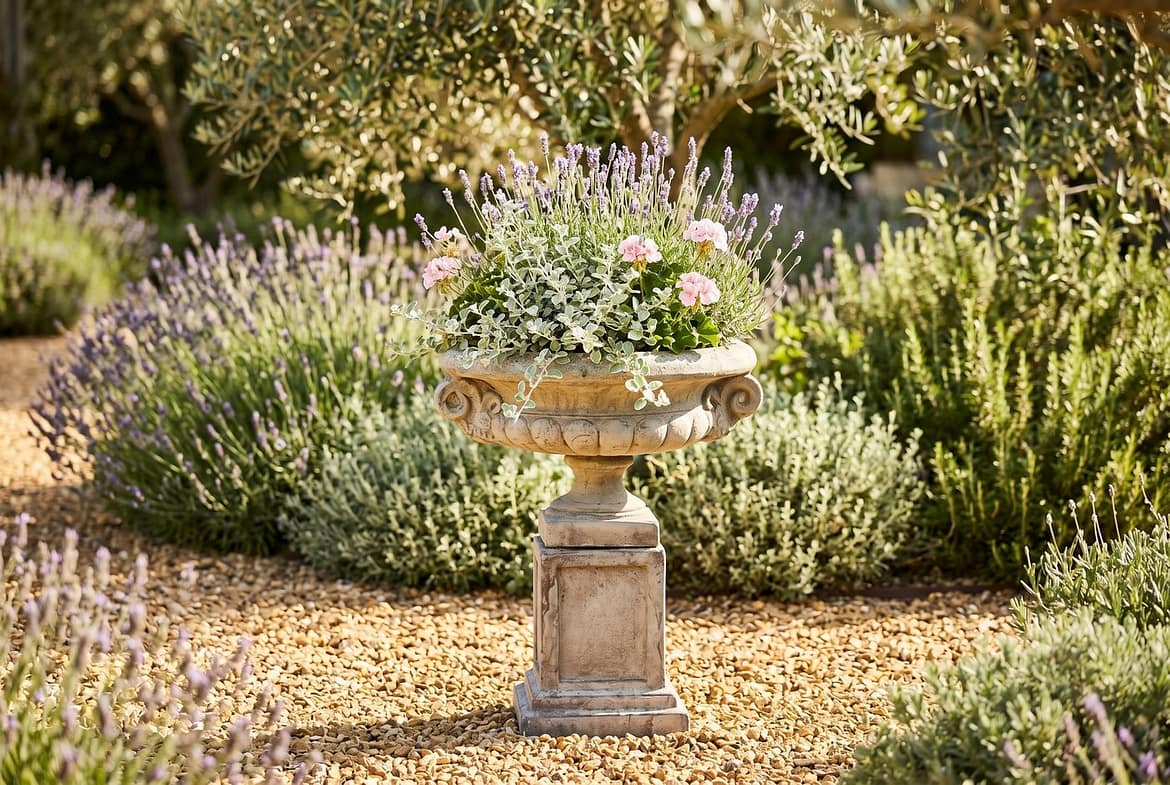
A classical stone urn earns its keep here. The Edwardian Stone Garden Tazza sits on a tall plinth and lifts planting to eye level, which gives a flat gravel garden instant height and a clear focal point. Its weathered, pale finish suits a sun-baked scheme far better than glossy modern containers. Plant it with trailing pelargoniums, silver helichrysum or a single architectural agave for an authentically southern look.
“A stone urn does two jobs at once,” says Matt W, who has fitted ornaments and water features across the UK for 16 years. “It draws the eye to a fixed point, and its weight grounds a loose, airy planting scheme. Without that anchor, a gravel garden can drift into looking unfinished.”
Water, used sparingly
There is no contradiction in adding water to a drought-tolerant garden. In the real Mediterranean, a small fountain or rill is a feature of courtyards precisely because the sound of moving water cools a hot space, at least to the ear.
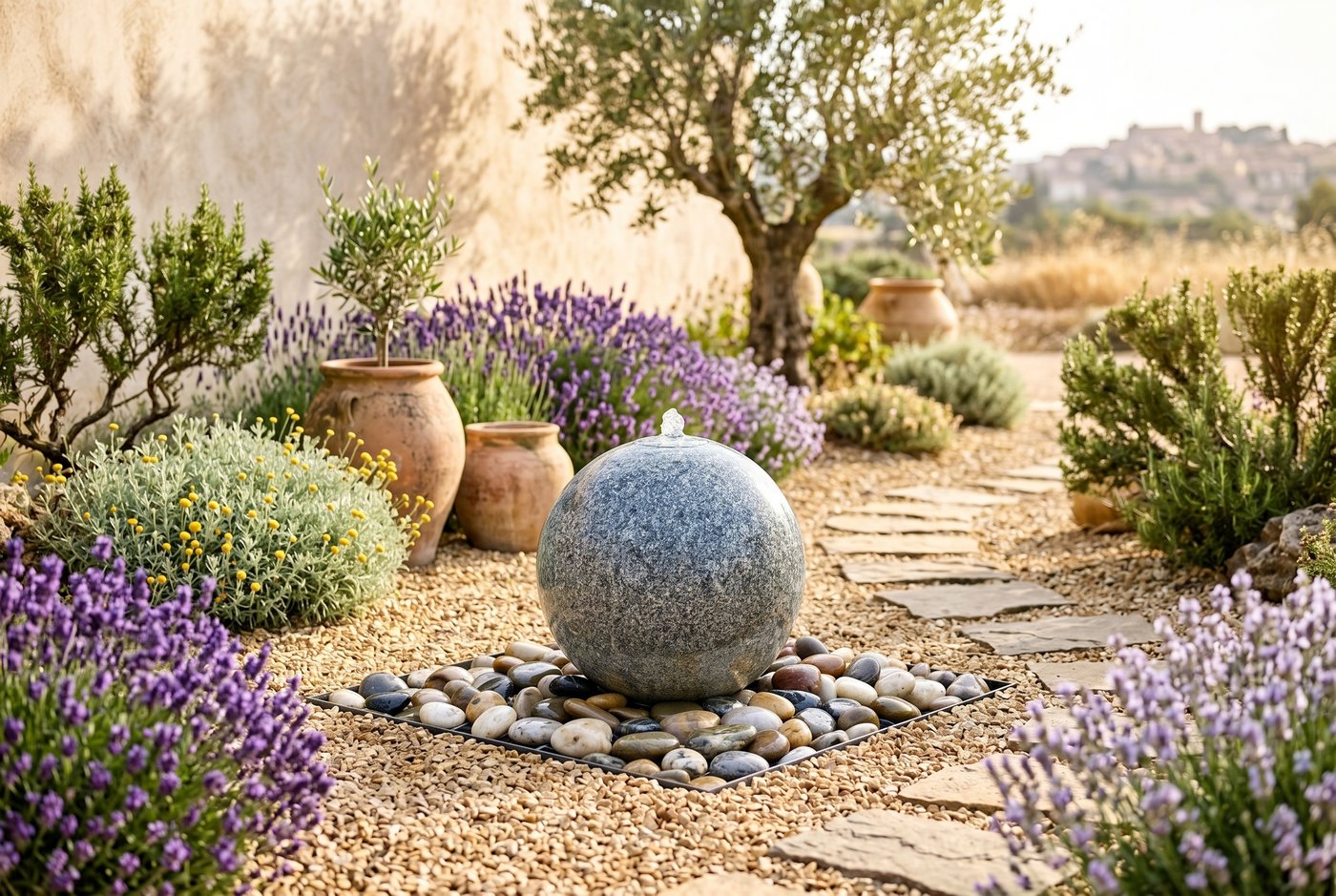
The trick is to keep it modest and self-contained. The Grey Flame Granite Sphere Water Feature recirculates the same water on a small pump, so it loses very little to evaporation and nothing to the soil. Its speckled grey granite suits a stone-and-gravel scheme, and the gentle film of water over the sphere catches the sun by day. Set it in a bed of cobbles where any splash drains straight back to the reservoir.
A single sphere or a low bowl is enough. A large pond would be out of character and would waste water in exactly the conditions a dry garden is built to handle.
https://gardenornaments.com/
Getting the surfaces right
Gravel is the floor of a Mediterranean garden, and it does real work. A 5cm layer over weed-suppressing membrane keeps roots cool, suppresses weeds and lets winter rain drain away fast. Use a warm buff or honey-toned gravel rather than cold grey to push the southern feel.
Break up the gravel with reclaimed stone setts, a few large rocks or a simple stone path. These hard elements hold the scheme together when the planting dies back in winter, which matters more in Britain than it does in Provence.
A garden that suits the times
The appeal is more than aesthetic. A Mediterranean garden uses less water, needs less mowing and asks for less feeding. Once the plants settle, usually within a year, the maintenance drops sharply. For anyone tired of nursing a lawn through July, that is a strong argument.
Start by lifting a tired patch of grass, improving drainage with grit and planting a tight group of sun-lovers around one strong focal piece. A stone urn or a small stone fountain gives that first scheme a centre to build around.
For stone urns, planters and self-contained water features suited to a dry, sunny plot, the specialists at gardenornaments.com carry a wide range and can advise on weight, fixing and frost resistance before you buy.




Leave a Comment