
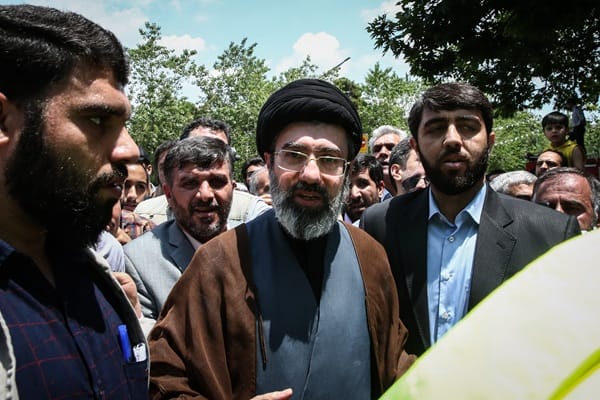
More than a month after the reported Israeli strike on the leadership compound of Ali Khamenei — known as the Beit-e Rahbari — the Islamic Republic is facing an increasingly unclear and potentially destabilising leadership crisis.
The Israeli strike, which killed the Supreme Leader along with senior officials and military commanders, has been followed not by clarity, but by silence.
At the centre of that silence is Mojtaba Khamenei, who is widely reported by some factions to be the successor, yet he has been conspicuously absent from public view, YnetGlobal reported.
According to a hospital source, Mojtaba Khamenei remains in an underground intensive care unit, suffering from catastrophic injuries.
These reportedly include paralysis in at least one leg, loss of function in an arm, spinal cord damage, brain trauma, and severe facial injuries.
Multiple surgeries have allegedly failed to restore his mobility, and his condition is said to require long-term specialised care — effectively preventing him from fulfilling the duties of leadership.
If accurate, such injuries would raise profound questions about who is truly governing Iran. However, these claims are strongly contradicted by officials within the regime. Mohsen Zanganeh has dismissed reports of a severe injury, insisting that Mojtaba’s condition is minor and that he remains actively in control of state affairs.
This assertion is further undermined by a notable absence: no senior official has publicly confirmed meeting or communicating with Mojtaba in the past month. Confusion has also emerged from conflicting signals within Iran’s political system, YnetGlobal reported.
The Fars News Agency — closely aligned with the Islamic Revolutionary Guard Corps — has described Mojtaba as a “janbaz,” a term typically reserved for individuals who have suffered life-altering injuries in service to the state.
Meanwhile, imagery circulating in Tehran, including a billboard reportedly depicting him with a missing arm, seems to reinforce the narrative of severe physical impairment. Other figures within the regime are attempting to project continuity.
Mohammad-Reza Rezaei Kouchi has claimed that Mojtaba survived not only the initial strike but also a subsequent attack on the hospital where he was being treated. If true, this statement underscores a significant security breakdown at the heart of the regime.
Perhaps most significantly, emerging reports indicate that the succession process itself is far from settled. Telegram channels linked to various factions have referenced a letter attributed to Ali Khamenei, addressed to the Assembly of Experts — the institution responsible for selecting the Supreme Leader.
In that letter, Mojtaba is reportedly not named as the successor, and the concept of hereditary leadership is explicitly rejected. If authentic, this would fundamentally undermine the narrative that power has smoothly transferred within the Khamenei family and instead point to an unresolved and potentially contested succession process.
Taken together, these developments suggest more than just confusion — they point to a regime under significant internal strain.
The combination of conflicting medical reports, absence of public appearances, contradictory official statements, and uncertainty over succession creates a picture of a leadership structure that may be far less stable than it appears from the outside.
In highly centralised systems such as Iran’s, ambiguity at the top is inherently dangerous. Power relies not only on control but also on the perception of control. If Mojtaba Khamenei is indeed incapacitated or unable to govern effectively, Iran may be operating under a form of fragmented or proxy leadership behind closed doors.
This situation has important implications: decision-making could slow down or become more unpredictable, internal competition within the regime might increase, and external actions, especially in regional conflicts, may become less predictable. At a moment of heightened tension in the Middle East, uncertainty at the very top of Iran’s leadership adds another layer of risk to an already volatile geopolitical landscape.
For now, the most telling detail is not what has been said but what has: no televised address, no verified appearance, and no confirmed contact. In a system built on tightly controlled messaging, such silence is rarely accidental. Until that silence is broken, questions over who truly holds power in Tehran will only grow louder.


Leave a Comment