
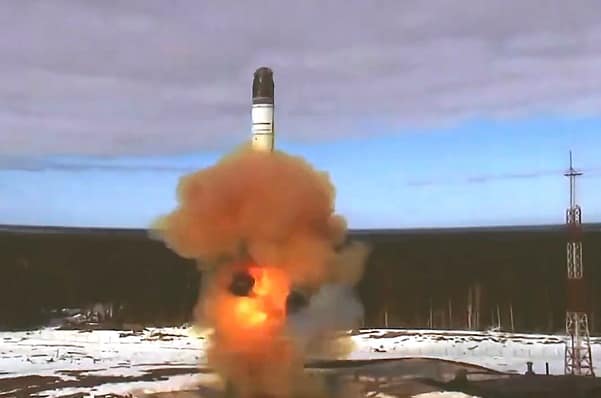
North Korea has adopted a dramatic new nuclear policy ordering what amounts to an immediate atomic response if its Supreme Leader, Kim Jong Un, is killed in what it defines as a foreign attack — a move intelligence officials warn could dangerously lower the threshold for nuclear escalation.
The so-called “dead man switch” doctrine has reportedly been written into the country’s constitution following a recent session of the Supreme People’s Assembly in Pyongyang, according to South Korean intelligence assessments.
Under the revised framework, any strike that threatens what North Korea calls its “command-and-control system” — effectively meaning Kim himself — would trigger an automatic nuclear retaliation without further political authorisation.
The policy marks one of the most explicit codifications of nuclear escalation ever publicly associated with the isolated regime, which has long relied on nuclear threats as a central pillar of its deterrence strategy.
South Korea’s National Intelligence Service (NIS) said the move reflects both internal regime insecurity and an attempt to hardwire continuity of retaliation into the state’s military doctrine, even in the event of leadership decapitation.
The development comes amid ongoing tensions on the Korean peninsula, with North Korea continuing periodic missile launches into surrounding waters and issuing regular threats against South Korea, Japan and US forces in the region.
The country remains one of the most heavily sanctioned and diplomatically isolated states in the world, having been largely cut off from the international system since the Korean War armistice in 1953.
It continues, however, to maintain strategic relationships with Russia and China, while accelerating its own weapons development programme.
The regime has been ruled by three generations of the same family — beginning with founding leader Kim Il Sung, followed by his son Kim Jong Il, and now his grandson Kim Jong Un — all of whom have maintained strict political control and a heavily centralised command structure.
Analysts say the latest constitutional change appears designed to eliminate any ambiguity about retaliation in the event of an assassination or external strike, effectively removing human decision-making from the critical moment of nuclear launch.
The wording reportedly states that if the “command-and-control system over the state’s nuclear forces is placed in danger by hostile forces’ attacks”, a nuclear strike “shall be launched automatically and immediately”.
While North Korea has previously claimed its nuclear forces exist solely for deterrence, the new doctrine formalises a worst-case escalation scenario that leaves minimal room for de-escalation once a perceived trigger event occurs.
The move is also being interpreted by some observers as a signal to internal audiences, reinforcing regime stability around Kim at a time when speculation periodically circulates about succession planning involving his daughter, Kim Ju Ae.
Regional governments have not publicly confirmed any operational change in North Korea’s nuclear posture, but intelligence agencies across East Asia are understood to be closely monitoring the implications of the revised doctrine.
For now, the message from Pyongyang is unmistakable: any threat to the leadership is no longer just a political red line — it is, on paper at least, a trigger for immediate nuclear retaliation.


Leave a Comment