
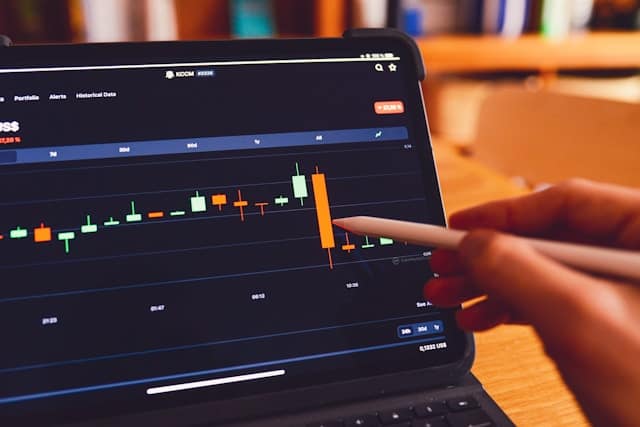
The process of backtesting a trading strategy is one of the most important steps designed to put you on the right path to successful strategy implementation.
A backtest is a simulation showing the performance your strategy attained on the historical price data, eventually allowing you to assess the risk of whether an edge you recognize is real and validate the behaviour of your implemented strategy before deploying it with live trading capital. If done correctly, a well-planned backtest can help you to find and understand the strengths and weaknesses of your trading strategies and signals and get more confident in your approach to active trading. If you are keen to understand all the stages of backtesting a trading strategy, keep reading our article, and discover the downsides and nuances of performing backtesting in its stages.
Step 1: Define your trading strategy
Before you start analysing charts, get the rules around your strategy as clear as possible. What has to happen to generate a buy or sell signal? Is it based on technical indicators, price action, or a combination of the two? For example, traders may include conditions that focus on how the price action moves, or use a volatility indicator. If you’re focused on the price action, and you need to understand this over very small timeframes, then you can benefit from knowing, e.g., what a tick is in trading — this is the smallest movement of a security up or down. You should also be aware of how high-frequency and scalping systems work. A helpful explanation of tick trading and its relevance can be found here: https://www.equiti.com/uae-en/news/trading-ideas/what-is-tick-in-trading-trading-tick-meaning/.
Step 2: Gather historical data
The first is that you test your strategy before you start trading. Do not turn on your Bot until you have enough experimental proof that proves its worth. This usually requires what is known as historical price data, which, simply put, is the set of price changes that have happened in the past. Choose a time frame that best suits your trading objectives. If you prefer short-term trades, then you will need intraday or tick-by-tick data. If you prefer long-term trades, then you should use either daily or weekly data. Many trading platforms provide historical data for free, while teams of brokers are willing to spare this information once you become a client. Ideally, you will also test in different market conditions. This means implementing the test in a bullish, bearish, and indifferent market. This way, you will know if your strategy is profitable in all market conditions.
Step 3: Choose the right tools
You have a plethora of backtesting tools at your disposal, ranging from spreadsheet templates to dedicated software and trading platform modules. Many traders choose to utilize coding languages like Python, using libraries such as Pandas and Backtrader in order to automate their testing. Others prefer to work with built-in backtesting modules of trading terminals and platforms like MetaTrader or TradingView. If you’re exploring platforms for live trading or simulation, companies like https://www.equiti.com/uae-en/ offer tools and markets that can support both analysis and execution.
Step 4: Run the test
So, you have your rules, data, and tools squared away. It’s time to conduct your backtest! Apply your strategy to historical data exactly as you would trading with real money in the market. Consider the entry and exit signals, position sizing, stop losses, and take profits. Don’t game the results either — it can be tempting to “forget…” losing trades, or assume you would have executed things perfectly. Realistic backtesting includes slippage, commissions, and other transaction costs that could have an impact on the result.
Step 5: Analyse the results
After the test is complete, you should interpret the results. Your performance will generally be measured by your total profits/losses, your maximum drawdown (the worst period for the strategy in terms of profit/loss), and your win ratio, among other factors. You’ll also want to assess the risk-adjusted performance of the strategy, such as the Sharpe ratio. Dig deeper into the bad periods for your strategy. Were they during high volatility? Low liquidity? This knowledge can help you to further enhance your rules.
Step 6: Optimise and validate
Based on your learnings, you may wish to revise aspects of your strategy, but beware of over-optimization. Adapting your rules too closely to historical data can render the model ineffective in the real world. Once you have made the changes, validate the updated strategy over a separate dataset (this is known as out-of-sample testing) to check that the new strategy remains viable.



Leave a Comment